The International Rescue Committee doesn't mince words. The Ebola outbreak tearing through the Democratic Republic of Congo is "likely far worse" than official figures suggest - and the reasons why should alarm anyone paying attention.
The IRC says the virus may have been spreading undetected since before March - potentially three full months before the outbreak was even confirmed in mid-May. Right now, health authorities are only tracing about 20% of contacts. That means for every person they know about, there are four more chains of transmission they can't see, can't track, and can't stop.
"Strengthening local, community-based prevention and infection control should be the immediate priority to control the outbreak at the source," said Rachel Howard, senior technical emergency health advisor at the IRC. "Without urgent funding, the situation could deteriorate rapidly."
| What Officials Are Reporting | What the Numbers Actually Suggest |
|---|---|
| 282 confirmed cases | 1,000+ suspected cases - and the IRC says it's likely far worse |
| 42 confirmed deaths | 200+ suspected deaths |
| Outbreak confirmed mid-May | IRC believes spreading may have started as early as February |
| 9 confirmed Uganda cases | IRC warning about spread to Burundi and South Sudan |
This is not a contained outbreak. It is an outbreak that containment efforts are losing ground against - in real time.
The Virus Nobody Had a Vaccine For
The strain driving this outbreak is called Bundibugyo - one of six known Ebola species, and one that has only been seen twice before in recorded history. There is no approved vaccine. There is no approved treatment. Doctors can manage symptoms, but they cannot cure the disease.
Three vaccine candidates are now in emergency development - from the International AIDS Vaccine Initiative, Moderna, and the University of Oxford - with the Coalition for Epidemic Preparedness Innovations committing up to $62 million to accelerate the work. The fastest of the three, Oxford's candidate, won't be ready for clinical trials for another two to three months. Moderna's mRNA approach is further behind. IAVI's modified Zaire vaccine - which showed close to 100% protection in monkeys - is seven to nine months from clinical trials at the earliest.
"I think this is clearly threatening to be as severe an outbreak as the 2014-16 West Africa outbreak, if not even worse."
- Dr. Mark Feinberg, head of the International AIDS Vaccine Initiative
That 2014-16 outbreak - the largest Ebola outbreak in history - infected nearly 29,000 people and killed more than 11,000.
The WHO's Director-General Dr. Tedros Adhanom Ghebreyesus flew to the epicenter of the outbreak over the weekend, visiting health workers at the Evangelical Medical Center in Bunia, Congo. He opened a new Ebola treatment center and honored five health workers who survived the disease. At least six others have already died, including two doctors in recent days.
What's Keeping Containment From Working
The IRC points to a cascade of compounding failures: diagnostic cartridge shortages creating testing backlogs, people avoiding health facilities out of fear, armed militia attacks disrupting response teams, and only 1 in 5 contacts being traced. In North Kivu and South Kivu, Rwanda-backed M23 rebels control key cities. In Beni, ADF fighters killed 16 people last Saturday in an area already affected by the outbreak. This isn't just a health crisis - it's a health crisis unfolding inside an active war zone.
Why This Matters Far Beyond Central Africa
Here's the part that rarely makes it into the headlines: Ebola spreads through close contact with an infected person's bodily fluids. That includes surfaces.
The virus can survive on contaminated hard surfaces for hours to days depending on temperature and humidity - long enough to transfer from a surface to a hand to a mucous membrane. Health workers in Congo are contracting it despite wearing full personal protective equipment, in part because decontamination of surfaces and equipment in under-resourced field conditions is imperfect.
Nine travel-related cases have already been confirmed in Uganda. The IRC is specifically warning about potential spread to Burundi and South Sudan. The WHO has already noted that the outbreak has spread to 22 health zones across three eastern provinces.
"The problem isn't just the virus. It's that surfaces carry it, and most disinfection protocols - even in healthcare settings - miss far more than the people running them realize."
This is the part that connects directly to your daily life - not because Ebola is at your doorstep, but because the same surface contamination problem that is killing health workers in Congo is operating at a lower intensity in every shared space you move through. The mechanism is identical. Only the pathogen and the stakes are different.
The Gap Between "Disinfected" and Actually Disinfected
Whether we're talking about Ebola on a field hospital surface in Bunia or influenza on a hotel TV remote in Dallas, the core problem is the same: most disinfection is incomplete, and the person doing it has no way to know.
A disinfectant wipe covers what it touches. A UV wand treats what it reaches at the right angle and dwell time. But surfaces are three-dimensional. They have ports, seams, indentations, and shadow geometries that resist both cloth and light. Studies consistently show that manual surface disinfection - even by trained healthcare workers - misses between 30% and 50% of surface area.
The reason is simple and brutal: you cannot see what you are missing.
This is exactly why hospital-grade decontamination protocols use UV-C irradiation systems with verification steps built in. The photons travel in straight lines, hit every surface in their path, and destroy viral RNA on contact - including the Bundibugyo glycoprotein structure that makes this Ebola strain so dangerous. What UV-C cannot do - in most consumer devices - is tell you whether you actually covered everything.
Most UV sanitizers ask you to trust the process. Until now, that's all you could do.
UVCeed: The First UV Disinfection Device That Shows You What You're Killing
UVCeed is the only consumer UV disinfection device that gives you real-time visual confirmation of your coverage while you work.
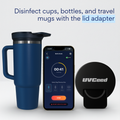
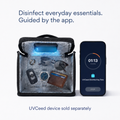
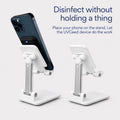
It attaches magnetically to your iPhone via MagSafe. Open the app, and you are looking at a live camera view of the surface you are treating - with your coverage path updating in real time as you move the device. You can see the corners you missed. You can see the port crevices that need another pass. You can see - not assume, but actually see - when the job is done.
No other device on the consumer market does this.
How It Compares
| Feature | Standard UV Wand | UV Sanitizing Box | UVCeed |
|---|---|---|---|
| Hospital-grade UVC (254nm) | Yes | Yes | Yes |
| Real-time coverage feedback | No | No | Yes - live camera view |
| Confirms missed spots | No | No | Yes |
| Works on irregular surfaces | Yes | No | Yes |
| MagSafe / phone integration | No | No | Yes - native MagSafe |
| Portable for travel | Yes | No | Yes |
The difference isn't incremental. It's the difference between cleaning in the dark and cleaning with the lights on.
How It Works - Three Steps
Step 1: Snap onto your iPhone UVCeed attaches via MagSafe in under a second. No case required, no setup, no fumbling.
Step 2: Open the app - see exactly what you're treating The app activates your phone camera and gives you a live view of the surface being disinfected. Watch your coverage in real time as you move the device across hotel nightstands, airplane tray tables, phone screens, keyboards, and anywhere else you need it.
Step 3: Cover everything - then confirm it The coverage map updates as you go. When you've hit every corner, every port, every seam - you'll see it confirmed in the app. No guesswork. No assumptions. Certainty.
What UVCeed Users Say
"I travel for work constantly - airports, hotels, conference rooms. Before UVCeed I was using a wand and basically hoping I got everything. Seeing actual coverage confirmation on my screen felt like turning the lights on for the first time. I don't travel without it now."
- Michael T., verified customer - frequent business traveler
The Bottom Line
The Ebola outbreak in Congo is a catastrophic, real-time demonstration of what happens when surface contamination goes unchecked and decontamination protocols are incomplete or overwhelmed. Health workers in full PPE are contracting a disease with a 50-90% fatality rate, in part because surface decontamination in active outbreak conditions is genuinely hard to do perfectly.
You are not in Bunia. But you are touching surfaces every day that carry pathogens - influenza, RSV, norovirus, and others - that spread through exactly the same mechanism. The only difference is probability and severity.
Most people wipe down their phone occasionally and call it clean. Most people are wrong about how much they're actually covering. And most people have no way to know the difference - because until UVCeed, no consumer device showed you.
That's over now.
Stop Guessing. Start Seeing.
The only UV disinfection device with a live camera view. See your coverage. Confirm you got every inch. Know you're protected.
Free shipping on all orders - 30-day money-back guarantee
Disclosure: This article is sponsored by UVCeed. Product efficacy claims are based on published research on UV-C germicidal irradiation at 254nm wavelength. UVCeed is not a medical device and is not intended to diagnose, treat, cure, or prevent any disease. Ebola outbreak information referenced in this article is sourced from reporting by ABC News, NPR, BBC, and The Associated Press, June 2026.
Want More Articles Like This?
Get research on UV-C treatment and product updates delivered to your inbox.