TL;DR
The FDA is currently tracking 18 active foodborne illness outbreak investigations simultaneously, accounting for 7,324 illnesses, 394 hospitalizations, and 3 deaths so far in 2026, according to Food Safety News. The pathogens span Cyclospora, Salmonella, Listeria, E. coli, and even Clostridium botulinum in powdered infant formula. Running this many concurrent investigations is unusual, and the breakdown shows why food safety in 2026 has become less about any single scary headline and more about a system under sustained, simultaneous strain.
What Actually Happened
The FDA's active outbreak table currently lists 18 investigations, collectively responsible for 7,324 illnesses, 394 hospitalizations, and 3 deaths, two from Cyclospora in Michigan and one from Listeria in soft cheese, per Food Safety News. Of the 18, 11 remain ongoing and 6 have concluded, with a newly identified Salmonella I 4,[5],12:i:- outbreak affecting 30 people still undergoing traceback investigation.
The pathogen breakdown shows the scale is not concentrated in one category:
- Cyclospora: 6 investigations, including the iceberg lettuce outbreak that alone accounts for 6,358 of the total illnesses.
- Salmonella: 4 investigations, including jalapeño peppers (345 cases) and shell eggs (98 cases).
- Listeria monocytogenes: 2 investigations, tied to soft ricotta and requesón cheese and other unidentified sources.
- E. coli: 2 investigations, tied to frozen blueberries and other unidentified sources.
- Clostridium botulinum: 1 investigation, tied to powdered infant formula, a category where any contamination is treated with particular urgency given the age of the affected population.
Food Safety News also noted an inspection gap: 11 of the foreign facilities linked to these outbreaks had no on-site inspection initiated, with FDA instead conducting remote regulatory assessments, compared to standard on-site inspections at domestic firms.
Why 18 Simultaneous Investigations Is Notable
A single active outbreak investigation is a normal, ongoing part of the food safety system. Eighteen running at once, spanning five different pathogen categories and product types from produce to infant formula, points to something structural rather than a single bad batch or one contaminated facility. It reflects both a genuinely higher volume of contamination events reaching the food supply this year and improved detection and genomic tracing capability that catches outbreaks earlier and connects more cases to a shared source than in past years.
Either way, the practical takeaway for a household is the same: the odds that at least one active recall is relevant to something currently in your kitchen are meaningfully higher in a year with 18 concurrent investigations than in a quieter year.
What to Actually Do With This Information
- Check the FDA's active outbreak list periodically, not just when a headline catches your attention, since 11 of the 18 are still unresolved.
- Pay closer attention to product-specific recalls in categories you buy regularly, produce, deli meat, eggs, and packaged soups have all had active investigations in 2026.
- Keep your refrigerator and pantry recall-check habit routine, rather than reactive, given how frequently new recalls are surfacing this year.
- Treat surfaces that touched a recalled product, not just the product itself, once you identify something in your kitchen matching an active investigation.
- Watch for symptom patterns, not just news headlines, since incubation periods vary widely by pathogen, from hours for some Salmonella exposures to weeks for Listeria.
Where UV-C Fits (and Where It Does Not)
UV-C at 254 nm inactivates bacteria including Salmonella, E. coli, and Listeria on hard, non-porous kitchen surfaces by damaging the DNA that lets them reproduce, which makes it a useful layer for the counters, handles, and containers a recalled product may have touched. 254 nm UV-C does inactivate bacteria on food surfaces themselves when there is direct line of sight, but FDA rules prevent us from citing a specific reduction percentage on food, so we do not, and Clostridium botulinum spores in particular require heat-based controls, not surface UV-C, given how the toxin forms.
UV-C is not a substitute for checking product recall lists or for cooking to safe temperatures. It is a complement for the surfaces around food handling.
Where UVCeed Fits
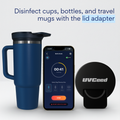
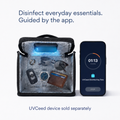
UVCeed is a 254 nm UV-C device that pairs with your phone camera and app to guide a session across the exact surface you are treating. You aim UVCeed at one section, hold it steady while the app confirms that section is complete, then move to the next section if the surface is larger than the coverage area.
In a year running 18 concurrent outbreak investigations, that means treating the counter, cutting board edges, and fridge handle any time a recall check turns up a match in your kitchen, without reaching for a chemical spray near food-prep areas every time. No wipes to restock, and a tilt-safety shutoff that turns the lamp off if the device rotates away from the target.
FAQ
Is 2026 actually worse for food safety, or is this just better detection? Both factors are likely contributing. Improved genomic sequencing and traceback technology lets investigators connect more cases to a shared source than in past years, while the raw case counts across multiple concurrent investigations also suggest genuinely elevated contamination events, per Food Safety News.
Which of the 18 outbreaks caused the most illnesses? The Cyclospora outbreak tied to iceberg lettuce, at 6,358 of the total 7,324 illnesses across all 18 investigations, by far the largest single contributor.
Why does it matter that 11 foreign facilities had no on-site inspection? Remote regulatory assessments are a lower level of scrutiny than physical, on-site inspection. It highlights an oversight gap between domestic and foreign supplier verification that Food Safety News flagged as part of its coverage.
Should I be more worried about food safety in general right now? The practical response is the same regardless of the exact cause: check recall lists for products you buy regularly, and treat the surfaces around any recalled product you find, rather than assuming any single category is uniquely dangerous.
Does this mean the food supply is unsafe overall? No. The vast majority of food consumed daily is not linked to any active outbreak. The concurrent investigation count reflects the system actively catching and tracking problems, not a collapse of food safety broadly.
The Bottom Line
Eighteen simultaneous outbreak investigations is a scale worth paying attention to, not because any single one is uniquely alarming, but because the odds of something in your kitchen matching an active recall are higher this year than most. Build the recall check into a routine, and treat the surfaces around anything you find.
Want More Articles Like This?
Get research on UV-C treatment and product updates delivered to your inbox.