When Jake Rosmarin boarded the MV Hondius for what should have been an adventure of a lifetime, he had no idea he'd spend the next six weeks in a government quarantine facility in Omaha, Nebraska - crossing days off a calendar and praying he didn't develop symptoms of one of the world's most lethal viruses.
"I have been traumatized by this whole experience," he told ABC News. "I want to know when I leave that the chances of me risking other people, my family, friends, the general public - I want that to be 0%."
Three people are dead. Thirteen Americans are still confined, some under around-the-clock surveillance with security contractors parked outside their homes. And the World Health Organization has confirmed 13 total cases - all traced back to a single cruise ship.
| Stat | Figure |
|---|---|
| Deaths confirmed globally | 3 |
| Incubation period (days until you know you're safe) | 42 |
| WHO-confirmed cases | 13 - all from one ship |
The outbreak has put a spotlight on something virologists have been saying for years: surface contamination is dramatically underestimated by the average person. Most people wipe down their phone once a week at best. Almost nobody thinks about the hotel room remote control, the airplane tray table, or the gym equipment handle they grabbed this morning.
"Most people believe they're being careful. Most people are wrong. The surfaces they trust are contaminated far more often than they realize."
The Andes strain of hantavirus that ravaged the MV Hondius is particularly alarming to scientists because, unlike most hantavirus strains, it can spread between people - not just from rodent contact. The WHO has called person-to-person transmission a rare and dangerous characteristic of the Andes virus. It travels through respiratory droplets and, critically, through contact with contaminated surfaces.
What Most People Don't Know About How Viruses Live on Surfaces
You cannot see a virus. You cannot smell contamination. And the spray-and-wipe method most people use provides a false sense of security that researchers find genuinely troubling.
Studies have shown that manual wiping with disinfectant cloths misses between 30% and 50% of a surface area due to uneven application, user technique, and shadowed geometries - corners, ports, buttons, and crevices that a cloth physically cannot reach.
The science is unambiguous:
- Hantaviruses can remain infectious on surfaces for several days under the right environmental conditions
- A 2020 study in the Journal of Hospital Infection found SARS-CoV-2 could survive on hard surfaces for up to 28 days at room temperature
- Hantavirus surface viability research suggests similar persistence in cool, humid environments - precisely the conditions found on cruise ships
- UVC light at 254nm wavelength has been scientifically validated to destroy viral DNA and RNA, rendering pathogens incapable of replication - it is the disinfection method used in hospital operating theaters and biosafety labs worldwide
This is exactly why hospitals don't rely on staff wiping things down. They use UV-C germicidal irradiation - the same technology now available to anyone who can't afford to get sick.
The Quarantine Files: What the People on That Ship Are Going Through
The MV Hondius passengers repatriated to Nebraska weren't quarantined in the casual sense. According to The New York Times, those who left the Omaha facility were transported via non-commercial jets alongside health workers, then placed in private residences with "around-the-clock surveillance."
Dr. Stephen Kornfeld - a physician who was on the ship and actually treated sick passengers - flew from Nebraska to Oregon to find a uniformed security contractor parked outside his home. He told reporters the car didn't bother him because he intended to stay home regardless. "If it makes somebody out there less paranoid that I'm going to spread anything to my neighbors, OK."
The passengers are past the 21-day primary symptom window but must wait the full 42-day incubation period before they can be certain they didn't contract the virus. Some chose to remain in the Nebraska quarantine unit because, as Rosmarin explained, "once you go home, you're not gonna be able to be tested" with the same frequency.
⚠ What Health Officials Aren't Saying Loudly Enough
The MV Hondius outbreak is unusual in its severity and the Andes strain's transmissibility. But surface contamination from dozens of other viral and bacterial pathogens - influenza, RSV, norovirus, C. diff - is happening in the environments you move through every day. Your phone. Your desk. Your hotel room. Your child's school supplies. The outbreak is extraordinary. The underlying contamination threat is entirely ordinary.
The broader public health implication that rarely makes headlines: the passengers on that ship represent an extreme version of a risk that exists at a lower level in almost every shared space you occupy. A cruise ship outbreak becomes international news. The norovirus you picked up at the hotel conference center doesn't. The difference is scale, not mechanism.
Why "Wiping It Down" Isn't the Answer You Think It Is
The standard household disinfectant wipe - the one you use on your phone, your countertop, your kid's tablet - is better than nothing. But it has a fundamental flaw most people never consider: you can't see what you're missing.
Surface disinfection isn't just about the chemical killing the pathogen. It's about coverage. A spray or wipe is only as effective as the area it actually makes contact with, and the human tendency is to wipe the parts of an object that are visually prominent. The mic port of your phone. The crevices around a charging port. The back corners of a remote control. The seams of a keyboard.
These are precisely where pathogens congregate and persist - and precisely where a cloth doesn't go.
"The problem with disinfectant wipes isn't what they do. It's what they miss - and you can't see what you're missing."
UV-C disinfection eliminates this problem through physics. Photons travel in straight lines and flood every surface they can reach - including angled planes, indentations, and ports that a wipe never touches. There's no "technique" that reduces efficacy. You move the light across the surface, and every photon that lands destroys what's there.
The remaining problem with UV-C - until now - has been that you couldn't see your coverage. You were still flying blind, just with better ammunition.
The Only UV Device That Shows You What You're Killing - In Real Time
Every other UV sanitizer on the market asks you to trust that it's working. UVCeed is the only device that shows you it's working - in real time, on your phone screen.
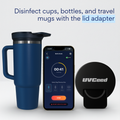
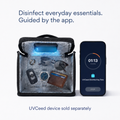
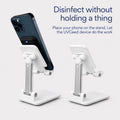
UVCeed attaches magnetically to your iPhone via MagSafe. Open the app, and you're looking at a live camera view of the surface you're disinfecting - with real-time visual confirmation of your coverage as you move. Watch the coverage map update. See the missed spots. No guessing. No blind faith in a product you can't see working.
No other consumer UV device on the market does this.
What Makes UVCeed Different
| Feature | Standard UV Wand | UV Sanitizing Box | UVCeed |
|---|---|---|---|
| Hospital-grade UVC (254nm) | ✓ | ✓ | ✓ |
| Real-time coverage feedback | ✗ | ✗ | ✓ Live camera view |
| Confirms missed spots | ✗ | ✗ | ✓ |
| Works on irregular surfaces | ✓ | ✗ | ✓ |
| MagSafe / phone integration | ✗ | ✗ | ✓ Native MagSafe |
| Portable / carry-anywhere | ✓ | ✗ | ✓ |
The comparison isn't close. Every other device leaves you guessing about coverage. UVCeed eliminates the guess entirely.
How It Works - Three Steps
Step 1: Attach magnetically to your iPhone UVCeed snaps onto any MagSafe-compatible iPhone in under a second. No clips, no cases, no setup.
Step 2: Open the app and see what you're disinfecting The UVCeed app activates your phone camera and gives you a live view of the surface you're treating. You can see exactly where the UVC light is being applied in real time - something no other device offers.
Step 3: Move, confirm coverage, done Sweep the device across the surface and watch the coverage map update in the app. When you've covered everything - including corners, ports, and crevices - you'll know it. Not assume it. Know it.
What UVCeed Users Are Saying
"I travel constantly for work - hotels, airports, conference rooms. Before UVCeed I was using a wand and basically hoping for the best. Seeing actual coverage confirmation on my screen felt like turning the lights on for the first time. I haven't traveled without it since."
- Michael T., verified customer · Frequent business traveler
The Bottom Line: You Can't Protect What You Can't See
The MV Hondius outbreak is a worst-case-scenario version of a contamination risk that operates quietly in every environment you move through. The passengers on that ship - now under 24/7 government surveillance, some with security contractors parked outside their homes - didn't take unusual risks. They went on a vacation. The virus was already there, on the surfaces they shared with hundreds of other people.
You are touching surfaces that dozens, hundreds, or thousands of other people have touched. Your hotel nightstand. The airplane tray table. The touchscreen kiosk at the pharmacy. The gym equipment. Your own phone, which studies consistently rank among the most heavily contaminated personal objects humans carry.
Disinfecting those surfaces isn't paranoia. It's the only rational response to what you now know is there. And doing it correctly - with confirmation that you've actually covered the surface - is the difference between real protection and a false sense of security.
UVCeed is the only device built for people who aren't willing to guess.
Stop Guessing. Start Seeing.
The only UV disinfection device with a live camera view. See your coverage. Confirm you got every inch. Know you're protected.
Free shipping on all orders · 30-day money-back guarantee
Disclosure: This article is sponsored by UVCeed. Product efficacy claims are based on published research on UV-C germicidal irradiation at 254nm wavelength. UVCeed is not a medical device and is not intended to diagnose, treat, cure, or prevent any disease. Hantavirus outbreak information referenced in this article is sourced from reporting by ABC News and The New York Times, June 2026.
Want More Articles Like This?
Get research on UV-C treatment and product updates delivered to your inbox.