TL;DR
- Most state childcare licensing codes require a dedicated isolation area with a cot or mat for each ill child, kept separate from kitchen and toilet areas. California's rule (Title 22, Section 101226.2) is typical of what inspectors check first. Cornell Law
- A peer-reviewed review of state licensing regulations found environmental sanitation was the weakest-scoring category of all; facilities relying only on the legal minimum are not meeting CDC-recommended practice. PMC
- The health room is a cross-traffic hub: sick kids waiting for pickup, well kids getting a routine temperature check, and staff handling both with the same equipment, often the single highest-liability room in the building.
- UV-C is a documented supplement to, not a replacement for, the EPA-registered disinfectant wipe-downs your licensing code requires. A portable device like UVCeed adds a fast, line-of-sight pass on cots, thermometers, and toys between required chemical cleaning cycles.
The room inspectors and parents both notice first
If you run a licensed daycare or manage a school health room, you already know the nurse's office or "sick room" gets disproportionate scrutiny, from inspectors, from parents dropping off a feverish child, and from staff who use it a dozen times a day. That scrutiny is written into the regulations.
California's childcare licensing code spells out exactly what a center's isolation space must contain: it has to be "located to afford easy supervision of children by center staff," it must have "a mat, cot, couch or bed for each ill child," and it cannot be positioned in a kitchen or general-use toilet area. The rule was amended again as recently as October 2023, meaning regulators are still actively tightening this requirement, not treating it as settled. Cornell Law, Cal. Code Regs. Tit. 22, Section 101226.2
That isolation area doesn't exist in a vacuum. California also requires a documented daily health check for identifying illness before a child reaches the classroom, meaning the same cot and thermometer get used both for symptom checks on arriving children and isolation of children already sick. Cornell Law, Cal. Code Regs. Tit. 22, Section 101626.1 Every state's language differs slightly, but the pattern holds nationally: the reference standard, Caring for Our Children, developed by the CDC, the American Academy of Pediatrics, and the National Resource Center for Health and Safety in Child Care, sets frequency and method requirements for cleaning, sanitizing, and disinfecting cots, mouthed toys, diaper-changing surfaces, and shared equipment, and most state licensing codes borrow from it directly. Child Care Technical Assistance Network, Caring for Our Children Basics
Why "meeting the minimum" still isn't enough
Here is the part that should concern any director who assumes their center is covered simply because they pass inspection each year. A peer-reviewed review of state childcare licensing regulations, published in a CDC-affiliated public health journal, scored every state's rules against the 14 infection-control practices recommended by the CDC and Caring for Our Children. Only about 64% of those practices were even partially addressed across all states combined, and full implementation sat closer to 18%. Environmental sanitation, the category covering cots, toys, and diaper-changing areas, scored the lowest of any category reviewed, at 1.7 out of 4.0. The researchers' conclusion is blunt: facilities that treat licensing minimums as their ceiling rather than their floor are not meeting CDC-recommended practice. PMC, Review of State Licensing Regulations
That gap has financial teeth. New York's Office of Children and Family Services classifies inadequate sanitation as a citable violation subject to escalating daily fines, and its own enforcement guidance describes sanitation lapses as "non-rectifiable," meaning they cannot simply be corrected on the spot the way a missing form can. OCFS, Child Care Inspections and Violations A citation like that, or a parent complaint reaching your state's public licensing database, does more damage to enrollment than the fine itself.
Layer onto that a workforce problem that makes consistent protocol harder to sustain. The childcare workforce has been shrinking again since spring 2024, after a brief post-pandemic recovery, and a 2025 survey of Minnesota providers found more centers struggling to maintain required staff-to-child ratios than the year before, alongside a 13-point jump in centers reporting declining financial stability. NWLC Minneapolis Fed Fewer permanent staff means more substitutes rotating through the health room, each with less institutional memory of how long the disinfectant needs to sit or which cots go in which bin. Protocols that depend on a veteran staffer's memory break down fast; protocols that are simple, visual, and hard to skip survive staff turnover.
A practical checklist for the health room and high-touch operational surfaces
- Confirm your isolation area meets code, not just habit. Check your state's language on square footage, cot placement, and separation from food and toilet areas, and document the layout in your policy manual so a new director inherits the requirement, not just the room. Cal. Code Regs. Tit. 22, Section 101226.2
- Separate "sanitize" from "disinfect" at the point of use. Regulators frequently cite centers for using a sanitizer where a registered disinfectant with a longer contact time was required, especially on diaper-changing surfaces. Post the required product, dilution, and dwell time above the surface it applies to. mybrightwheel
- Treat thermometers and cots as shared medical equipment, not toys. Use single-use probe covers or a documented between-child sanitizing step for thermometers, and sanitize cots and mats between different children even for a short visit.
- Follow a frequency table, not intuition. Mouthed toys need daily or after-each-use sanitizing, most other toys need at least weekly sanitizing, and high-touch surfaces like sign-in tablets belong on a daily schedule. A printed chart posted in the room removes guesswork for a substitute on day one. NAEYC Frequency Table
- Keep a log. Inspectors and plaintiffs' attorneys alike operate on the same principle: if it isn't written down, it didn't happen. A dated cleaning log costs two minutes a day and is your best evidence in a dispute. mybrightwheel
- Add the front desk and sign-in area to the schedule. CDC guidance for schools calls out daily cleaning of frequently touched surfaces like counters, keyboards, and shared electronics, which in a daycare context means your sign-in kiosk. CDC, Everyday Actions for Schools
Where UV-C fits
254 nanometer UV-C light is a well-established germicidal tool. It works by damaging the nucleic acids of bacteria and viruses on a surface, the same inactivation mechanism the EPA describes when it lists UV as a supplemental disinfection method in healthcare and public settings. EPA, Disinfecting Surfaces with UV Light
It also has real limits any facilities manager should understand before budgeting for it. UV-C only works on surfaces it can directly reach: it is a line-of-sight technology, so a crease in a vinyl cot, the underside of a thermometer clip, or a toy sitting in a shadow will not be treated unless the light physically hits it. It is not a spray or fog that reaches into every crevice the way a liquid disinfectant does. That is precisely why UV-C is not a substitute for the EPA-registered disinfectant wipe-downs your state licensing code already requires on diaper-changing tables; it is an addition to that protocol, not a replacement for it.
UV-C at germicidal wavelengths is also a genuine hazard to unprotected eyes and skin. Direct or reflected exposure from bare UV-C sources can cause painful eye irritation and skin reddening within seconds at close range, which is why the standard engineering approach is to house the lamp so it cannot expose people, and to restrict use to unoccupied areas or devices specifically engineered to prevent exposure. OSHwiki, Occupational Exposure to Artificial Sources of UVR Any UV-C device used around children needs to run only when the area is unoccupied, or be built with a mechanism that disables output the moment a person or pet is detected in range.
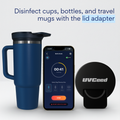
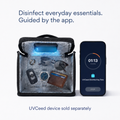
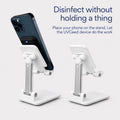
A portable UV-C device is not something you hand to a temp aide with no training and hope for the best. UVCeed pairs a handheld 254nm UV-C unit with a smartphone app that shows, in real time, which parts of a surface have been treated and which haven't, so a staff member isn't guessing whether they got the whole cot or just the middle third. Published research on the device describes this augmented-reality coverage tracking along with a detection feature that halts UV output if a person or pet moves into range, addressing the exposure concern directly rather than leaving it to staff judgment. PMC, UVCeed: Leveraging AR, AI, and Gamification for UV-C Disinfection
In a realistic health room workflow: after a feverish child is picked up and the cot is stripped and wiped down with the required disinfectant per posted protocol, a staff member aims the device at the vinyl cot surface, holds steady until the app confirms the section is complete, then moves to the next section, covering seams and edges a wipe alone might miss. The same routine applies to a shared thermometer between uses, a bin of returned mouthed toys, the changing table after the disinfectant's contact time has elapsed, and the front desk sign-in tablet at day's end. Because the app tracks completion instead of relying on memory, the process stays consistent even when the person running it is a substitute who started that morning.
If food or snack-time surfaces are part of the same room's cleaning routine: 254 nm UV-C inactivates bacteria on food surfaces, but FDA rules prevent us from citing a specific reduction percentage on food, so we do not.
To be clear: running UVCeed over a surface does not, on its own, satisfy your state's licensing sanitation requirement. Keep your EPA-registered disinfectant, posted dwell times, and cleaning log exactly as your code requires. UVCeed is the fast, repeatable pass that closes gaps between those required chemical cycles, on the surfaces (cots, thermometers, toys, tablets) touched by the most children in the shortest time.
FAQ
Does UV-C disinfection satisfy state daycare licensing sanitation requirements on its own? No. Licensing codes specify particular EPA-registered disinfectant products, dilutions, and contact times for surfaces like diaper-changing tables. UV-C is supplemental, not a substitute for that required chemical protocol.
Is it safe to use a UV-C device around children in the health room? Direct UV-C exposure to eyes or skin is a genuine hazard, so any device used near children should run only when the area is unoccupied, or, like UVCeed, include a sensor that stops UV output if a person or pet enters range.
How often does a state require cots and mats to be sanitized in a childcare center? Requirements vary by state, but the common baseline is cleaning and sanitizing between different children's use, with individually labeled bedding to avoid mix-ups. Check your state code for exact language.
What's the difference between sanitizing and disinfecting, and why does it matter for inspections? Sanitizing reduces germs to a safe level; disinfecting destroys nearly all remaining germs and requires a stronger product and longer contact time. Inspectors specifically cite centers for using a sanitizer where a registered disinfectant was required, especially on diaper-changing surfaces.
Can UVCeed be used on a thermometer between children? Yes, as a supplemental step after your required cleaning procedure, a single-use probe cover or the sanitizing method your state specifies, the device can be aimed directly at the thermometer body between uses, since thermometers move between sick and well children multiple times a day.
The bottom line
Running a compliant, trustworthy health room isn't about any single product. It's about a documented protocol that survives staff turnover, satisfies your licensing code, and holds up if a parent or inspector asks hard questions about the cot their child just used. UV-C, used correctly and safely, is a genuinely useful supplement to that protocol on the highest-touch surfaces in the building. If you want a device built to make that supplemental pass fast, trackable, and safe around children, see how UVCeed fits into your existing routine.
Want More Articles Like This?
Get research on UV-C treatment and product updates delivered to your inbox.