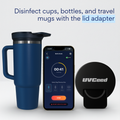
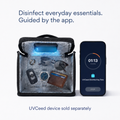
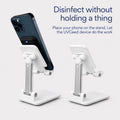
Most UV-C products advertise "99.9%" and stop there. That phrase is the subject of a federal class-action lawsuit (Garbus v. UV Sanitizer USA LLC, EDNY 2:20-cv-05358). We are publishing something different: the full table of pathogens UVCeed has been applied to using published UV-C dose-response data, with the dose required, the surface condition the study tested, and the citation for every row.
"99.9%" is no longer a marketing claim. It is now the central allegation of a federal consumer-protection suit against a UV-C vendor. The appropriate response from a serious UV-C company is to publish the dose-response data, not the slogan.
How to read this table
Three variables determine whether a UV-C exposure actually inactivates a pathogen on a surface. Each needs to be understood on its own.
1. Dose (mJ/cm²). UV-C efficacy is dose-driven, not time-driven. Dose is the energy per unit area delivered to the target surface, measured in millijoules per square centimeter at the germicidal 254 nm wavelength. The same dose can be delivered as a weak source held for a long time or a strong source held briefly.
2. Log reduction. Kill rates are expressed logarithmically because surviving populations compound. 1-log = 90% inactivated. 2-log = 99%. 3-log = 99.9%. 4-log = 99.99%. 5-log = 99.999%. A 3-log reduction is the common infection-control benchmark for high-touch surface disinfection. The table below reports the published dose for 3-log inactivation at 254 nm on a hard, non-porous surface, in the absence of organic soil.
3. Coverage. A published dose only matters if it was delivered to the pixel you cared about. Dose that lands on 70% of a surface is a 70%-coverage outcome, not a dose outcome. This is the specific problem UVCeed is engineered to solve - the phone camera maps the surface in real time, the device's known emitter geometry projects a dose distribution onto that map, and the app only marks each pixel complete when its integrated dose crosses threshold. The three variables are joined: dose, log target, coverage. Any UV-C claim that omits one of the three is incomplete.
The table that follows holds the first two constant (dose and log target) and reports what the peer-reviewed literature has established for each pathogen.
The table
Every pathogen below is listed with the published 254 nm dose required for a 3-log reduction on a hard, non-porous surface, the surface condition tested in the source study, and the citation. Unless otherwise noted, every row is literature-derived (not UVCeed in-house tested).
| Pathogen | Type | Dose for 3-log (mJ/cm², 254 nm) | Surface tested (literature) | Result source | Citation |
|---|---|---|---|---|---|
| SARS-CoV-2 | Virus (enveloped RNA) | 3-5 | Liquid droplet, hard surface | Literature-derived | Buonanno et al. 2020, Sci Rep. DOI 10.1038/s41598-020-67211-2 |
| Influenza A (H1N1) | Virus (enveloped RNA) | 3-4 | Aerosol / stainless steel | Literature-derived | McDevitt et al. 2012, Appl Environ Microbiol. DOI 10.1128/AEM.06960-11 |
| Human coronavirus 229E | Virus (enveloped RNA) | ~5 | Suspension / hard surface | Literature-derived | Walker & Ko 2007, Environ Sci Technol. DOI 10.1021/es070056u |
| Respiratory syncytial virus (RSV) | Virus (enveloped RNA) | 1-2 | Suspension | Literature-derived | Walker & Ko 2007 and related work; RSV is among the most UV-sensitive respiratory viruses. DOI 10.1021/es070056u |
| Rhinovirus | Virus (non-enveloped RNA) | 3-4 | Suspension / surface | Literature-derived | Tseng & Li 2007, J Occup Environ Hyg. DOI 10.1080/15459620701329012 |
| Norovirus (murine norovirus surrogate) | Virus (non-enveloped RNA) | 20-25 | Stainless steel / suspension | Literature-derived | Park, Linden & Sobsey 2011, Lett Appl Microbiol. DOI 10.1111/j.1472-765X.2010.02982.x |
| Escherichia coli | Bacteria (gram-negative) | 6-8 | Suspension / hard surface | Literature-derived | Chang et al. 1985, Appl Environ Microbiol. DOI 10.1128/aem.49.6.1361-1365.1985 |
| Staphylococcus aureus (incl. MRSA) | Bacteria (gram-positive) | 6-10 | Hard surface | Literature-derived | Conner-Kerr et al. 1998, Ostomy Wound Manage. PMID 9866596 |
| Pseudomonas aeruginosa | Bacteria (gram-negative) | 10-11 | Suspension / hard surface | Literature-derived | Chang et al. 1985 and derivative work. DOI 10.1128/aem.49.6.1361-1365.1985 |
| Salmonella Typhimurium | Bacteria (gram-negative) | 7-8 | Hard surface / food contact | Literature-derived | Chang et al. 1985 and later food-safety replications. DOI 10.1128/aem.49.6.1361-1365.1985 |
| Mycobacterium tuberculosis | Bacteria (acid-fast) | 10 | Aerosol / surface | Literature-derived | Riley, Knight & Middlebrook 1976, Am Rev Respir Dis. PMID 817628 |
| Clostridioides difficile spores | Bacterial spore | 50+ (and often much higher for full sporicidal effect) | Hard surface | Literature-derived | Nerandzic et al. 2010, BMC Infect Dis. DOI 10.1186/1471-2334-10-197 |
| Aspergillus niger | Fungus / mold | 180-330 | Hard surface / spore | Literature-derived; known UV-C limitation | Kowalski 2009, Ultraviolet Germicidal Irradiation Handbook, Springer. ISBN 978-3-642-01998-2 |
| Canine parvovirus (CPV) | Virus (non-enveloped DNA) | 50+ | Hard surface | Literature-derived; UV-C is not a substitute for bleach for CPV cleanup | Multiple veterinary infection-control reviews. |
What this table deliberately does NOT claim
UVCeed is not a medical device. The FDA has not cleared UVCeed as a sterilant for medical instruments or as a therapeutic device. Nothing in this table should be read as a clinical outcome claim.
UVCeed does not replace soap and water. Mechanical cleaning removes organic soil, biofilm, and shadowed debris that UV-C cannot penetrate. On any surface with visible contamination, cleaning precedes disinfection.
UVCeed does not replace EPA-registered disinfectants for food-contact surfaces. Food-service and food-processing environments have specific registered-product requirements. UV-C is a complement, not a substitute.
UVCeed is not the right tool for C. difficile spore cleanup. The dose required for sporicidal effect on C. difficile exceeds what a handheld device delivers in practical session times. Established protocols use chlorine-based sporicides for a reason.
UVCeed is not the right tool for canine parvovirus decontamination. CPV is a non-enveloped DNA virus that is remarkably resistant to UV-C. The accepted veterinary protocol is a dilute sodium hypochlorite (bleach) solution. UV-C may contribute as a secondary measure on dry, pre-cleaned surfaces but it is not a primary tool here.
We do not say "99.9%" without context. Every efficacy figure above is tied to a specific pathogen, surface condition, dose, and peer-reviewed source. Every row is labeled literature-derived until a UVCeed-commissioned lab report replaces it. For a pilot evaluator at a dental group, veterinary chain, hotel ops team, or assisted-living facility, the answer today is it's all inferred from peer-reviewed dose-response curves, with citations.
Why coverage is as important as dose
A 10 mJ/cm² dose delivered to 70% of a surface is a 70%-coverage outcome, not a 10 mJ/cm² outcome. The 30% of pixels that never crossed threshold are reservoirs. In clinical infection-control terms they are "missed sites" and they are how outbreaks propagate in otherwise well-run facilities.
This is the specific problem UVCeed is engineered to solve. The phone's camera maps the surface in real time, the device's known emitter geometry projects a dose distribution onto that map, and the app integrates photons-per-pixel until each pixel passes threshold. Pixels that have not crossed threshold stay red. The user re-covers them until the entire surface turns green.
Every other category of UV-C device either sidesteps the coverage problem or ignores it. Enclosed chambers (PhoneSoap Pro and similar) solve coverage by physically trapping the object in a controlled geometry - fine for a phone, useless for a dental chair arm, a hotel-room remote, a veterinary exam table, or a stethoscope diaphragm. Open wands rely on operator discipline; see the FDA's 2022 Safety Communication on UV wands. Users cannot see UV-C, cannot see dose, and cannot see coverage, so they guess.
Camera-verified coverage is the missing link between a published dose-response curve and a real-world disinfection outcome. The efficacy table above is the dose-response half. The app is the coverage half. Both are required.
How we will update this table
This article is version 1. It will be revised in public, with a dated changelog at the bottom of this page every time a row changes. The specific triggers for an update:
- A superseding peer-reviewed study is published with a tighter dose-response figure. The citation is updated; the prior citation is preserved in the changelog.
- A regulatory development (EPA, FDA, or equivalent non-US authority) changes how a claim can be worded.
Each revision is dated at the bottom of this page so a buyer, auditor, or regulator can reconstruct what we were saying on any given date. We revise rows in public rather than silently editing them.
For consumers and for B2B buyers
For consumers. If you want to use UVCeed effectively at home, the two things that matter are the pathogen you are worried about (which sets the dose target) and whether every pixel of the surface actually received that dose (which is what the coverage map in the app is for). The table above tells you how much energy a 3-log kill actually requires. The app tells you whether you delivered it.
For B2B buyers (dental, veterinary, hotel operations, assisted living, long-term care, EMS, commercial kitchen, salon, med-spa). UVCeed is best evaluated by running a structured pilot in your own environment with your own bioburden profile - the surfaces that matter in a dental operatory are different from the surfaces that matter in a hotel room, and both are different from a kennel. The rows above that are relevant to your environment can serve as the dose-response reference your infection-control lead maps against your actual high-touch surface list. The two questions worth asking of any UV-C product you are evaluating, including this one, are the same: can it deliver the published dose at your typical working distance in a practical session time, and can it prove coverage after the fact.
Sources
- Buonanno et al. 2020. Far-UVC light (222 nm) efficiently and safely inactivates airborne human coronaviruses. Scientific Reports 10:10285. DOI 10.1038/s41598-020-67211-2
- McDevitt et al. 2012. Aerosol susceptibility of influenza virus to UV-C light. Appl Environ Microbiol 78(6):1666-1669. DOI 10.1128/AEM.06960-11
- Walker & Ko 2007. Effect of ultraviolet germicidal irradiation on viral aerosols. Environ Sci Technol 41(15):5460-5465. DOI 10.1021/es070056u
- Park, Linden & Sobsey 2011. Inactivation of murine norovirus, feline calicivirus and echovirus 12 as surrogates for human norovirus by UV light (254 nm). Lett Appl Microbiol 52(2):162-167. DOI 10.1111/j.1472-765X.2010.02982.x
- Chang et al. 1985. UV inactivation of pathogenic and indicator microorganisms. Appl Environ Microbiol 49(6):1361-1365. DOI 10.1128/aem.49.6.1361-1365.1985 / PMID 2990336
- Conner-Kerr et al. 1998. The effects of ultraviolet radiation on antibiotic-resistant bacteria in vitro. Ostomy/Wound Manage 44(10):50-56. PMID 9866596
- Riley, Knight & Middlebrook 1976. Ultraviolet susceptibility of BCG and virulent tubercle bacilli. Am Rev Respir Dis 113(4):413-418. PMID 817628
- Nerandzic et al. 2010. Evaluation of an automated UV-C device for decontamination of C. difficile and other HAI pathogens in hospital rooms. BMC Infect Dis 10:197. DOI 10.1186/1471-2334-10-197 / PMID 20615229
- Kowalski 2009. Ultraviolet Germicidal Irradiation Handbook: UVGI for Air and Surface Disinfection. Springer. ISBN 978-3-642-01998-2
- Tseng & Li 2007. Inactivation of viruses on surfaces by ultraviolet germicidal irradiation. J Occup Environ Hyg 4(6):400-405. DOI 10.1080/15459620701329012
- FDA 2022. UV Wands That Give Unsafe Levels of Radiation - FDA Safety Communication. fda.gov
- Garbus v. UV Sanitizer USA LLC, No. 2:20-cv-05358 (E.D.N.Y.). Reporting
Version 1.1. Changelog will be maintained at the bottom of this page. Every row in the table above is literature-derived unless explicitly marked "UVCeed in-house" with a linked third-party laboratory report.
Want More Articles Like This?
Get research on UV-C treatment and product updates delivered to your inbox.