Tuberculosis cases have risen for three straight years as pandemic-era infections reactivate across the country. Most people think TB is a thing of the past - but the CDC data says otherwise. One hospital-grade technology has been fighting TB in medical facilities for decades, and it's now available in your pocket.
If tuberculosis sounds like something out of a history textbook, you're not alone. Most Americans assume it was eradicated decades ago. But the latest data from the Centers for Disease Control and Prevention tells a very different story.
More than 10,600 tuberculosis cases were confirmed in the United States in 2024 - the highest annual total since 2013 and the third consecutive year of increases. That's roughly three cases for every 100,000 people, and doctors say the real number is likely higher because many infections go undiagnosed.
Tuberculosis - historically called "the white plague" because of the pale, wasted appearance of those it afflicts - is caused by Mycobacterium tuberculosis, a bacterium that primarily attacks the lungs. It spreads through the air when an infected person coughs, sneezes, or even speaks. Unlike many illnesses that require prolonged contact, TB can be transmitted by a single cough in a crowded room.
So why is it surging now?
Infectious disease experts point to what they're calling a "rebound effect" from the COVID-19 pandemic. During 2020 and 2021, TB surveillance and screening programs were disrupted across the country. Routine testing slowed. Treatment programs were understaffed. And critically, latent TB infections - cases where the bacteria were present in the body but dormant - went undetected.
Now those latent infections are activating. According to health experts, approximately 25% of the world's population has been infected with TB bacteria at some point. In most people, the immune system keeps the bacteria dormant. But in 5% to 10% of those infected, the bacteria eventually wake up and cause active disease - the contagious, dangerous form of TB.
Add in increased international travel, migration from countries where TB is more prevalent, and public health systems that still haven't fully recovered from pandemic-era staffing cuts, and you have the conditions for exactly what we're seeing: a disease that most Americans forgot about is quietly making a comeback.
And if it goes untreated, TB is fatal in about half of its victims.
Why TB Is More Dangerous Than Most People Realize
Part of what makes tuberculosis so insidious is that it can hide in your body for years without causing symptoms. A person with latent TB isn't contagious and may feel perfectly fine - until the infection activates.
When active TB does develop, the symptoms can be deceptively mild at first: a persistent cough, fatigue, weight loss, night sweats, chest pain. Many people mistake it for allergies, a lingering cold, or the aftereffects of a respiratory infection. By the time they seek medical attention, they may have been spreading the disease for weeks or months.
TB bacteria are also remarkably hardy. Unlike many pathogens that die quickly in the environment, Mycobacterium tuberculosis can survive on surfaces and in dust particles. In crowded, poorly ventilated indoor spaces - think waiting rooms, shelters, schools, public transit, and offices - the risk of airborne transmission is especially high.
And then there's the drug-resistance problem. If a patient starts antibiotic treatment but doesn't complete the full 4-to-6-month course, the bacteria can mutate and become drug-resistant. Drug-resistant TB is significantly harder and more expensive to treat, requiring longer and more complex medication regimens. It's a growing concern that the medical community takes very seriously.
The bottom line: TB is airborne, it can lurk undetected, it can survive on surfaces, and it can become resistant to treatment. This isn't a relic of the past. It's a serious, present-day public health threat - and it requires a modern defense strategy.
The Surface and Air Problem Most People Don't Think About
When most people think about TB prevention, they think about antibiotics and screening tests. Those are critical. But they only address the disease after someone is already infected.
What about the spaces where TB actually spreads?
TB bacteria become airborne when an infected person coughs or sneezes, releasing tiny droplet nuclei that can float in the air for hours. These particles can also settle on surfaces - desks, countertops, medical equipment, door handles, tray tables - where they remain viable.
In healthcare settings, this has been understood for decades. Hospitals with TB wards have long used specialized ventilation systems and environmental controls to reduce transmission. But outside of hospitals, most public spaces have no such protections.
Chemical disinfectants are the default for surface cleaning. But here's the problem: most disinfectant wipes require 4 full minutes of wet contact time to kill tough pathogens like Mycobacterium tuberculosis. In practice, almost nobody waits that long. You give the surface a quick wipe, the liquid evaporates in seconds, and you move on - with the bacteria still alive.
There's also growing concern about what's in those chemical wipes. Research has found that common disinfectant chemicals known as QACs (quaternary ammonium compounds) have been detected in 80% of human blood samples tested. For families, healthcare workers, and anyone using chemical wipes multiple times a day, that's a troubling finding.
So what do hospitals use when chemical wipes aren't enough?
UV-C Light - The Same Technology Hospitals Have Used Against TB for Nearly a Century
Here's something most people don't know: ultraviolet-C (UV-C) light has been used to fight tuberculosis in healthcare settings since the 1930s. It isn't new science. It's one of the oldest and most well-validated infection control tools in existence.
UV-C light at germicidal wavelengths physically destroys the DNA and RNA of bacteria - including Mycobacterium tuberculosis and even drug-resistant strains. Unlike antibiotics, bacteria cannot develop resistance to UV-C because it's a physical process, not a chemical one. The light breaks the molecular bonds that allow the organism to function and reproduce. It simply stops working.
A landmark study published in PLoS Medicine and conducted by researchers at Imperial College London found that UV-C light reduced airborne tuberculosis transmission by up to 70% in a hospital ward treating patients with both HIV and active TB. The CDC's own National Institute for Occupational Safety and Health (NIOSH) has published detailed guidelines recommending UV-C germicidal irradiation as an environmental control measure for TB in healthcare facilities.
This isn't experimental technology. It's proven science, backed by decades of peer-reviewed research and recommended by the world's leading health authorities.
Now, that same hospital-grade UV-C technology is available in a portable, consumer-friendly device called UVCeed.
UVCeed - Hospital-Grade UV-C Protection, Designed for Everyday Life
UVCeed was designed by Dr. Peter Bonutti - a practicing surgeon and medical device innovator with over 400 patents - on a simple premise: the same UV-C technology that protects patients in hospitals should be available to every family, everywhere.
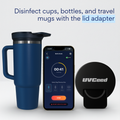
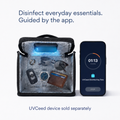
UVCeed is a compact, rechargeable UV-C LED device that attaches directly to your smartphone. In just 30 seconds, it eliminates up to 99.99% of bacteria and viruses - on virtually any surface. No chemicals. No residue. No 4-minute waiting game.
And because UV-C light works through a physical mechanism - destroying the DNA and RNA of pathogens - it's effective against even the hardiest bacteria, including mycobacteria.
What Makes UVCeed Different From Other UV Devices
The consumer UV market is full of products that don't deliver - bulky sanitizing boxes, cheap wands with no safety features, and devices that can't produce a verified germicidal dose. UVCeed is a different category entirely:
| Feature | UVCeed Advantage |
|---|---|
| AI-Powered Dosage | Machine learning calculates the precise UV-C dose for each surface type, distance, and angle - ensuring maximum pathogen elimination every time. |
| Real-Time Visual Proof | Patented augmented reality shows treated vs. untreated areas on your phone screen in real time. No guessing. |
| Machine Vision Safety | Built-in camera detection automatically pauses UV-C light if a person or pet enters the treatment zone. No other consumer UV device has this. |
| 30-Second Disinfection | Hospital-grade 265nm UV-C LED eliminates 99.99% of bacteria and viruses in just 30 seconds. No 4-minute wait like chemical wipes. |
| Portable & Rechargeable | Pocket-sized, mercury-free, and attaches to your smartphone via MagSafe or adhesive. Protection goes wherever you go. |
| Lab-Verified Results | Peer-reviewed research published on PubMed Central confirms effectiveness against Staph, E. coli, Klebsiella, and SARS-CoV-2. |
Independent peer-reviewed research published in the National Institutes of Health's PubMed Central has validated UVCeed's effectiveness against Staphylococcus aureus, E. coli, Klebsiella pneumoniae, and SARS-CoV-2 under controlled laboratory conditions. This isn't marketing language - it's published science.
UVCeed is also EPA-registered and CE-certified, meeting the same safety standards as hospital-grade UV equipment. It has earned multiple industry recognitions including a Fast Company 2023 Next Big Things in Tech Award and a Mom's Choice Award honoring excellence in family-friendly products.
Who's Already Using UVCeed
UVCeed is trusted in professional healthcare settings - including deployment at Sarah Bush Lincoln Hospital for daily staff use across key facility areas. Healthcare professionals rely on it for the same reason hospitals have relied on UV-C against TB for nearly a century: it works.
Everyday users include:
- Healthcare workers who want to disinfect shared equipment, break room surfaces, and personal items between shifts
- Parents who want to sanitize pacifiers, bottles, toys, and high chairs without chemical residue
- Frequent travelers disinfecting hotel remotes, airplane tray tables, and rental car surfaces in seconds
- Office workers keeping keyboards, phones, and shared desks genuinely clean - not just visually wiped
- People who use public transit, gyms, or shared workspaces where the risk of exposure to airborne illnesses is highest
- Families with elderly or immunocompromised members who are at the greatest risk from infections like TB
"As a physician, I understand the importance of effective disinfection. UVCeed provides the same UV-C wavelength we use in medical facilities, making it perfect for families who want hospital-grade protection at home. I recommend UVCeed to my patients and use it in my own home." - Verified Medical Professional, Licensed Physician
The Real Cost of Getting Sick
Tuberculosis treatment isn't a quick course of antibiotics. The standard regimen requires taking medications every day for 4 to 6 months. Drug-resistant cases can require treatment lasting 18 months or longer, with more aggressive and expensive medications.
Beyond TB specifically, infectious illness of any kind carries real financial consequences:
- $500 to $2,000+ per illness episode in doctor visits, urgent care, testing, and prescriptions
- $1,200 to $3,600 annually in lost income when illness keeps you or your child home from work or school
- Missed events - weddings, graduations, vacations, business trips - that can't be rescheduled
- Career disruption from multiple sick days that affects raises, reviews, and professional momentum
UVCeed pays for itself by helping prevent just one or two costly illness episodes per year. At a fraction of the cost of a single urgent care visit, it's one of the most practical health investments a family can make - especially as TB and other infectious diseases continue to climb.
How It Works - 3 Simple Steps
-
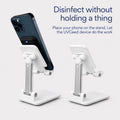
Attach and open the app. UVCeed connects to your smartphone via MagSafe or adhesive attachment. Download the free app (iOS or Android), and you're ready to go.
-
Point and treat. Aim UVCeed at any surface - a waiting room chair, your child's desk, a gym bench, your office keyboard, a hotel bathroom counter. The app uses your phone's camera to show you the area being treated in real time.
-
See the results. In 30 seconds, the treated area turns green on your screen, confirming disinfection is complete. UVCeed's AI-powered dosage control ensures the right amount of UV-C energy is delivered every time. The device automatically shuts off when finished.
Built-in machine vision safety technology automatically detects humans and pets and pauses the UV-C light immediately - a patented feature unique to UVCeed that no other consumer device offers.
Don't Wait for a Disease You Thought Was Gone
Tuberculosis isn't a historical footnote. It's the leading infectious disease killer worldwide, responsible for more deaths annually than HIV/AIDS. And it's rising in the United States for the third straight year, fueled by pandemic-era gaps in screening and a public that largely forgot the disease existed.
Screening and antibiotics are essential. But they only work after someone is already infected. The real opportunity is prevention - reducing your exposure to pathogens on the surfaces and in the spaces where you live, work, and travel.
UV-C light has been fighting TB in hospitals for nearly 100 years. It's recommended by the CDC. It's backed by decades of peer-reviewed science. And now, thanks to UVCeed, it's available to every family.
PROTECT YOUR FAMILY WITH THE SCIENCE HOSPITALS TRUST
Get the UVCeed Smart Disinfection Device and see for yourself why hospitals, doctors, and thousands of families rely on UV-C technology to stay healthy.
Visit uvceed.com to order now with free shipping and a 30-day money-back guarantee.
Also available on Amazon.
Disclaimer: This article is sponsored content. UVCeed is a surface disinfection device and is not a medical device. It does not treat, cure, or prevent disease in humans. Effectiveness based on independent lab testing under controlled conditions; actual results may vary. UV-C light should always be used as directed. The CDC data cited in this article is publicly available at cdc.gov. Research on UV-C and tuberculosis transmission referenced in this article was published in PLoS Medicine and by CDC/NIOSH. Always follow local health authority guidelines for TB prevention, including screening, treatment, and staying home when symptomatic.
Want More Articles Like This?
Get research on UV-C treatment and product updates delivered to your inbox.