TL;DR
Ruby Princess became the third Princess Cruises ship to suffer a norovirus outbreak in 2026 - more than 100 passengers and crew reported gastrointestinal illness during a July sailing (Cruise Law News, July 2026). That follows the Star Princess (over 150 sick in March) and Caribbean Princess (102 sick in May) (CBS News, March 2026; CDC VSP Outbreak Updates). Norovirus takes about 1,000 times less exposure than a stomach flu virus to make you sick, and it survives on cabin surfaces for up to two weeks (CDC Norovirus). Your cabin steward cleans. That does not mean it is disinfected. Here is what to actually do.
What happened
Ruby Princess reported more than 100 passengers and crew with vomiting and diarrhea during a summer voyage. Princess Cruises confirmed to the CDC that the crew followed their outbreak response plan: increased cleaning and disinfection, isolation of sick passengers, and stool sample collection (CBS News, March 2026).
This is the third confirmed Princess outbreak of 2026. The CDC's Vessel Sanitation Program only triggers a public outbreak report when at least 3% of passengers or crew report acute gastrointestinal illness, so smaller flare-ups do not appear in the public log at all (CDC VSP Outbreak Criteria).
Why cruise ships are norovirus factories
- Norovirus is the leading cause of gastroenteritis outbreaks on cruise ships. From 2010 to 2024, the CDC attributed roughly 90% of cruise gastrointestinal outbreaks with a confirmed cause to norovirus (CDC Vessel Sanitation Program).
- As few as 18 viral particles can cause infection. A single infected person sheds billions per gram of stool (CDC Norovirus Clinical Overview).
- Norovirus survives on hard surfaces for up to two weeks and is resistant to hand sanitizer alcohol at typical concentrations - only soap and water or bleach-based disinfectants reliably remove it (CDC Norovirus Prevention).
- Cruise ships combine dense population, buffet dining, shared restrooms and grab bars, air-conditioned enclosed spaces, and rapid passenger turnover between voyages. That is a near-perfect transmission environment.
The surfaces that actually infect you
CDC investigators and cruise line internal audits consistently flag the same touchpoints:
- Cabin remote control - shared between guests, rarely deep-cleaned, and one of the highest-contact items in your entire trip.
- Cabin door handle and safe keypad - both hands, first thing after every excursion.
- Bathroom sink and toilet flush handle - your closest exposure to a fellow passenger's stool particles.
- Buffet tongs and beverage station handles - direct hand contact from every passenger before you.
- Elevator buttons and stair handrails - unavoidable, high-frequency.
- Casino chips and slot machine buttons - if you gamble, expect the highest hand-to-mouth transfer risk on the ship.
Your cabin steward does not deep-disinfect these between guests. Turnover between voyages runs on hours, not days.
What to actually do on your next cruise
- Pack a UV-C device. Alcohol wipes do not reliably kill norovirus. Bleach wipes work but destroy every finish they touch. UV-C works on hard surfaces without chemistry or residue.
- Session the remote, safe keypad, and door handle on day one. Then again after every dining venue turnover.
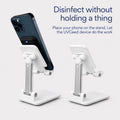
- Run a session on your phone. You are touching every one of those surfaces and then your face - your phone is the courier.
- Wash your hands with soap and water for 20 seconds after every restroom trip. Hand sanitizer alone is not enough for norovirus (CDC Handwashing).
- If someone on your ship gets sick, escalate your routine. Norovirus is airborne through vomit aerosols and stays viable on surfaces for two weeks. Do not share a bathroom with a sick cabinmate unless you disinfect between uses.
- Do not rely on the ship's "increased cleaning." Every outbreak press release includes that phrase. Every outbreak happens anyway.
Where UVCeed fits
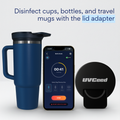
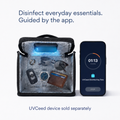
UVCeed is a 254 nm UV-C device with an app that guides you through sessions: you aim the light at one section of the surface (like the remote, the safe keypad, or the bathroom faucet), hold steady while the app confirms the section is complete, and move to the next section for surfaces larger than the coverage area.
254 nm UV-C is the same wavelength range used in hospital surface disinfection systems and is documented to inactivate norovirus surrogates on hard non-porous surfaces (EPA UV Disinfection Guidance; NIH PMC - UV inactivation of norovirus surrogates).
UVCeed is USB-C charged, includes tilt-based safety shutoff, and fits in a carry-on. That last part matters - alcohol wipes and bleach cleaners are TSA-restricted or leaky, UVCeed is not.
FAQ
Are cruise ship outbreaks really getting worse? 2023 and 2024 both had elevated cruise norovirus counts vs. the pre-pandemic baseline. 2026 is on pace with those years, and Princess in particular has seen three confirmed outbreaks so far (CDC VSP Outbreak List).
Does hand sanitizer kill norovirus? Not reliably at the concentrations used in most dispensers. The CDC's guidance is soap and water for at least 20 seconds (CDC Handwashing).
Can UVCeed sanitize my phone? Yes. Your phone is one of the highest-touch objects on a cruise. Run a session on both sides.
Can I use UVCeed on food I brought aboard? 254 nm UV-C inactivates bacteria on food surfaces. FDA rules prevent us from citing a specific reduction percentage on food, so we do not. On the packaging, wrapper, and container, UV-C is straightforward hard-surface disinfection.
Will the cruise line care if I bring UV-C? No. UVCeed is a personal device the size of a small remote. Cruise lines allow personal sanitizing devices and, honestly, are grateful for anything a guest does that reduces outbreak risk.
The bottom line
Three Princess outbreaks in 2026 is a signal, not an accident. The ship's cleaning program is designed around a threshold - it does not kick in until 3% of passengers are already vomiting. Your cabin turnover is measured in hours. The remote in your hand was in someone else's hand this morning.
Bring the tool that closes that gap.
Want More Articles Like This?
Get research on UV-C treatment and product updates delivered to your inbox.