TL;DR
Researchers at the University of East Anglia analyzed 1,281 bacterial samples spanning the 1970s through the early 2000s alongside modern genomes from six continents to trace how Acinetobacter baumannii, one of the World Health Organization's top-priority drug-resistant pathogens, became a global hospital threat. The resistance did not emerge suddenly. It built up in waves over three decades, with a critical turning point around the acquisition of the oxa23 gene, and the dominant resistant lineage had already taken over worldwide by roughly 2005. This piece covers what the study found and why it reinforces surface-level infection control as a frontline defense, not an afterthought.
What Actually Happened
The research team analyzed 1,281 bacterial samples, combining historical isolates going back to the 1970s with modern genomic sequences collected from six continents, to reconstruct the evolutionary path of Acinetobacter baumannii, according to Phys.org's coverage of the study. Rather than finding a single sudden emergence event, researchers found the bacterium evolved gradually, in a wave-like pattern of adaptation and resistance accumulation, over roughly three decades.
A critical turning point identified in the study was the acquisition of the oxa23 gene, a genetic element that significantly enhanced the organism's ability to withstand powerful antibiotic treatments. By approximately 2005, the resulting lineage had become the dominant strain of A. baumannii worldwide. The research also identified at least four distinct evolutionary lineages rather than one uniform strain, three showing gradual step-by-step resistance changes and a fourth being detected with increasing frequency in recent samples, suggesting a newer variant may be actively emerging.
Why This Bacterium Matters in a Hospital Setting
Acinetobacter baumannii is one of the World Health Organization's critical-priority pathogens for new antibiotic development because it survives well on hospital surfaces and equipment and has accumulated resistance to nearly all standard antibiotic classes over time. A separate 2026 hospital surface study at Zewditu Memorial Hospital found that 77.45% of swabbed hospital surface samples showed bacterial growth, yielding 171 bacterial isolates, illustrating how routinely inanimate objects, bed rails, IV poles, call buttons, mobile equipment, act as a transfer point from surface to patient.
The 30-year resistance timeline matters for a specific reason: it shows that antibiotic stewardship alone did not stop this pathogen's spread, because the resistance built up quietly for decades before becoming a recognized crisis. That reinforces why infection control practices that do not depend on antibiotics, including surface disinfection protocols, remain a critical layer of defense rather than a secondary consideration.
What This Means for Infection Control Practically
- Surface transmission is not a secondary risk factor for resistant organisms like A. baumannii, it is one of the primary routes by which the pathogen moves between patients in a healthcare setting.
- Chemical-resistant strains are a documented phenomenon. Separate research on Enterobacteriaceae has shown bacteria can evolve resistance to some surface disinfectants over repeated exposure, which is part of why physical disinfection methods that do not rely on chemical exposure gradients are being studied as a complementary layer.
- High-touch, high-turnover surfaces are the priority. Bed rails, call buttons, mobile equipment handles, and shared devices carry the highest transfer risk in the hospital surface study.
- This is not just a hospital problem. The same class of resistant organisms can travel home on shared items, luggage, or medical equipment used outside a clinical setting.
Where UV-C Fits (and Where It Does Not)
UV-C at 254 nm inactivates a broad range of bacteria, including drug-resistant organisms like Acinetobacter baumannii, on hard, non-porous surfaces by damaging the DNA that lets them reproduce, a mechanism that is independent of the antibiotic-resistance genes that make chemical treatment harder against these strains. That is part of why UV-C germicidal systems are already used in upper-room and HVAC applications in ICUs and transplant wards for other resistant organisms.
UV-C requires direct line of sight and does not disinfect surfaces it cannot reach, including the underside of equipment, fabric, or areas blocked by cables and tubing. It is a complement to, not a replacement for, standard hospital cleaning protocols and hand hygiene.
Where UVCeed Fits
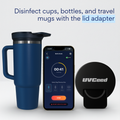
UVCeed is a 254 nm UV-C device that pairs with your phone camera and app to guide a session across the exact surface you are treating. You aim UVCeed at one section, hold it steady while the app confirms that section is complete, then move to the next section if the surface is larger than the coverage area.
For anyone managing personal medical equipment, shared devices, or frequent contact with healthcare settings, that structured, guided approach matters because resistant organisms don't announce themselves visually. No chemical residue, no wipes to replace, and a tilt-safety shutoff that turns the lamp off if the device rotates away from the target.
FAQ
Is Acinetobacter baumannii a new threat? No. The study shows it has been accumulating resistance since at least the 1970s and had already become the dominant global lineage by roughly 2005. It is not new; it was simply building quietly for decades before wider recognition.
Can regular people be exposed to this bacteria outside a hospital? Yes, though it is primarily a healthcare-associated pathogen. It can travel on shared medical equipment, luggage used during hospital stays, and surfaces in close contact with healthcare settings.
Does UV-C work differently against drug-resistant bacteria than regular bacteria? The mechanism is the same: UV-C damages bacterial DNA regardless of the organism's antibiotic-resistance genes, since the resistance genes protect against chemical antibiotics specifically, not against DNA damage from UV light.
Why is a 30-year-old resistance timeline relevant to a 2026 study? Because it changes how researchers think about surveillance. If resistance builds in slow waves over decades rather than emerging suddenly, catching new resistant lineages early requires ongoing genomic surveillance, not just reacting to acute outbreaks.
What is the oxa23 gene and why does it matter? It is a genetic element identified in the study as a key turning point that significantly enhanced the bacterium's resistance to powerful antibiotics, contributing directly to it becoming the dominant global lineage by 2005.
The Bottom Line
A resistant superbug that took three decades to become a global problem is a reminder that infection control cannot wait for the next antibiotic. Surface-level defense, done consistently, is one of the few controls that does not depend on the bacteria's resistance profile at all.
Want More Articles Like This?
Get research on UV-C treatment and product updates delivered to your inbox.