TL;DR
As of August 6, 2026, the US has confirmed 2,465 measles cases across 47 jurisdictions, already surpassing the full-year 2025 total of 2,289 infections, which itself was the highest annual count in more than three decades. There are 38 separate outbreaks reported this year, and 94% of confirmed cases are outbreak-associated rather than isolated. This piece breaks down what the current data shows, why measles is uniquely difficult to contain, and where surface-level UV-C disinfection realistically fits into a broader defense.
What the Data Actually Shows
The numbers, compiled from CDC surveillance data and US News reporting:
- 2,465 confirmed cases in the US as of August 6, 2026
- 47 jurisdictions reporting cases
- 38 new outbreaks in 2026 alone
- 94% of confirmed cases (2,407 of 2,566) are outbreak-associated, meaning they trace to a known chain of transmission rather than an isolated import
- 16 cases reported among international visitors to the US
For comparison, 2025 saw 2,289 total infections across 45 outbreaks for the entire year, which was already the highest annual case count the US had recorded in more than 30 years, according to the CDC's measles data page. 2026 crossed that full-year total before August ended.
The CDC's own modeling is stark on what is driving this: a 1% decrease in the childhood MMR vaccination rate could cause an estimated 17,000 additional measles cases, 4,000 hospitalizations, and 36 preventable deaths each year, underscoring how sensitive outbreak size is to small shifts in community immunity.
Why Measles Is a Different Kind of Threat
Measles is one of the most contagious viruses known, capable of infecting 9 out of 10 susceptible people in close contact with an infected person. It spreads primarily through the air via respiratory droplets, and the virus can remain infectious in airspace for up to two hours after an infected person has left a room, per CDC transmission guidance.
This is an important distinction for how families should think about risk: measles is primarily an airborne threat, not a surface-contact threat. No disinfection product, UV-C included, addresses airborne transmission in real time in an occupied room. The single most effective protection remains MMR vaccination, which the CDC states is about 97% effective after two doses.
What Families Can Actually Do
- Confirm vaccination status for everyone in the household who is eligible, particularly before travel or large gatherings where exposure risk rises.
- Check local outbreak activity through your state health department before travel to an affected area.
- If you or your child were exposed and are unvaccinated, contact your doctor immediately; post-exposure prophylaxis can reduce severity if given quickly.
- In a pediatrician's waiting room or urgent care, treat every hard surface as if the last patient before you could have been contagious, since measles can also survive briefly on surfaces even though airborne spread is the dominant route.
- Disinfect what travels with you after any visit to a clinic, waiting room, or crowded venue during an active local outbreak: your phone, keys, and stroller handle.
Where UV-C Fits (and Where It Does Not)
UV-C at 254 nm is well documented as effective against a broad range of viruses on hard, non-porous surfaces, including enveloped viruses generally, by damaging viral genetic material on contact. It is a reasonable addition to a waiting-room or post-clinic routine for hard surfaces like phones, clipboard pens, and stroller handles.
Where it does not help, and this matters more for measles than almost any other pathogen on this blog: UV-C does not address airborne transmission in an occupied space, and it is not a substitute for vaccination, masking during an active outbreak, or standard clinical infection-control protocols. We are not aware of published UV-C efficacy data specific to measles virus, so we do not make a specific claim here. Treat UV-C as one layer for the surfaces you control, not as outbreak protection.
Where UVCeed Fits
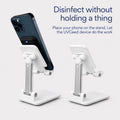
UVCeed is a 254 nm UV-C device that uses your phone camera and app to guide a session across a hard surface. You aim UVCeed at one section, hold it steady while the app confirms the section is complete, then move to the next section if the surface is larger than the coverage area.
In the context of measles specifically, the realistic use case is narrow and surface-focused: your phone and keys after a pediatrician visit, the stroller handle after a crowded venue, and doorknobs at home if a household member is in isolation. It is one small layer in a plan where vaccination does the heavy lifting.
FAQ
Is the measles vaccine still the best protection? Yes, unambiguously. The CDC states two doses of MMR vaccine are about 97% effective at preventing measles, and no surface-disinfection practice comes close to that level of protection against an airborne virus.
Why are cases rising now specifically? CDC data ties the rise to declining childhood vaccination rates in specific communities, combined with global measles activity increasing after a pandemic-era dip, according to the CDC's measles data page.
Can UV-C kill measles virus on surfaces? We are not aware of a published, measles-specific UV-C efficacy study, so we do not make that specific claim. UV-C at 254 nm is broadly documented against many viruses on hard surfaces, but measles' primary transmission route is airborne, which surface disinfection does not address.
How do I know if my area has an active outbreak? Your state health department publishes current case counts and exposure locations. The CDC's measles data and research page also tracks jurisdiction-level totals.
What should I do if my child was in a room with a confirmed measles case? Contact your pediatrician immediately. Post-exposure options, including vaccination within 72 hours or immune globulin within 6 days, can reduce the chance or severity of infection depending on timing and vaccination history.
The Bottom Line
2026 has already outpaced all of 2025 on measles, and the driver is a gap in vaccination coverage, not a gap in surface hygiene. Get vaccinated, know your local outbreak status, and treat surface disinfection as a supporting layer, not the main defense.
Want More Articles Like This?
Get research on UV-C treatment and product updates delivered to your inbox.