TL;DR
Cyclospora cayetanensis is having a moment. As of late July 2026 the CDC has logged more than 6,700 confirmed U.S. cases with roughly 11,500 more under review, and Taylor Farms has recalled iceberg lettuce shipped to 27 states (CDC HAN 00531; CNN, July 21 2026). The uncomfortable part: chlorine does not work on it. Iodine does not work on it. There is currently no EPA-registered disinfectant that lists Cyclospora cayetanensis on its label. 254 nm UV-C is the most credible non-thermal option we have, but it is not a magic wand. Here is what the peer-reviewed evidence actually says, and how to use that at home without overstating the claim.
Why this parasite is different
Cyclospora is a protozoan that lives inside a thick-walled oocyst - essentially a microscopic armored egg. That shell is what makes it so hard to kill.
- The FDA states that chlorine and other common antimicrobial chemical treatments are not effective against Cyclospora cayetanensis because the oocyst resists them (FDA - Cyclosporiasis and Fresh Produce).
- The CDC classifies it alongside Cryptosporidium as resistant to standard water disinfection and notes it can remain infectious in recreational water for days (CDC - Cyclosporiasis: Prevention).
- Iodine is equally ineffective per CDC and state health guidance - the parasite is unlikely to be killed by routine chemical sanitizing (CDC - Cyclospora General Information).
That is the regulatory reality: none of the chemicals you already own kill this thing. Washing produce reduces surface load and is worth doing, but it is not a kill step.
What UV-C actually does to Cyclospora
Cyclospora cayetanensis is notoriously hard to study because it cannot be cultured in a lab. Most of what we know about UV disinfection of this parasite comes from work on close relatives - Cryptosporidium parvum in particular - and from surrogate oocysts.
The good news:
- 254 nm UV-C damages the DNA of Cryptosporidium and comparable protozoan oocysts enough to stop them from causing infection, even without physically destroying the oocyst (EPA UV Disinfection Guidance Manual, 2006).
- Peer-reviewed Cryptosporidium dose-response work shows full inactivation (>3-log) at roughly 40 mJ/cm² of 254 nm UV in benchtop water tests (Bukhari et al., Applied and Environmental Microbiology, 1999).
- The mechanism - pyrimidine dimer formation in the oocyst DNA - is the same across these protozoans, which is why the field extrapolates Cryptosporidium data to Cyclospora while everyone waits for direct culture methods.
The catch:
- UV works in line of sight. On irregular surfaces like leafy greens, berries, and rough packaging, oocysts hiding in crevices, folds, and stem attachments may never be hit directly - a phenomenon known as shadowing.
- Dose matters. 40 mJ/cm² for a Cryptosporidium-class oocyst is measurably higher than what knocks out common bacteria (typically 5-10 mJ/cm² for E. coli and Salmonella) (USDA ARS UV Radiation research).
Bottom line: UV-C is a genuinely promising tool against Cyclospora, not a marketing gimmick. But dose, exposure time, and surface geometry all matter, and we do not claim a specific log-reduction percentage on food because FDA rules prevent it.
Why chemistry mostly fails here
This is worth spelling out because most consumers assume "if bleach does not work, some other chemical must."
Ineffective and confirmed as such:
- Chlorine (bleach) - FDA and CDC agree it does not reliably inactivate Cyclospora oocysts.
- Iodine - CDC guidance groups it with chlorine as insufficient.
- No EPA-registered disinfectant currently lists Cyclospora cayetanensis on its approved label. Chlorine dioxide is sometimes floated but lacks Cyclospora-specific efficacy testing.
Some laboratory effect - not field-validated kill steps:
- Sodium dichloroisocyanurate (NaDCC) at 1 g/L for 1-2 hours has shown significant reductions in oocyst sporulation (Ortega and Sanchez, Clinical Microbiology Reviews, 2010).
- Magnesium oxide nanoparticles have shown similar sporulation reductions in benchtop conditions.
- Zero-valent iron plus sand filtration is a physical-chemical hybrid promising for irrigation water treatment - removal rather than kill (USDA ARS research).
Why not just use stronger chemicals? The doses required to plausibly affect the oocyst wall - high-concentration chlorine dioxide, aggressive oxidizers, extended contact times - start creating their own food-safety and worker-safety problems: residues, byproducts, corrosivity. That is exactly why FDA's practical guidance points to physical and mechanical controls (microfiltration, ozone, heat) rather than chemical treatment, and why FDA recommends heating cookable produce to 158 °F (70 °C) as the only reliable in-home kill step (FDA Retail Food Safety Guidance).
What this means for your kitchen
If you have iceberg lettuce, cilantro, basil, raspberries, or blackberries at home this summer, here is a practical routine that reflects what the science actually supports:
- Check the recall list first. If your product is under a Taylor Farms or upstream supplier recall, discard it. Do not attempt to clean it. See FDA - Investigations of Foodborne Illness Outbreaks.
- Rinse thoroughly under running water. This reduces surface load. It is not a kill step, but it matters.
- Where practical, cook. FDA's own guidance flags heating to 158 °F as the only reliable kitchen kill step.
- Run a UV-C session on the prep zone. Cutting board, colander, knife, faucet handle, refrigerator handle. These are the surfaces that carry oocysts across your kitchen when you handle contaminated produce.
- For raw produce being served raw: you can also run a session on the produce itself. 254 nm UV-C inactivates bacteria and protozoa on food surfaces including leafy greens. FDA rules prevent us from citing a specific reduction percentage on food, so we do not. Use it as a supplement to washing, not a substitute for it, and recognize that shadowed crevices may not receive full dose.
Where UVCeed fits
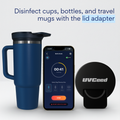
UVCeed is a 254 nm UV-C device with an app that guides you through sessions: you aim the light at one section of the surface, hold steady while the app confirms the section is complete, and then move to the next section for surfaces larger than the coverage area.
For a Cyclospora scenario specifically, that session-based approach is what matters. You are not sweeping quickly across a cutting board or a bunch of cilantro. You are giving each section the dwell time a Cryptosporidium-class oocyst actually needs.
FAQ
Does UV-C actually kill Cyclospora? 254 nm UV-C damages protozoan oocyst DNA enough to prevent infection, based on peer-reviewed evidence on Cryptosporidium and comparable oocysts. Direct Cyclospora dose-response data is limited because the parasite cannot be cultured in a lab. FDA rules prevent us from citing a specific reduction percentage on food, so we do not.
Why does chlorine not work? The oocyst wall is thick and chemically resistant. FDA and CDC both confirm chlorine and iodine do not reliably inactivate Cyclospora.
Can I use UVCeed on the produce itself? Yes. 254 nm UV-C inactivates bacteria and protozoa on food surfaces including leafy greens. Rinse first, then run a session on the produce and on the prep zone.
What about the produce I've already washed - is that enough? Washing reduces surface load but is not a kill step for Cyclospora. The FDA's only reliable in-home kill step is cooking to 158 °F. For raw applications, a UV-C session on the prep zone plus the produce is a reasonable belt-and-suspenders approach.
Is UV-C safe on food? 254 nm UV-C is widely used in commercial food processing (water, produce, packaging) and does not leave chemical residue. Do not stare into the beam and do not run a session on exposed skin - standard germicidal UV-C safety applies.
The bottom line
Cyclosporiasis is one of the few pathogens where the chemistry cabinet genuinely fails you. Chlorine does not work. Iodine does not work. No EPA-registered disinfectant claims efficacy. That leaves heat, filtration, and UV-C as your credible options.
UVCeed is not a substitute for the CDC's guidance to cook cookable produce and to discard recalled product. It is the tool that covers the surfaces and situations where those steps do not apply, and does it with a session-based protocol that respects the dose these resistant oocysts actually need.
Want More Articles Like This?
Get research on UV-C treatment and product updates delivered to your inbox.