Canine parvovirus is one of the hardest pathogens in small-animal medicine. It is non-enveloped, highly environmentally stable, and documented to remain infectious on surfaces for up to 7 months under favorable conditions (Decaro & Buonavoglia 2012, Vet Microbiol; AAHA Infection Control, Prevention, and Biosecurity Guidelines). Bleach dilutions (1:30 sodium hypochlorite with 10-minute contact) remain the gold standard, backed by AAHA and ASPCA shelter-medicine protocols. UV-C is not a replacement.
But in a working clinic, where kennels get turned every 90 minutes and exam-table seams see 30 patients a day, UV-C adds a verification layer that bleach alone cannot: proof that every square centimeter of the surface was treated, by a system that cannot forget a corner.
This article is for practice owners, DVMs, infection-control leads, and shelter medicine directors evaluating whether a camera-verified UV-C tool belongs in their between-patient turnover workflow. We will state the limits of UV-C before the use cases. If you are looking for a parvo silver bullet, this is not it. If you are looking for a defensible verification layer that documents what your team already does well, keep reading.
The parvo problem (and why bleach is still the right answer most of the time)
Non-enveloped viruses - canine parvovirus (CPV-2a, 2b, 2c), feline panleukopenia virus, feline calicivirus - are among the most UV-C-resistant pathogens in the veterinary environment. The capsid structure that lets them survive months of desiccation also lets them absorb and shrug off UV-C photons.
Published dose-response data put the UV-C requirement for 3-log reduction of CPV and its close relatives at roughly 50 mJ/cm2 or higher, orders of magnitude above the 2-3 mJ/cm2 that handles enveloped respiratory viruses such as influenza or SARS-CoV-2. Nerandzic et al. 2010 demonstrated the analogous challenge with C. difficile spores on hospital surfaces, where room-level UV-C decontamination required extended cycles and still functioned as a supplement to, not a replacement for, chemical cleaning. The general principle - that non-enveloped and spore-forming organisms require UV-C doses an order of magnitude higher than enveloped viruses - is codified in Kowalski's UV-GI Handbook.
UV-C is not a replacement for bleach for parvo. For a confirmed CPV-exposed kennel, follow AAHA and ASPCA protocols: bleach, dwell, rinse. Do not substitute.
So where does UV-C fit?
Not in the known-exposed CPV kennel. That kennel gets 1:30 sodium hypochlorite, 10-minute contact, and a rinse, every time.

UV-C fits everywhere else. It fits the exam-table seam between parvo patients where the vinyl mat meets the stainless. It fits the keyboard, the stethoscope diaphragm, the otoscope handle, the chair arm, the cabinet handle, the floor-crevice spot the mop missed. It fits the 50-plus high-touch surfaces per exam room that a wipe-down does not reliably reach, and that the clinic has no documented log for when the state inspector asks.
The 15 surfaces per vet exam room most protocols miss
A typical small-animal exam room contains 40 to 60 distinct high-touch surfaces. Most clinic cleaning protocols address a dozen of them explicitly. The rest get handled by habit, by eyeballing, and by the specific tech on shift that day. Here are the 15 that most consistently fall through the cracks, grouped by zone.

Patient zone
- Exam-table surface - the big one, usually wiped. Pathogen vector: everything the last patient brought in.
- Exam-table seam - where the vinyl or rubber mat meets the stainless base. Giardia cysts and fecal particulate collect here. Spray bottles overshoot it.
- Scale platform - fecal contamination from anal-gland expression, loose stool, urine. Routinely wiped on top, rarely on the edges.
- Otoscope handle - handled by every ear exam, including Malassezia and Pseudomonas otitis patients. Dermatophyte transfer risk from feline exams.
- Otoscope earpiece holder - the metal clip. Direct cerumen contact. Almost never wiped.
Staff zone
- Keyboard - between-patient chart updates by hands that just handled a patient. Bordetella, canine influenza, feline URI pathogens.
- Mouse - same vector as keyboard. Textured surface, hard to wipe effectively.
- Computer monitor edge - the bezel where the tech leans to point at an X-ray. Routinely touched, never cleaned.
- Stethoscope diaphragm and tubing - direct patient contact, moved patient to patient without wiping. Documented reservoir for MRSP (methicillin-resistant Staphylococcus pseudintermedius).
- Thermometer handle - rectal thermometry means the handle is in a glove while the probe is in a patient, but between patients the handle gets set on the counter. Fecal cross-contamination.
Ambient zone
- Cabinet handle - every drug pull, every supply grab. Dozens of touches per shift.
- Drawer pull - same.
- Exam-room doorknob, both sides - inside handle touched by every tech, every DVM, every client. Outside handle touched by every client, including ones from a kennel-cough-positive household.
- Countertop next to sink - the "I'll put this here for a second" surface. Nasal swabs, ear swabs, loose stool samples.
- Pen cup rim - the pen gets wiped, if anything. The cup never does.
Each surface has at least one documented zoonotic or nosocomial transfer vector in the veterinary literature - Giardia from fecal cross-contamination, dermatophytes from feline exams, Bordetella and canine influenza virus from respiratory patients, MRSP from skin-and-ear patients, Leptospira from reproductive and urinary presentations. A wipe-down misses them not because the chemistry is wrong, but because the hand holding the wipe cannot remember 15 surfaces every 15 minutes for 10 hours.
What UV-C does well in a vet clinic (and what it does not)
A plain breakdown. If a vendor cannot write this list honestly, do not pilot their product.
UV-C does well
- Enveloped viral pathogens on hard surfaces - canine coronavirus, canine parainfluenza, canine influenza virus, feline herpesvirus, FeLV and FIV outside the body. 2-3 mJ/cm2 handles these.
- Feline calicivirus with elevated dose - achievable with camera-verified dwell on a stationary surface.
- Vegetative bacteria - Bordetella bronchiseptica, Staphylococcus pseudintermedius (including methicillin-resistant strains), Pasteurella, Pseudomonas on hard surfaces.
- Post-wipe verification - confirming that the chemical pass actually covered the surface, including seams and edges the spray missed.
- Auditability for state inspection and AAHA accreditation - timestamped coverage logs per surface, per exam room, per tech.
- Operatory-grade turnover between exotic-animal appointments where chemical residue is contraindicated (reptile, avian, small mammal species sensitive to QAC and bleach fumes).
UV-C does NOT do
- Parvovirus decontamination of a confirmed-exposed kennel. Use bleach. Do not substitute.
- Dermatophyte spore eradication (Microsporum canis). Fungal spores require bleach plus mechanical removal of hair and keratin substrate.
- Penetrating organic matter - feces, blood, urine, purulent discharge. UV-C cannot see through soil. Mechanical cleaning comes first, always.
- Replacing autoclave for surgical instruments. UV-C is a surface tool, not a sterilization process for critical items.
- Replacing hand hygiene. Nothing replaces hand hygiene.
A DVM will respect this list because it is the list a DVM would write.
The exam-table seam problem
Every veterinarian who has worked a parvo case knows the seam where the vinyl mat meets the stainless base is where everything hides. The spray bottle overshoots it. The wipe does not get into it. The accelerated hydrogen peroxide pass sits on top of it. And the seam is where fecal particulate, hair, dander, and respiratory droplet residue accumulate across a day of appointments.
A UV-C wand without coverage verification cannot tell you whether the seam received dose. The tech waved the wand near it. Maybe for two seconds. Maybe for four. The seam is a one-centimeter-wide sub-region of a 60-by-120-centimeter table, and from the operator's perspective, it is invisible.
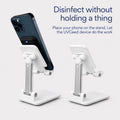
UVCeed addresses the seam problem specifically. The device MagSafe-mounts to the back of the tech's phone. The phone's camera watches the surface. The app renders a coverage heat map of the exam table in real time, with the seam resolved as its own sub-region. The system counts the UV-C dose that reached the seam and flags the surface as incomplete if the seam has not received adequate exposure. The tech makes a second pass on the flagged region and the log closes out.
This is the single demo that sells a vet practice owner. Not the big-surface sweep. The seam.
The verification pass - a 4-minute workflow between appointments
The clinic's existing chemistry does not change. UV-C sits downstream of it.
- Tech completes the standard wipe-down with the clinic's existing disinfectant - accelerated hydrogen peroxide, Rescue, Virkon, or whatever the medical director has standardized.
- Tech MagSafe-mounts UVCeed to the back of her phone.
- Tech opens the app. The exam-room checklist loads - the 15 surfaces above, plus any clinic-specific additions.
- Tech walks the checklist. The camera renders coverage. The app logs dose per surface in real time.
- App flags any surface that did not receive sufficient dose. Tech runs a second pass on the flagged surface only.
- Session closes. Log pushes to the practice manager's cloud folder - timestamped, surface-by-surface, tech-identified.
End to end: four minutes between patients. The practice manager now has a compliance log the state inspector can read. The owner has documentation for AAHA accreditation. The DVM has one less thing to worry about.
The three objections a vet practice owner will raise
"Can't I just use my bleach solution and call it done?"
For a known-exposed CPV kennel - yes. Do not change that. The bleach-dwell-rinse protocol is the standard of care and UV-C does not displace it.
For routine between-patient turnover across 30-plus appointments a day, bleach's 10-minute contact time plus rinse is operationally impractical. Techs will not do it. The surfaces will not get it. UV-C fills the between-patient gap that bleach is too slow to cover, and it does so without changing the chemistry on the surfaces where bleach is already in use.
"What about ozone generators or whole-room foggers?"
Different operational tier, different trade-offs. Ozone and foggers raise throughput, residue, material-compatibility, and staff-exposure questions. The room comes offline for the cycle. Electronics, leather, and some polymers degrade over time. UV-C spot verification is a targeted, between-patient tool, not a room-level reset. The two technologies address different problems.
"Does this earn me AAHA accreditation points?"
AAHA's infection-control standards require written protocols and documentation that cleaning occurred, not a specific technology. UVCeed's timestamped audit-trail log is the documentation the accreditation inspector asks for. The clinic can also publish its audit standard on its client-facing website as a differentiator - a verifiable claim about infection control that competitors making vague marketing claims cannot match.
Pilot design - a 60-day UVCeed trial in a 3-exam-room practice
A realistic structured pilot for a small-to-mid-sized small-animal practice.
- Week 1 - baseline. Head tech runs the clinic's current protocol unchanged. UVCeed deployed in audit-only mode on one exam room. No workflow change. Collect baseline coverage data and surface-miss rate.
- Weeks 2-4 - active use, single room. One exam room runs the UVCeed verification pass between every appointment. The other two exam rooms continue on the current protocol. Compare documented coverage, turnover time, and tech-reported friction.
- Weeks 5-8 - full rollout. All three exam rooms. 30-minute live training for all techs and DVMs. Monthly audit-trail report delivered to the practice owner and medical director.
- KPIs tracked throughout: time-to-turnover per exam room, documented coverage logs per week, state-inspection pass rate where applicable, zoonotic-incident internal reports (expected to remain unchanged or trend down).
- End state: a defensible compliance log, a client-facing differentiator the clinic can publish, zero change to the clinical chemistry the DVMs already trust.
The pilot does not ask the clinic to change its disinfectant, its parvo protocol, its hand-hygiene standard, or its kennel-turnover procedure. It layers verification on top.
Running this pilot
The structure above is designed to drop into a working small-animal practice without disturbing the clinical chemistry the medical director has already standardized on. UV-C sits downstream of the existing wipe-down, not in place of it. The 60-day arc produces three outputs the practice owner needs - a surface-by-surface coverage log, a time-to-turnover delta per exam room, and a written protocol the AAHA inspector can read without a demo.
A pilot is a clinical decision and we treat it as one. No add-to-cart. No consumer flow. As live pilot data comes back from veterinary early adopters, this article gets revised in public rather than silently edited - the parvo-dose numbers, the surface list, and the four-minute workflow time all get re-anchored to real clinic data as it accrues.
Sources
- American Animal Hospital Association. Infection Control, Prevention, and Biosecurity Guidelines. https://www.aaha.org/aaha-guidelines/infection-control-configuration/infection-control-prevention-and-biosecurity-guidelines/
- Decaro N, Buonavoglia C. Canine parvovirus - a review of epidemiological and diagnostic aspects, with emphasis on type 2c. Veterinary Microbiology. 2012;155(1):1-12. https://doi.org/10.1016/j.vetmic.2011.09.007
- ASPCA Pro. Shelter medicine disinfection and sanitation protocols. https://www.aspcapro.org
- Nerandzic MM, Cadnum JL, Pultz MJ, Donskey CJ. Evaluation of an automated ultraviolet radiation device for decontamination of Clostridium difficile and other healthcare-associated pathogens in hospital rooms. BMC Infectious Diseases. 2010;10:197. https://doi.org/10.1186/1471-2334-10-197
- Kowalski W. Ultraviolet Germicidal Irradiation Handbook: UVGI for Air and Surface Disinfection. Springer, 2009.
Want More Articles Like This?
Get research on UV-C treatment and product updates delivered to your inbox.