You have heard this before. 2020, PhoneSoap TikToks, the FDA pulling wands off shelves, class-action lawyers circling the "kills 99.99%" copy. You are right to be skeptical. Most consumer UV-C products shipped in the last five years were either the wrong wavelength, the wrong dose, the wrong distance, or asked the user to do something a human physically cannot do: see invisible light and track where it has already been. This article is not a defense of the category. It is a physics explainer, a failure-mode checklist, and an honest answer to the question of whether any UV-C device belongs in your home.
What UV-C actually is (and why 254 nm matters)
Ultraviolet light sits just past the visible spectrum, between roughly 100 nm and 400 nm. It is split into three bands: UV-A (315-400 nm, the band that tans and ages skin), UV-B (280-315 nm, the band that burns), and UV-C (100-280 nm, the band the atmosphere filters out before it reaches the ground). UV-C is the only band that is reliably germicidal. The sweet spot sits between about 240 nm and 280 nm, where photons carry enough energy to be absorbed by nucleic acids. Low-pressure mercury lamps emit a near-monochromatic line at 254 nm, which is why that number appears in every peer-reviewed UVGI (ultraviolet germicidal irradiation) paper written in the last 70 years.
The practical problem is that "UV-C" has become a marketing word rather than a measurement. Low-pressure mercury tubes genuinely emit at 254 nm. True UV-C LEDs (265-280 nm) exist but are expensive, inefficient, and have short lifespans. The LEDs sold on marketplaces for a few dollars under a "UV-C" label almost universally are not UV-C at all. A widely-cited Hackaday teardown in April 2020 measured a $63 "germicidal" bulb and found its spectrum peaking between 394 nm and 414 nm - that is UV-A bleeding into visible violet, not UV-C. The International Ultraviolet Association's COVID-19 FAQ documents the same pattern across the industry: multiple products marketed as UV-C emitted only UV-A on test.
Why does the wavelength matter so much? Because the germicidal effect is not "ultraviolet light hits a microbe." It is a specific photochemical reaction that only happens efficiently in a narrow band. A 395 nm LED can tan your skin. It will not meaningfully inactivate a virus no matter how long you leave it on.
The science that is actually settled
When a 254 nm photon is absorbed by DNA or RNA, it induces a covalent bond between adjacent pyrimidine bases - most commonly a thymine-thymine or uracil-uracil dimer. Dimerized nucleic acid cannot be transcribed or replicated. The organism is still physically intact. It just cannot reproduce. This is why UVGI is described as "inactivation" rather than "killing," and why it works on viruses (which have no metabolism to disrupt) just as well as on bacteria.
The dose required to achieve a given log-reduction is well-characterized for most relevant pathogens. Dose is the product of intensity and time, measured in millijoules per square centimeter (mJ/cm²):
Dose (mJ/cm²) = Intensity (mW/cm²) × Time (seconds)
Representative dose targets for a 3-log (99.9%) reduction at 254 nm, drawn from decades of water-treatment and air-handling literature:
- SARS-CoV-2 on surfaces: approximately 3-5 mJ/cm²
- Influenza A: approximately 2 mJ/cm²
- E. coli: approximately 6 mJ/cm²
- Staphylococcus aureus: approximately 7 mJ/cm²
- Clostridioides difficile spores: 50 mJ/cm² or more

Two things fall out of this immediately. First, the required dose varies by more than an order of magnitude across common pathogens, so any device that claims a single fixed "cycle time" is answering the wrong question. Second, intensity falls off with the square of the distance from the lamp. A device that delivers 5 mJ/cm² at one inch delivers roughly 1.25 mJ/cm² at two inches and about 0.3 mJ/cm² at four inches. Distance is not a detail. It is the dominant variable.
The 7 failure modes

Every consumer UV-C product on the market fails on at least one of the following. Most fail on several. The order below is roughly the order in which real users encounter them.
1. Shadow
UV-C travels in straight lines and does not bend around corners. Any part of a surface that is not in direct line-of-sight of the lamp receives essentially zero dose. The crease where your phone case meets the glass, the gap under a key on a keyboard, the recessed charging port, the underside of a stethoscope diaphragm - all shadowed, all un-dosed. Reputable manufacturers acknowledge this explicitly in their own documentation. The HoMedics UV-Clean portable sanitizer carries the disclaimer:
"Direct exposure to UV-C light is required. Surface areas not directly exposed may not be dosed to the above levels."
That sentence is doing a lot of work. It is the manufacturer stating, in plain English, that the device cannot sanitize anything it cannot see. The Washington Post's 2021 review of consumer UV sanitizers reached the same conclusion from the user side: closed-box sanitizers may dose the top of a phone adequately while leaving the bottom, sides, and crevices effectively untreated. A verified-dose system solves shadow by mapping coverage per-pixel on the phone screen in real time, so the user can see exactly which regions have not yet received the beam and reposition the device.
2. Wrong wavelength
Discussed above, but it belongs in the failure list because it is the single most common reason a consumer UV-C product does nothing at all. If the bulb emits at 395 nm instead of 254 nm, no amount of time, distance, or technique will produce germicidal effect. The Hackaday teardown and IUVA testing documented products shipping with cosmetic blue-violet LEDs behind a "UV-C" label. The only way to know for certain is a spectrometer trace from the manufacturer or a third party. A verified-dose system is built around a known-wavelength 254 nm mercury source and reports the dose figure in units that only make sense if the wavelength is correct.
3. Wrong dose
A product that tells you "sanitizes in 30 seconds" without specifying intensity, distance, and target pathogen is quoting a number that cannot be checked. 30 seconds of what, from how far, against what organism? Dose in mJ/cm² is the only unit that composes correctly across devices. Everything else is marketing. The FDA's own guidance on UVGI emphasizes that dose, not time, is the operative quantity. A verified-dose system reports the integrated dose on each region of the surface and only declares the surface complete when every pixel has crossed the dose threshold for the selected pathogen target.
4. Wrong distance
The inverse-square law is unforgiving. It also cuts both ways: too far away, and the surface receives no useful dose. Too close, and the user receives a dangerous one. In its 20 July 2022 Safety Communication, the FDA warned that certain consumer UV wands exposed users to radiation levels up to 3,000 times the recommended occupational exposure limit at a working distance of approximately two inches. JAMA's coverage of the finding noted that the affected products had been marketed as safe for use on skin and around children.
"Do Not Use Certain Ultraviolet (UV) Wands That Give Unsafe Levels of Radiation" - FDA Safety Communication, 20 July 2022

For the record: UVCeed was not on the FDA's July 2022 list. A verified-dose system calibrated to a known working distance, with the beam shielded away from the user's eyes and skin, is architecturally different from a hand-waved bare-bulb wand.
5. Wrong time
Even with the correct wavelength, correct device, and correct distance, waving the lamp across a surface too quickly delivers inadequate dose. Human intuition about "a few seconds should be enough" is wrong by one to two orders of magnitude. The problem is that the user has no feedback: UV-C is invisible, and the surface looks identical before and after. A verified-dose system eliminates the guess by integrating dose over time on each pixel as the user moves the device, and refusing to signal completion until the integral crosses the threshold.
6. Counterfeit bulb
A category-specific failure that deserves its own line. The $63 "UV-C" bulb torn down by Hackaday was not merely underpowered. It was a cosmetic UV-A LED sold as a germicidal lamp, with no 254 nm output at all. Marketplace listings are flooded with these. Price is not a reliable filter - plenty of counterfeit units cost more than legitimate ones. The defense is to buy from manufacturers that publish spectral traces, use known mercury-lamp physics (which cannot be faked - a mercury discharge emits at 254 nm because of atomic physics, not because of a sticker), and verify dose at the point of use.
7. User error (the catch-all)
This is the failure that subsumes all the others. A human being cannot see 254 nm light. A human being cannot track which square centimeter of a phone screen has been covered and which has not. A human being cannot integrate intensity over time in their head while moving a lamp across a textured surface. Every device that depends on the user to do these things is depending on something the user cannot do. The only way out of user error is to move the measurement off the user and into the device. The phone camera, pointed at the surface being sanitized, can see the UV-C beam's reflection, map the coverage on-screen, and count the accumulated dose per pixel in real time. That is the architectural shift. Everything else in this article is a consequence of it.
"Kills 99.9%" - the phrase that is now a lawsuit magnet
The percentage claim without context is the single most legally hazardous sentence in the consumer sanitizer category. A 2020 class-action complaint, Garbus v. UV Sanitizer USA LLC (EDNY 2:20-cv-05358), alleged that the defendant's portable UV light product did not deliver the germ-reduction percentages advertised. Coverage from Top Class Actions and ClassAction.org summarized the central allegation: a context-free percentage claim is not a product specification. It is an advertising statement that courts can and do test against measurement.
A scientifically meaningful efficacy claim has to specify the organism, the dose in mJ/cm², the surface material, and the test method. "Kills germs" is not a claim. It is a mood. The reason reputable UVGI literature talks in log-reductions at specified doses is that any other formulation falls apart under cross-examination, in both the scientific and the legal sense.
What a verified-dose system actually does differently

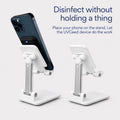
The architecture is specific. A low-pressure mercury source emits a narrow line at 254 nm - the wavelength is a consequence of mercury atomic physics, not a design choice. The device clips to the back of a phone via MagSafe. The phone's rear camera is pointed at the surface being sanitized. Software on the phone watches the camera feed, identifies the illuminated region, and maps coverage on-screen as the user moves the device across the surface. Each pixel in the camera frame carries an accumulating dose counter in mJ/cm². When every pixel in the user-selected region has crossed the dose threshold for the chosen target - 5 mJ/cm² for routine viral loads, more for bacterial spores - the device signals completion.
The user does not have to guess at wavelength (fixed by the lamp's physics), distance (fixed by the geometry of the clip and the surface being treated), time (integrated by the software), or coverage (the camera draws it on screen). The seven failure modes above are addressed structurally, not by asking the user to be more careful.
This is not a claim that the device does something magic. It is a claim that the measurement problem has been moved from the user, who cannot see UV-C, to the camera, which can.
The honest answer to "should I buy a UV-C sanitizer?"
For most surfaces, in most households, the honest answer is no. Soap and water is cheaper, better-studied, and does not depend on getting a dozen variables right. A bleach wipe on a kitchen counter is more effective than any consumer UV device ever shipped. If a product can be wiped, wipe it.
UV-C earns its place where wiping does not work: the microphone grille and speaker ports on a phone, the gaps between keys on a keyboard, the fabric of a CPAP mask that cannot tolerate alcohol, hearing aids that cannot be submerged, a stethoscope diaphragm between patients, the shared remote in a hospice room, the toys in an immunocompromised household where every surface matters and chemical residue is a problem. For those cases, a device that solves the seven failure modes above is the only honest option in the category. A device that does not solve them is theatre.
If you take one thing from this article, let it be this: dose is the unit. Everything else is marketing. Ask any manufacturer for the dose in mJ/cm², the wavelength in nm, the working distance in inches, and the method by which the device verifies that the dose was actually delivered to the surface in question. If they cannot answer in those units, the product does not work.
Sources
- Hackaday, "Buyer Beware: This LED Bulb Sold As Germicidal Doesn't Emit UV-C" (April 2020): https://hackaday.com/2020/04/15/buyer-beware-this-led-bulb-sold-as-germicidal-doesnt-emit-uv-c/
- International Ultraviolet Association, COVID-19 FAQ: https://iuva.org/iuva-covid-19-faq
- U.S. Food and Drug Administration, "Do Not Use Certain Ultraviolet (UV) Wands That Give Unsafe Levels of Radiation," Safety Communication, 20 July 2022: https://www.fda.gov/medical-devices/safety-communications/do-not-use-ultraviolet-uv-wands-give-unsafe-levels-radiation-fda-safety-communication
- JAMA, coverage of FDA UV wand safety finding: https://jamanetwork.com/journals/jama/fullarticle/2795910
- The Washington Post, "Are UV sanitizers worth it? What to know about UV light and the coronavirus" (February 2021): https://www.washingtonpost.com/lifestyle/2021/02/16/uv-sanitizer-phone-covid-germs/
- Top Class Actions, "UV Sanitizer Light Claims Challenged in Class Action Lawsuit" (Garbus v. UV Sanitizer USA LLC, EDNY 2:20-cv-05358): https://topclassactions.com/coronavirus-covid-19/uv-sanitizer-light-claims-challenged-in-class-action-lawsuit/
- ClassAction.org, "Does It Really Work? Class Action Claims Portable UV Light Can't Kill 99.99% of Viruses, Germs, Bacteria": https://www.classaction.org/blog/does-it-really-work-class-action-claims-portable-uv-light-cant-kill-99.99-percent-of-viruses-germs-bacteria
- HoMedics UV-Clean portable sanitizer product documentation (manufacturer disclaimer quoted verbatim).
Want More Articles Like This?
Get research on UV-C treatment and product updates delivered to your inbox.