TL;DR
- In May 2026, Pennsylvania regulators suspended a Philadelphia dentist's license after inspectors found reused single-use vials, unsterilized handpieces, and other lapses; patients were told to get tested for HIV and hepatitis. ABC News
- Patients rank office cleanliness as one of the top reasons they return to a dental practice, just behind quality of work, according to a 1-800-DENTIST patient survey. DrBicuspid.com
- CDC and OSHA both require documented protocols for clinical contact surfaces and bloodborne pathogen exposure control, and most of the failure points show up in fast-turnaround areas like chairs, check-in kiosks, and reception, not just the sterilization room. CDC | OSHA
- 254nm UV-C is a genuine supplement for surfaces and shared devices between patients, but it is line-of-sight only, does not replace autoclave sterilization of instruments, and has real skin and eye exposure hazards that require sensible use.
What a license suspension in Philadelphia should tell you
In March 2026, the Pennsylvania Department of State sent investigators into a Center City dental practice, Smiles at Rittenhouse Square, for an unannounced inspection. What they found was serious enough to suspend the treating dentist's license two months later: reused single-use vials of local anesthetic given to multiple patients, IV saline bags that weren't replaced between implant procedures, and handpieces with visible blood and saliva that went back into service without sterilization. Philadelphia's health department is now contacting everyone who was treated at the practice between April 2025 and May 2026, potentially hundreds of patients, and urging them to get tested for hepatitis B, hepatitis C, and HIV. Deputy Health Commissioner James Garrow put it plainly: "when you are in a dentist office that's unsanitary, unsafe, the risk always exists." ABC News
State attorneys involved in the case specifically flagged the reuse of single-use items as a pathway for transmitting hepatitis C, hepatitis B, HIV, and other pathogens between patients. WHYY The headline failures were instrument and injection related, which is squarely a sterilization and clinical-protocol problem, not something any surface disinfection device fixes. But the story is a useful wake-up call for a broader reason: it shows how fast an infection control lapse turns into a public health notice, a closed practice, and a permanent mark on a provider's reputation. Patients don't parse the difference between "the autoclave logs were wrong" and "the office felt unclean." Once trust breaks, it breaks across the whole experience, from the reception desk to the operatory chair.
The stakes are higher than most practice owners assume
Two federal frameworks already govern infection control in dental and medical offices, and neither one is optional.
The CDC's dental infection prevention guidance directs practices to clean and disinfect clinical contact surfaces that aren't barrier-protected with an EPA-registered hospital disinfectant after every patient, and to use an intermediate-level, tuberculocidal disinfectant if a surface is visibly contaminated with blood. It specifically calls out frequently touched items like light handles, drawer knobs, and unit switches as reservoirs for cross-contamination between patients and staff. CDC The CDC also publishes a formal Infection Prevention Checklist for Dental Settings that practices are encouraged to use for periodic self-assessment. CDC For medical offices, urgent care centers, and other ambulatory settings, the CDC's parallel Guide to Infection Prevention for Outpatient Settings lays out the same baseline: hand hygiene, PPE, safe injection practices, and routine disinfection of the environment and equipment. CDC
Separately, OSHA's Bloodborne Pathogens Standard (29 CFR 1910.1030) requires every dental and medical employer with exposure risk to maintain a written Exposure Control Plan, updated annually, that identifies which roles are exposed to blood or other potentially infectious material and describes the engineering and work practice controls in place. OSHA OSHA has explicitly stated that a written checklist for dental offices should be evaluated against, not substituted for, the actual requirements of the standard, meaning inspectors expect practices to show real, documented practice, not just a form on the wall. OSHA
Then there's the commercial reality. A 1-800-DENTIST patient survey found that 91 percent of respondents ranked office cleanliness as a reason they would return to the same dentist, behind only the quality of clinical work and a clear explanation of treatment options, and ahead of a gentle chairside manner, short wait times, and friendly staff. DrBicuspid.com A more recent study on patient perception found that after the COVID-19 pandemic, the large majority of dental patients said their expectations around hygiene had permanently shifted, and most reported directly noticing changes to how their usual practice handled disinfection and PPE. PubMed In a market where patients compare practices on Google reviews before they ever call for an appointment, visible hygiene is not a back-office concern. It is part of the product.
A practical hygiene checklist for the areas patients actually see
Instrument sterilization gets the regulatory attention, and it should. But most of a practice's visible hygiene footprint, and a real share of its cross-contamination risk, lives in the spaces around the clinical work. A working checklist for office managers:
- Reception and waiting room. Wipe down and disinfect the front desk counter, pens, clipboards, and any shared reading material or toys at set intervals throughout the day, not just at open and close.
- Check-in kiosks and tablets. Touchscreens, iPads, and signature pads get touched by every patient and are rarely included in written disinfection protocols. Build them into the same rotation as clinical contact surfaces.
- Between-patient chair turnover. Armrests, headrests, bracket trays, light handles, and unit switches should be cleaned and disinfected with an EPA-registered hospital disinfectant after every patient, per CDC guidance, with barrier protection changed out where used. CDC
- Shared devices. Anything staff and patients both handle, such as card readers, intraoral cameras, and shared styluses, needs its own line item in the cleaning schedule.
- Staff break room. Refrigerator handles, microwave buttons, and shared coffee equipment are easy to overlook but get touched by every staff member multiple times a day.
- Document it. Keep a simple log of who cleaned what and when. If a state inspector or OSHA compliance officer ever asks for evidence of your protocol, a checklist with initials and timestamps is worth far more than a verbal assurance.
Where UV-C actually fits, and where it doesn't
254nm UV-C light is a well-established germicidal technology. At sufficient dose, it damages the DNA and RNA of bacteria and viruses on exposed surfaces, which is why hospitals and labs have used UV-C room disinfection for years. It is real science, but it has real limits that matter in a clinical setting.
UV-C only disinfects what it can directly "see." It is line-of-sight only, meaning shadowed areas, the underside of an armrest, the inside of a drawer, or anything not directly illuminated is not treated. It cannot penetrate blood, saliva, or visible debris, which is exactly why CDC guidance requires cleaning before disinfection, not as a substitute for it. CDC And critically, UV-C surface disinfection does not replace autoclave sterilization of dental and medical instruments. Sterilizing handpieces, scalers, and other reusable instruments is a regulated, validated process with its own monitoring requirements, and no UV-C surface device is a substitute for it.
UV-C also carries genuine safety considerations that any responsible practice should know before adopting it. Direct skin and eye exposure to 254nm UV-C is a documented hazard, capable of causing photokeratitis, photoconjunctivitis, and skin irritation with sufficient exposure. PMC That's why germicidal UV-C devices are designed to be used in unoccupied spaces, or in the momentary gaps of a patient turnover, rather than run continuously in occupied rooms. Used correctly, on the right surfaces, during the right window in the day, it's a legitimate supplement to a cleaning and disinfection protocol. Used as a substitute for wipe-downs, disinfectant contact time, or instrument sterilization, it isn't doing the job it's being asked to do.
Where UVCeed fits into a real practice workflow
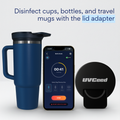
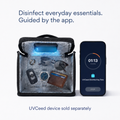
UVCeed is a portable 254nm UV-C device built for exactly this kind of supplemental, high-touch surface use, not for replacing your sterilization protocol or your OSHA-mandated disinfectant wipe-down. In a dental or medical office, that looks like a handheld device that a front desk staffer or dental assistant keeps within reach and uses in the gaps between patients and during slower stretches of the day.
Practically, that means aiming the device at the check-in tablet after a patient signs in, holding steady until the app confirms the section is complete, then moving to the next section, the card reader, the pen tray, the armrests. It means giving the reception counter and waiting room chairs a pass between busy blocks of appointments, alongside your regular disinfectant wipe-down, not instead of it. It means treating the break room microwave buttons and coffee station handles once a shift, so staff hygiene gets the same attention as patient-facing surfaces. None of this replaces your Exposure Control Plan, your EPA-registered disinfectant, or your autoclave log. It's a fast, visible layer on top of the protocol you already have to run anyway, one that a patient sitting in your waiting room can actually notice.
FAQ
Does UV-C disinfection satisfy OSHA's Bloodborne Pathogens Standard on its own? No. OSHA requires a written Exposure Control Plan with specific engineering and work practice controls, including proper use of EPA-registered disinfectants on contaminated surfaces. UV-C is a supplement to that plan, not a replacement for it. OSHA
Can UV-C sterilize dental instruments instead of an autoclave? No. Instrument sterilization is a regulated, validated process with biological indicator monitoring. 254nm UV-C surface disinfection is a different tool for a different job, environmental surfaces and shared devices, not reusable clinical instruments.
Is it safe to run a UV-C device while patients are in the waiting room? Direct 254nm UV-C exposure to skin and eyes is a known hazard, so germicidal UV-C is meant for unoccupied surfaces or brief, targeted use during natural gaps in patient flow, not continuous operation around occupied seating. PMC
What's the fastest win for a practice trying to improve visible hygiene without a big process overhaul? Start with the surfaces every patient touches in the first sixty seconds: the check-in tablet, the pen, the front counter. These are rarely part of a formal cleaning schedule but are the first thing a patient notices.
Does a clean-looking waiting room actually affect whether patients come back? Patient surveys suggest yes. Cleanliness ranks just behind clinical quality as a reason patients return to the same dental practice, and most patients say their hygiene expectations have shifted since the pandemic. DrBicuspid.com | PubMed
The bottom line
Regulatory compliance and patient trust used to feel like separate conversations for a lot of practice owners: one for the OSHA binder, one for the front desk. The Philadelphia case is a reminder that they're the same conversation now. Patients can't audit your sterilization log, but they can see whether the waiting room chair looks cared for and whether the check-in tablet gets wiped down. Handling both, the regulated instrument protocol and the visible surface layer, is what actually protects a practice's patients and its reputation.
Want More Articles Like This?
Get research on UV-C treatment and product updates delivered to your inbox.