You will probably touch your face again before you finish this sentence. That is not a guess. In a 2015 study in the American Journal of Infection Control, researchers video-recorded 26 medical students for four hours and counted 2,346 face touches. The average came to 23 touches an hour, roughly one every two and a half minutes.
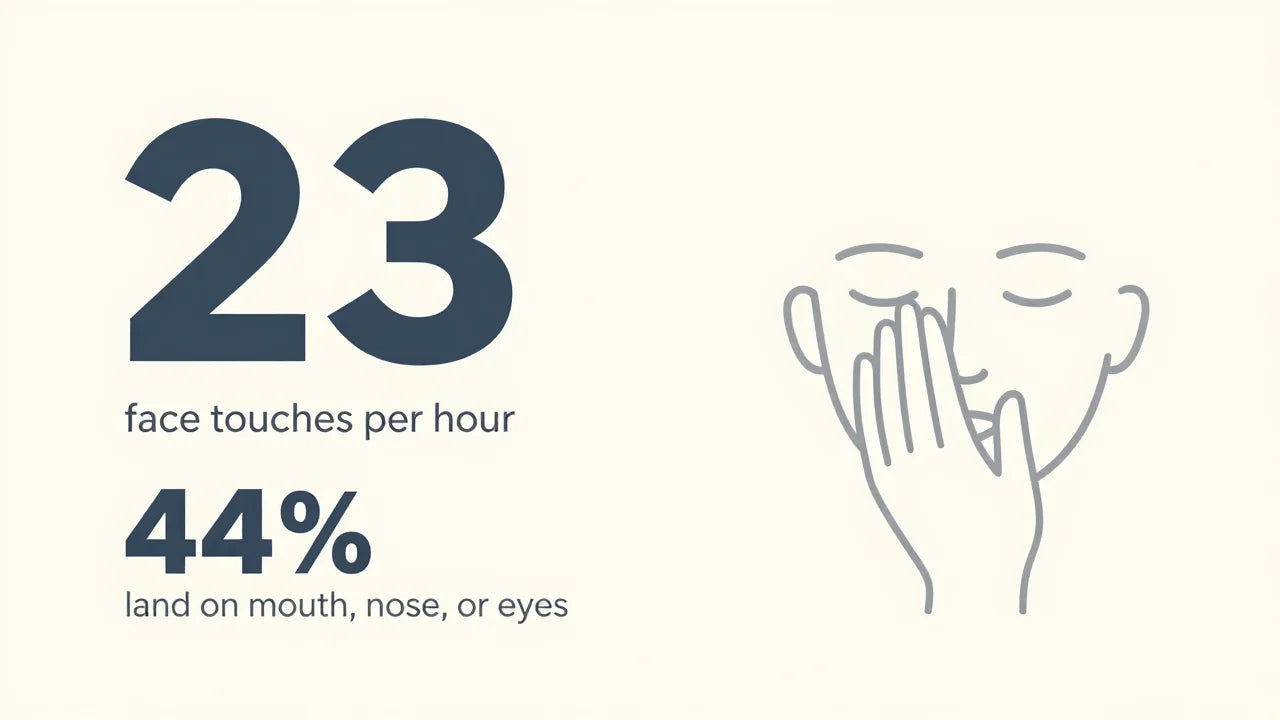
What makes that number matter is where the touches land. Just under half, 44 percent, hit a mucous membrane: the mouth, the nose, or the eyes. Those are the entry points. If a germ is sitting on your hand, an automatic touch can move it somewhere it can take hold. The study's authors put it plainly: face touching is a frequent, mostly unconscious habit, which is exactly why hand hygiene matters so much.
What also stands out in that study is how automatic the behavior really is. The subjects were medical students, people who spend years learning about infection control, and they still touched their faces constantly across the four-hour window. That is the nature of an automatic habit: it runs below the level of attention, so simply deciding to stop rarely works. A more reliable plan is to lower the load at the source, on the surfaces that keep putting germs on your hands in the first place.
But hands are only half the story. Hands do not invent germs; they pick them up from surfaces. And the surface most people handle more than any other is the same one they hold against their face. A recent Reviews.org survey found Americans check their phones 186 times a day. That is the object sitting between your hand and your cheek all day.
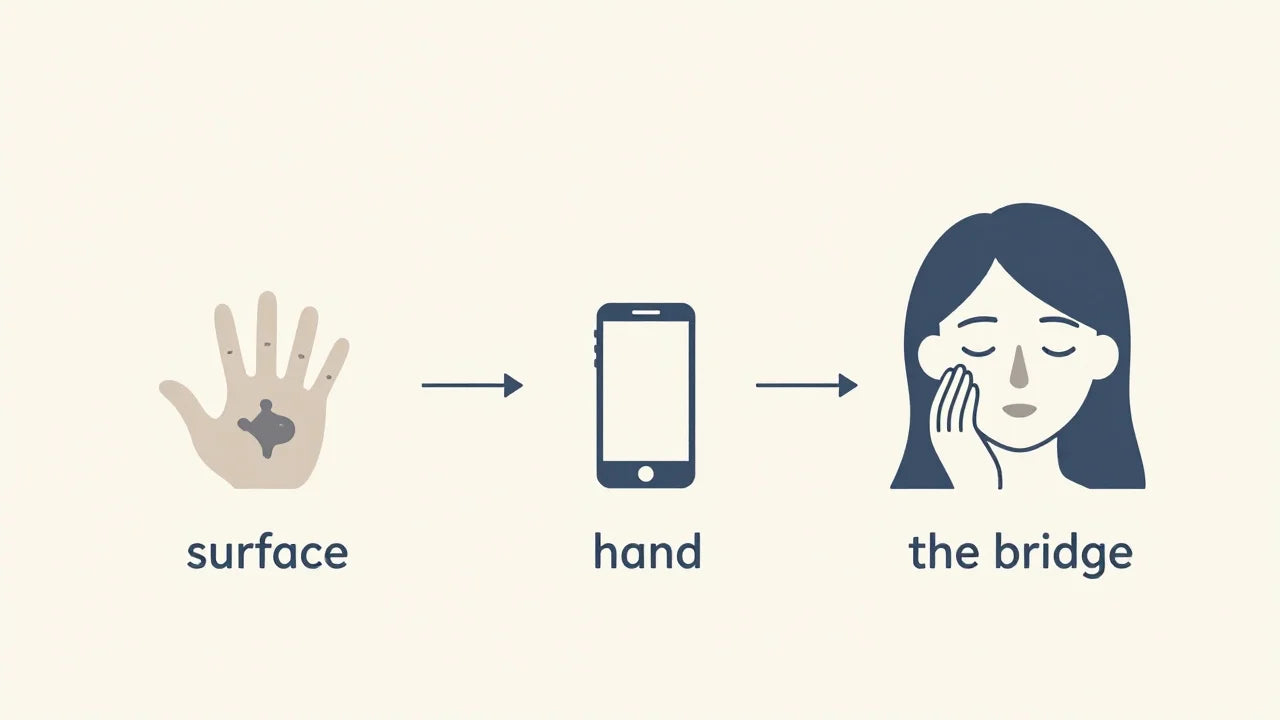
Your phone is the bridge
Trace the route a germ takes. It lands on a surface. Your hand touches the surface. Your hand touches your face. A phone fits into every step of that chain, and it adds one of its own: it travels from the restaurant table to the gym bench to the train seat, then comes up to your cheek.
Research keeps confirming that the phone is not a clean bystander. A 2022 study in Microbiology Spectrum found the microbes on a smartphone closely mirror the owner's hand, evidence that bacteria move back and forth between the two all day. The same study measured about 1.75 million bacteria on a typical touchscreen, and found that a simple wipe cut the load by roughly tenfold.
An earlier UK survey by the London School of Hygiene & Tropical Medicine and Queen Mary, University of London, swabbed phones and hands across 12 cities. Bacteria showed up on 92 percent of phones and 82 percent of hands, and one in six phones carried fecal bacteria. People with fecal bacteria on their hands were three times more likely to have it on their phone.
Why the phone is a different kind of surface
The phone sits in the middle of the chain for a simple reason: it is warm, it is handled constantly, and it is rarely cleaned the way hands are. You wash your hands after the restroom and before a meal. Your phone skips every one of those steps. It picks up whatever was on the last surface it touched, and it carries that straight to your cheek the next time you take a call.
Part of what makes the phone such an effective carrier is that it is also a comfortable place for microbes to settle. The researchers behind the Microbiology Spectrum study described the smartphone as an ecological niche, a warm surface that spends much of the day near the body and in a pocket. Microbes do not just land on it; they can persist there, which is what turns a quick touch into a round trip between your hands and the screen.
Where the load comes from
That persistence is why the phone matters more than a doorknob you touch once and leave behind. A phone is touched hundreds of times a day, held in a warm hand, pressed to a warm face, and rarely washed. It is less a single surface and more a moving collection of everything the day has put in front of it: the cafe counter, the gym bench, the train rail, the shared keyboard.
None of this means the phone is uniquely dangerous, and it is not an argument for sealing yourself off from the world. It is an argument for treating the phone as a single, cleanable chokepoint. You cannot disinfect every rail and counter you brush past in a day, but you can reliably disinfect the one object that touches both those surfaces and your face. One step in the middle does more than a dozen steps you will forget.
A habit you can actually keep
None of this needs to be alarming. Face touching is automatic, surfaces are everywhere, and your phone is the one surface you can reliably keep clean without rebuilding your whole day.
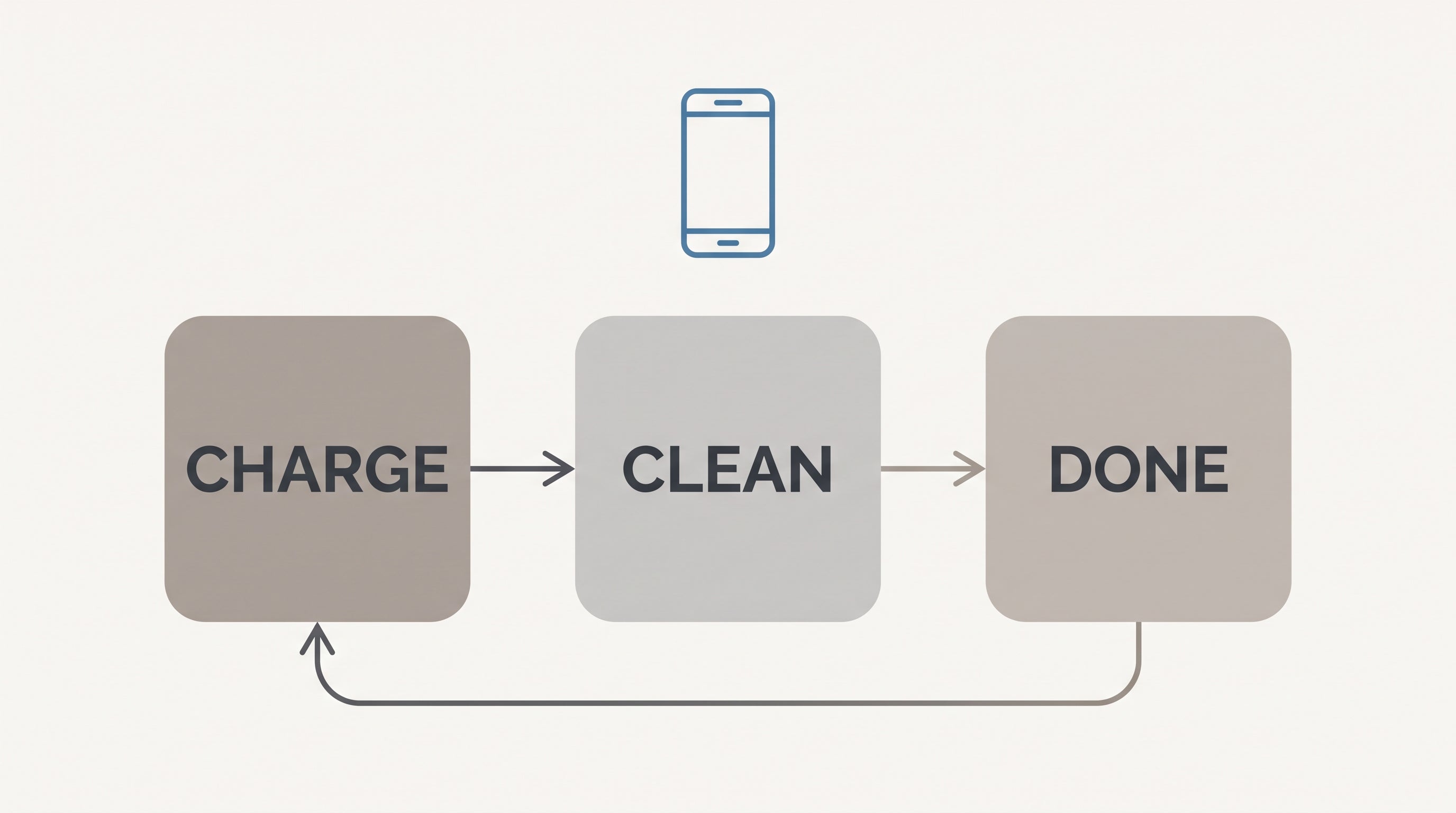
The most useful habit is not "stop touching your face," because automatic habits are hard to switch off. It is "clean the object that keeps landing next to your face." A phone can be disinfected in seconds, without water or a damp cloth, and without changing your routine.
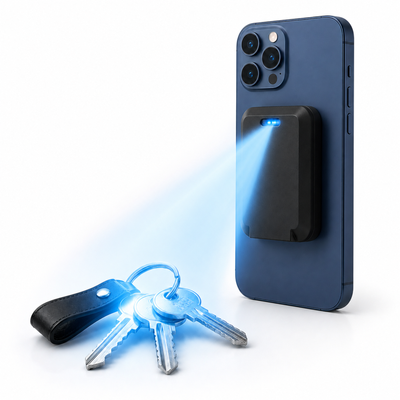
That is where UV-C fits naturally. A device like UVCeed attaches to the back of the phone and uses the camera to guide the pass, so you can see what you have already covered instead of guessing. In lab testing, it inactivated 99.9 percent of Staph aureus in 15 seconds, 99.99 percent of E. coli in 24 seconds, and 99.9 percent of SARS-CoV-2 in 32 seconds. See how the camera-guided pass turns a guess into something you can watch.
How to anchor the habit so it sticks
The reason most cleaning routines fall apart is that they depend on remembering. A better way is to attach the new step to something you already do every day, so it rides along instead of competing for attention. Pair it with plugging the phone in to charge at night, or with setting it down the moment you walk in the door. The trigger already exists; you are only adding a few seconds to it.
What keeps the habit alive after the first week is the visible part. When you can watch the coverage fill in as you go, the step stops feeling like a chore and starts feeling like a task with a finish line. That is the difference between guessing you cleaned something and knowing it, and it is the same principle behind a checklist: visible progress beats willpower over the long run.
The payoff is specific rather than vague. The surfaces that matter, the phone, the earbuds, the doorknob, are all small enough to treat in seconds. A quick pass removes the guesswork from the one object that sits between your hands and your face, and that single change quietly lowers the load on every automatic face touch that follows. None of this requires becoming a germaphobe. It is closer to the way people treat washing hands: a small, regular step that does not take over the day but makes everything after it a little safer.
None of this takes the place of hand washing or the other basics. It sits alongside them, aimed at the one gap most routines leave open: the surface your hands and face both keep coming back to. Fill that gap and the rest of the day's touches have a lot less to work with.
Sources
Kwok, Gralton & McLaws, "Face touching: A frequent habit that has implications for hand hygiene," American Journal of Infection Control, 2015 - pmc.ncbi.nlm.nih.gov
He, Shen, Zhang, Sun & Shao, "Smartphones as an Ecological Niche of Microorganisms," Microbiology Spectrum, 2022 - pmc.ncbi.nlm.nih.gov
London School of Hygiene & Tropical Medicine and Queen Mary, University of London, 2011 - via Medical News Today
Reviews.org, 2026 Cell Phone Usage Stats Report - via Deseret News
Want More Articles Like This?
Get research on UV-C treatment and product updates delivered to your inbox.