TL;DR
A microbiology-backed study from WaterFilterGuru swabbed reusable water bottles and found an average of 20.8 million colony-forming units (CFU) of bacteria per bottle, more than 40,000 times the bacterial load typically found on a household toilet seat, according to Earth.com's coverage of the findings. More than 20% of bottles tested carried coliform bacteria, a marker for fecal contamination. If your kid's bottle has been riding in a backpack since school started, this is worth a closer look.
What the study actually found
Researchers swabbed a range of reusable bottle types, testing spout-top, screw-top, squeeze-top, and straw-lid styles for bacterial load. Spout-top and screw-top lids came out worst, averaging around 30 million CFU each, while even squeeze-top bottles, generally considered easier to keep clean, carried roughly 6,000 times the bacteria found on a toilet seat, per NewBeauty's summary of the data.
The bacteria identified weren't limited to generic environmental species. Testers found gram-negative rods and Bacillus species across samples, and more than one in five bottles tested positive for coliform bacteria, the family that includes E. coli and signals fecal contamination, according to WaterFilterGuru's own reporting.
Why a water bottle is worse than most surfaces
A toilet seat is dry, hard, cleaned regularly, and briefly touched. A water bottle is the opposite of that profile on every count. It's wet inside almost constantly, it's touched by mouths directly (not just hands), it often sits capped for hours creating a warm, dark, moist environment, and it's rarely cleaned beyond a quick rinse.
Add-ins make it worse. Bottles used for anything beyond plain water, sports drinks, protein powder, flavor packets, juice, create more food for bacteria to grow on, according to the same research. A bottle that goes from the fridge to a backpack to a gym bag and back without a real wash cycle is accumulating bacterial load the entire time, not resetting each time it's refilled.
What to actually do
- Wash bottles daily with hot, soapy water, not just a rinse. If the bottle is dishwasher-safe, run it through a full cycle, ideally with a heated dry setting.
- Pay special attention to the lid, straw, and any silicone gasket or seal. These are the parts researchers found carried the highest bacterial counts, and they're the parts most people skip when hand-washing.
- Let bottles air dry completely before recapping. Sealing a bottle while still damp creates the exact moist environment bacteria need to multiply.
- Stick to water when possible. Sports drinks, flavor additives, and protein shakes all accelerate bacterial growth compared to plain water.
- Replace bottles with worn seals, cracked straws, or scratched interiors on a regular basis, since damaged surfaces are harder to fully clean.
Where UV-C fits
Washing handles the bulk of the problem, but bottle interiors, especially narrow necks, straw tubes, and lid threads, are notoriously hard to reach with a brush or dishwasher spray arm. That geometry is exactly where residual bacteria tend to survive a normal wash cycle.
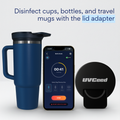
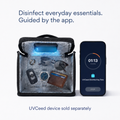
254 nm UV-C light inactivates bacteria on surfaces it directly reaches. For a water bottle, that means the interior walls and any accessible lid or straw components once the bottle is open and empty. UVCeed's app-guided session structure aims the device at one section, the bottle interior, the lid, the straw, and holds until the app confirms that zone's dose is complete before moving to the next, which matters because UV-C is line-of-sight: it can't disinfect what it can't directly reach, so covering a bottle's separate parts deliberately, rather than assuming the whole unit is covered in one pass, is what actually gets the job done.
This isn't a replacement for washing. It's a supplement for the parts of a daily-carry bottle, the lid threads, the mouthpiece, the areas a sponge doesn't fully reach, that a normal wash cycle tends to leave behind.
FAQ
Is my water bottle actually dirtier than a toilet seat? By bacterial colony count, the study data says yes, dramatically so. Toilet seats are cleaned regularly and stay dry; water bottles are wet, sealed, and touched by mouths, which is a much better environment for bacterial growth, according to the WaterFilterGuru findings.
Does the dishwasher fully clean a water bottle? It helps significantly, especially with a heated dry cycle, but narrow necks, straw interiors, and gasket seals can still trap residue that the spray arm doesn't fully reach, which is why manual attention to those parts still matters.
How often should kids' water bottles actually be washed? Daily, at minimum, with a full wash rather than a quick rinse, and lid components should get the same attention as the bottle body since research consistently shows lids and straws carry the highest bacterial counts.
Can UV-C damage a water bottle? No. 254 nm UV-C is a light-based disinfection method with no chemical residue and no abrasive contact, so it won't degrade bottle materials the way some harsh cleaning chemicals can over repeated use.
What about the water itself, can UV-C disinfect that? UVCeed is designed for surface disinfection of the bottle and its components, not water treatment. Combine a clean, dry bottle with a good water source rather than relying on the device to treat what's inside.
Want More Articles Like This?
Get research on UV-C treatment and product updates delivered to your inbox.