Leave Germs Behind. Not Your Gear.
Compact UV-C that kills Measured UV-C dose on cookware, utensils, drinkware and shared camp gear - no chemicals, no consumables, barely any weight.

Clean-looking camp gear is not the same as clean
You filter your water and pack out your trash. But the surfaces you cook on, eat from and share with the group are a different problem - and the usual fixes come with trade-offs.
Wipes add weight and trash
Chemical wipe packs are heavy for what they do, and every used wipe is waste you carry out. At camp, that adds up fast.
Shared cookware passes more than food
Group camping means the same pot, ladle and tongs get handed around between every trip. Nobody knows the last time any of it was properly disinfected.
No running water at camp
A quick rinse at the trailhead is nothing like a proper clean. Food-contact surfaces at camp - cutting boards, bowls, utensil handles - stay contaminated longer than most people realize.
Damp gear in a closed pack
Gear that goes back into a bag wet - drinkware, pouches, straps - sits in warm, moist conditions that let bacteria multiply between trips.
Pick your camp setup
Start with the core device, or go all-in with the kit that covers cookware, gear and drinkware.

UVCeed Disinfection Device
Clips to your phone and disinfects cookware, utensils, drinkware and gear surfaces in seconds - shows live coverage on screen so nothing gets missed.

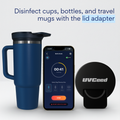
UVCeed Travel Mug Adapter
Fits over your Stanley, Yeti or travel mug and uses the UVCeed device to disinfect the interior - handles the drinkware that goes everywhere at camp.

The Basecamp Kit
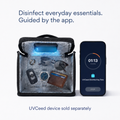
The device plus the smart lid in one kit - covers surfaces, gear and drinkware so your whole camp setup is handled.
Disinfect any camp surface in three steps
No chemicals, no heat, no waiting. If your phone is charged, UVCeed is ready.
Clip it on
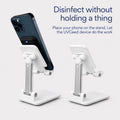
Snap UVCeed onto your phone. No setup, no pairing - it is charged and ready when you are.
Aim and disinfect
Point the device at the cookware, utensil or gear surface and hold within the specified range until the app reports the target dose has been reached. Repeat for as many items as you need in one session - your phone screen maps the coverage live so you know exactly what has been treated.
Done
UV-C treatment reaches only the surfaces the light touches. Nothing to rinse, nothing to wipe off, nothing to pack out.
One device, every camp chore
Cookware, utensils, drinkware, gear surfaces - aim and hold on each area until the app reports the target dose has been reached.


UV-C at camp: what it does, and what it doesn't
The outdoor gear world is full of products that promise more than they deliver. UV-C disinfection is not new technology - hospitals have used it for decades - but portable UV-C for camping is recent enough that a lot of claims in the market are getting ahead of the evidence. This guide gives you a straight account of what UV-C actually does for campers, what it does not do, and how to fit it honestly into a camp hygiene routine.
What UV-C light is and how it works
UV-C is short-wavelength ultraviolet light, in the 200-280 nanometer range. At those wavelengths, the light disrupts the DNA and RNA of bacteria, preventing them from reproducing or functioning. The mechanism is physical, not chemical - no reaction, no residue, nothing to rinse. This is why UV-C has been used in hospital air handling systems and water treatment facilities for decades: it kills pathogens without adding anything to the environment.
UVCeed puts UV-C into a device that clips directly onto your smartphone. You point it at a surface, hold within the specified range until the app reports the target dose has been reached, and your phone screen shows a live coverage map of every area you have treated. You can work through multiple surfaces in a single session. On directly exposed surfaces it kills Measured UV-C dose.
The one rule you need to know: line of sight
UV-C works on surfaces the light can reach. If the light cannot reach it, the UV-C cannot treat it. On flat camp surfaces - the inside of a cook pot, the face of a cutting board, a spork laid flat - this is straightforward. Aim the device at the surface and hold until the coverage map confirms it is done. For complex shapes, rotate the item so each face gets exposed. That is the entire technique. It is the same trade-off you accept with any surface disinfection method: you have to cover the surface.
The line-of-sight rule is also why UVCeed is not a water purifier. UV-C water purification requires a controlled dose delivered into the water column over time, in equipment designed for that purpose. UVCeed projects UV-C light at surfaces. It is a surface disinfection tool, not a water treatment device. For drinking water in the backcountry, use a purpose-built filter, a SteriPen or chemical treatment - the methods that have been tested and rated for that specific use. Do not use UVCeed for drinking water treatment. This is not a limitation that will change with firmware or technique; it is a physical distinction between the two applications.
What you can actually use it on at camp
Within its scope - surface disinfection - UVCeed is genuinely useful at camp:
- Cookware: the interior and rim of pots, pans and bowls before and after cooking.
- Utensils: sporks, spoons, tongs, ladles - especially in group camping where they get handled by multiple people.
- Drinkware: the rim and interior of mugs and tumblers; pair with the Travel Mug Adapter for insulated bottles.
- Shared gear surfaces: cutting boards, camp table surfaces, multi-tools, knife handles.
- High-touch gear: headlamp controls, trekking pole grips, tent zipper pulls - anything that gets handled constantly and rarely gets washed.
How it compares to chemical wipes on the trail
Chemical wipes work. The trade-offs are weight, pack-out waste and residue. A canister of wipes or a resealable bag adds grams that add up over miles. Used wipes are waste you carry out. And anything the wipe touches that will contact food should be rinsed - which at a dry camp means using water you may not want to spend.
UVCeed rechargeable via USB-C, with no consumables. No used wipes, no chemical residue, no replacement parts. Charge it from your power bank or solar panel and it is ready. For a multi-day trip, the trade-off math tends to favor UV-C: the device is light, nothing accumulates in your trash bag, and there is nothing to rinse off food-contact surfaces.
A realistic camp routine
Here is a practical sequence that works for most camp setups:
- Before cooking: a quick pass over the cutting board, pot interior and utensils before the first use of the day.
- After group meals: while cookware is still laid out and before it gets packed away, aim UVCeed at each piece and hold until the app reports the target dose has been reached. Takes less than a minute for a full set.
- Drinkware between uses: if you are refilling a shared mug or the same tumbler all day, a pass between uses is faster than a rinse.
- Before packing out: treat gear surfaces - handles, knives, multi-tools - before they go back in the pack. Reduces what you carry out with you.
This is not a replacement for washing gear when you have access to water and biodegradable soap. It is the layer that handles what a rinse misses and what a wipe would require you to carry and pack out. For most campers who take hygiene seriously, that is exactly the gap it fills.
*Based on UV-C efficacy against tested bacteria on directly exposed surfaces. See product details for testing information.
What campers ask us
Can UVCeed purify my drinking water?
What can I actually use it on at camp?
How is it powered on the trail?
Does cold weather affect it?
How does it compare to packing chemical wipes?
Is it durable enough for backcountry use?
Pack lighter. Camp cleaner.
No chemicals to pack, no wipes to carry out, no consumables to restock. 254 nm UV-C that lives in your kit and charges from the same power bank as your phone.