Your Knife Is Clean. Your Cutting Board Isn't.
UV-C light kills the bacteria your dish soap leaves behind - on prep surfaces, cutting boards, utensils and the tools that touch your food. No chemical residue where it matters most.

Your kitchen looks clean. Your prep surfaces don't tell the whole story.
Home cooks obsess over ingredients, technique and temperature. But the surfaces where the food actually gets prepared are often the missing link in a truly clean kitchen.
Cutting boards trap bacteria in every groove
Every knife stroke cuts micro-channels into the surface. Dish soap cleans what it can reach - but bacteria settle deep into those grooves and survive a normal wash.
Your sponge is the dirtiest thing in the kitchen
Studies consistently rank the kitchen sponge as the most contaminated object in the home. Warm, wet and protein-fed - it's the ideal bacteria breeding environment, wiping those germs onto every surface you "clean."
Chemical sprays near food prep mean residue
Bleach and disinfectant sprays are effective - but using them on cutting boards, counters and utensils means the next thing you prep gets a dose of whatever you sprayed. Food-safe alternatives are often much weaker.
Cross-contact happens on shared boards and counters
Raw chicken on the board, then vegetables. Or a nut-based sauce, then a dish for someone with allergies. Cross-contamination on prep surfaces is one of the leading causes of foodborne illness at home.
Pick your clean kitchen setup
Start with the device that handles every prep surface, or get the full kit and cover your drinkware too.

UVCeed Disinfection Device
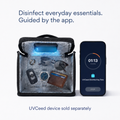
Clip it to your phone and scan cutting boards, knife handles, utensils, sponges and countertops. The live coverage map shows exactly what the UV-C light has reached.

UVCeed Travel Mug Adapter
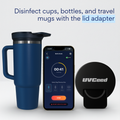
Fits Stanley, Yeti and most travel mugs. Keep the inside of your daily tumbler as clean as the outside.

The Clean Kitchen Kit
The device plus the Smart Lid in one bundle - everything you need to tackle prep surfaces and your daily drinkware. The complete kitchen upgrade.
Three steps between prep and peace of mind
No sprays. No waiting. No residue. If you can hold a phone, you can use UVCeed.
Clip it on
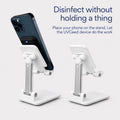
Snap the UVCeed device onto your phone. It's charged and ready in seconds - no app setup required to get started.
Aim and disinfect
Point the device at the cutting board, utensil, sponge or counter and hold within the specified range until the app reports the target dose has been reached. Your phone screen maps the UV-C coverage live so you can see every spot that has been treated. Treat as many surfaces as you need in one session.
Done - no rinsing required
UV-C treatment reaches only directly exposed surfaces. No residue to rinse, no chemicals to neutralize. Pick up your knife and get back to cooking.
The dirtiest surfaces in your kitchen (and how to actually clean them)
Ask most home cooks what the dirtiest spot in their kitchen is and they'll point at the trash can or the inside of the oven. The real answer is almost always the kitchen sponge - and right behind it are the cutting board, the sink basin, knife handles and the dish cloth hanging on the oven door. These are the surfaces that touch food directly, and they are the ones most likely to harbor the bacteria that cause foodborne illness.
The kitchen sponge
A study published in Scientific Reports found that a used kitchen sponge can harbor billions of bacteria per cubic centimeter - more than most surfaces a person encounters in daily life. The problem is structural: the open-cell foam traps food particles and moisture, creating a warm, nutrient-rich environment where bacteria multiply rapidly. Microwaving a sponge kills some bacteria but leaves others behind, and the heat can push surviving bacteria deeper into the foam. UV-C light treats the surface of the sponge - aim the UVCeed device at each side and hold until the app reports the target dose has been reached, treating all sides to reach as much of the surface area as possible. For maximum results, combine surface UV-C treatment with regular sponge replacement - every one to two weeks for heavy use.
The cutting board
Wooden and plastic cutting boards both accumulate bacteria in the micro-cuts left by knives. Dish soap does a reasonable job of surface cleaning but does not penetrate grooves. A study from UC Davis found that bacteria that soak into knife cuts in a wooden board are actually difficult to recover - the wood appears to pull them away from the surface - but new research has complicated that picture for heavily used boards with deep cuts. Plastic boards have shallower cuts initially but can develop deep grooves over time that are harder to sanitize. UV-C light works on what it can reach directly. Aim the device at the full board surface, then rotate the board and repeat. For deep grooves, boiling water or a dishwasher at a sanitizing cycle is the more reliable complement - UV-C and heat together cover more ground than either alone.
The sink basin and faucet handles
The sink is where raw proteins get rinsed, cutting boards get washed and dirty hands get cleaned. It is consistently among the highest-bacteria-count surfaces in the kitchen. Faucet handles are touched with contaminated hands before they are touched with clean ones - every time. Aiming UV-C at the faucet handle and the basin edge after prep work adds a layer of protection that a spray-and-wipe approach might miss.
Knife handles and utensil surfaces
Blade edges aside, the handle of a chef's knife and the handles of your spatulas, tongs and ladles see a lot of contact during a cooking session. UV-C is particularly well suited here - these are smooth, hard surfaces where the light can reach directly and thoroughly. A few seconds per tool is all it takes.
Dish cloths
Like sponges, dish cloths are warm and wet for hours at a time. UV-C treats the surface fibers - aim the device at a flat-laid cloth and hold on each area, then flip and repeat on the other side. This complements regular washing, not replaces it: laundering at a hot cycle remains the most thorough option for cloth items, but UV-C between washes can reduce the bacterial load significantly.
Where UV-C fits in your kitchen routine
It is worth being direct about what UV-C does and does not do. UVCeed is a surface and tool disinfection device - it is not intended for use on food itself, and it does not replace washing produce, cooking food to safe internal temperatures, or basic sanitation practices. What it does is add a fast, chemical-free step to your prep routine that handles the surfaces your food is prepared on. Keep washing your produce. Keep cooking chicken to 165 degrees. Keep replacing your sponge. Add UV-C as the layer that covers the boards, utensils and surfaces in between - with no residue and no rinsing required.
*Based on UV-C efficacy against tested bacteria on directly exposed surfaces. See product details for testing information.
Everything home cooks ask us
Can I use UV-C on food or produce itself?
Does it really disinfect a cutting board's grooves?
Can I use it on my sponge and dish cloth?
Does it leave any residue on food-contact surfaces?
Is it faster than sanitizing with boiling water?
Do I need to buy refills or replacement parts?
Cook like your surfaces are spotless.
No sprays. No residue. No guessing. A few seconds of UV-C between cuts is the step your prep routine has been missing.