By UVCeed Health & Wellness | April 2026
China's National Disease Control and Prevention Administration issued a public warning this week that cases of influenza, rhinovirus, and parainfluenza have been climbing steadily across the country since early April. The timing could not be worse. The May Day holiday - one of the largest mass travel events in the world - begins in days, with Shanghai's railway system alone expecting nearly 5 million passenger trips over the holiday period.
Health officials urged citizens to stay vigilant, practice hand hygiene, and monitor children closely for symptoms. Children under five are being hit hardest by parainfluenza infections, according to the Chinese CDC.
If this feels familiar, it should. The last time China warned about a respiratory illness spike right before a major travel holiday was in late 2019, just weeks before the Lunar New Year. Five million people left Wuhan before travel restrictions were imposed. The rest is a history that killed over 7 million people worldwide.
No one is suggesting this is a repeat of 2020. Chinese officials have stressed there is no evidence of a novel pathogen. But the underlying problem that made 2020 possible has not changed: respiratory viruses spread explosively when millions of people crowd into airports, train stations, hotels, and restaurants - touching the same surfaces, breathing the same air, and carrying pathogens from one city to the next.
And that problem is not limited to China. It is the reality of every travel season, everywhere in the world.
The Surface Problem That Most Travelers Ignore
When people think about catching the flu while traveling, they picture someone coughing on a plane. That is part of the story, but it is not the biggest part.
Respiratory viruses like influenza, rhinovirus, and parainfluenza spread through two primary routes: airborne droplets and contaminated surfaces. The surface route - what scientists call fomite transmission - is the one most travelers underestimate and do almost nothing to protect themselves against.
Here is why it matters. Influenza viruses can survive on hard surfaces for up to 48 hours. Rhinovirus can persist for days. Every surface you touch in a high-traffic travel environment - the check-in kiosk, the armrest, the tray table, the hotel remote, the bathroom door handle, the elevator button, the restaurant table - is a surface that hundreds or thousands of other people touched before you. And a single touch transfers enough viral particles to cause infection if you subsequently touch your face, your food, or your water bottle.
The average person touches their face 16 to 23 times per hour. During travel, when you are eating in unfamiliar places, sleeping in unfamiliar beds, and handling unfamiliar objects all day, the opportunities for surface-to-face transmission multiply dramatically.
Handwashing helps. But you cannot wash your hands every 30 seconds, and you cannot control what your children touch. The missing piece for most travelers is not hand hygiene - it is surface disinfection.
Why Hotel Rooms and Airplane Cabins Are Not as Clean as You Think
There is a persistent assumption that the places we pay to stay in and travel through are being professionally cleaned and disinfected. The reality is less reassuring.
Multiple studies have found that hotel room surfaces - particularly TV remotes, light switches, phone handsets, faucet handles, and countertops - routinely test positive for influenza, norovirus, and a range of bacteria including MRSA and E. coli. Housekeeping staff typically use the same cloth to wipe multiple surfaces, which often redistributes contamination rather than eliminating it.
Airplane tray tables are among the most contaminated surfaces in regular public use. A widely cited study found that tray tables harbored more colony-forming bacteria per square inch than the airplane lavatory flush button. Airlines typically do deep cleans once per day at most - meaning the tray table in front of you may have been used by four or five previous passengers since its last cleaning.
Rental cars, rideshare vehicles, public transit, airport security bins, and restaurant tables all present similar exposure profiles. They are high-touch, high-turnover surfaces that are cleaned on schedules designed for efficiency, not for pathogen elimination.
This is the environment you are walking into every time you travel. And it is the environment that turns a regional flu spike in one country into a global health event.
The Problem with Chemical Wipes on the Go
The most common traveler response to surface contamination is a canister of disinfecting wipes. It seems like a sensible precaution. But there are three problems with this approach that most people are not aware of.
Problem one: contact time. According to EPA guidelines, chemical disinfecting wipes must keep the surface visibly wet for the full contact time listed on their label - typically 4 to 10 minutes - to achieve the claimed kill rate. A quick wipe-and-dry does not work. How many travelers wipe down a tray table and then wait 10 minutes before using it? Effectively none.
Problem two: coverage. Wipes treat flat, accessible surfaces reasonably well. But they cannot reach inside a water bottle, cannot effectively clean textured surfaces like phone cases or fabric, and leave crevices and edges untreated. The places germs hide best are the places wipes reach worst.
Problem three: practicality. Wipes are bulky, they dry out, they create waste, and they leave chemical residue on surfaces you eat off of and objects you put near your face. For parents traveling with children, wiping down every surface a toddler might touch is a full-time job that still leaves gaps.
There is a reason hospitals do not rely on wipes alone. They use UV-C light.
UV-C Light: The Travel Disinfection Solution That Actually Works
UV-C germicidal irradiation has been the gold standard for pathogen elimination in hospitals, laboratories, and water treatment facilities for decades. It works by physically destroying the DNA and RNA of bacteria and viruses - a mechanism so fundamental that no pathogen has developed resistance to it in over 100 years of use.
UV-C is effective against influenza, rhinovirus, parainfluenza, coronavirus, norovirus, MRSA, E. coli, and virtually every other pathogen you might encounter on a contaminated surface. It does not require contact time. It does not leave chemical residue. It does not create antibiotic resistance. It works in seconds, not minutes.
The problem has always been accessibility. Hospital UV-C systems are large, expensive, and designed for institutional use. They are not something you can carry in your pocket.
Until now.
UVCeed: Hospital-Grade Disinfection That Travels With You
UVCeed is a pocket-sized, medical-grade UV-C disinfection device that uses the same 265nm wavelength trusted by healthcare facilities to eliminate up to 99.99% of harmful bacteria and viruses - in just 30 seconds, on any surface.
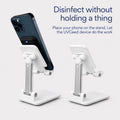
It clips directly to your iPhone via MagSafe. You point it at any surface. The patented AI-powered app guides you through the disinfection process in real time - showing you exactly what is being treated, ensuring the right distance and angle, and confirming when the surface reaches verified disinfection levels.
No chemicals. No residue. No waiting. No guessing.
For travelers, UVCeed changes the game:
Airplane tray tables and armrests. A 30-second pass before you settle in. No wipes to dig out, no chemical smell, no wet surface to wait on. Done before the flight attendant finishes the safety briefing.
Hotel room high-touch surfaces. Remote controls, light switches, phone handsets, faucet handles, doorknobs, and nightstands - disinfected in minutes after you check in. Peace of mind for the entire stay.
Restaurant tables and utensils. A quick, discreet pass over the table surface and utensils before your meal. Especially valuable when traveling internationally where sanitation standards vary.
Rental cars and rideshares. Steering wheel, gear shift, door handles, seat belt buckle, and touchscreen - the surfaces the last driver touched are the surfaces you are about to hold for hours.
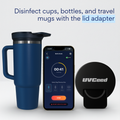
Water bottles and drinkware. The Universal Fit Lid Adapter positions UVCeed directly over any bottle opening from 0.5 to 4.5 inches - Stanley, Yeti, Hydro Flask, hotel glassware, baby bottles, travel mugs. Interior disinfection without chemicals entering your drinking water.
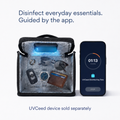
Kids' items. Pacifiers, toys, sippy cups, and anything else your child picks up off an airport floor or hotel carpet. The Disinfecting Tote creates an enclosed UV-C chamber for small items - drop them in, zip it closed, and they are disinfected before your child asks for them back.
UVCeed is TSA-compliant, weighs under 2 ounces, recharges via USB-C, and delivers approximately 60-80 disinfection cycles per charge. It fits in a jacket pocket, a purse, or a carry-on side pouch. It is the only portable UV-C device that provides real-time visual verification of disinfection through your smartphone.
Built by Surgeons. Trusted by Hospitals. Now Available to Families.
UVCeed was developed by Bonutti Technologies - a medical device incubator founded by orthopedic surgeon Dr. Peter M. Bonutti, with over 400 patents and 30+ years of innovation. It is backed by 8+ U.S. patents, currently deployed in healthcare facilities including Sarah Bush Lincoln Hospital, and was named one of Fast Company's Next Big Things in Tech.
The device uses built-in machine vision safety technology to detect the presence of humans and pets, automatically disabling UV-C output to prevent accidental exposure. It only operates through the smartphone app, which provides continuous safety monitoring throughout every disinfection session.
This is not a consumer gadget designed to look like medical technology. It is medical technology designed for consumer use.
The Complete Protection Kit for Travelers
The UVCeed Complete Protection Kit includes everything you need for comprehensive travel disinfection:
- UVCeed Device - portable, hospital-grade 265nm UV-C disinfection that clips to your iPhone via MagSafe
- Universal Fit Lid Adapter - disinfects the inside of any water bottle, cup, glass, or travel mug
- Disinfecting Tote - enclosed UV-C chamber for phones, keys, wallets, earbuds, pacifiers, and personal items
Everything fits in a single carry-on pouch. One device covers every surface and object you and your family will encounter on any trip.
Shop UVCeed at uvceed.com - Use code UV15OFF for 15% off + free shipping.
The Bottom Line
You do not need a novel pandemic to get sick while traveling. Ordinary influenza, rhinovirus, and parainfluenza - the exact viruses surging in China right now - spread through the same contaminated surfaces you encounter in every airport, hotel room, and restaurant in the world. The seasonal pattern is predictable. The transmission mechanism is understood. The surfaces are the same ones you will touch hundreds of times on your next trip.
The difference between getting sick and staying healthy often comes down to one thing: whether you took the 30 seconds to disinfect the surfaces before you touched them.
Chemical wipes cannot do the job in the time you actually have. Handwashing alone cannot cover the gap between every surface touch and every face touch. UV-C light can - and UVCeed puts hospital-grade UV-C disinfection in your pocket for the first time.
Travel season is here. The viruses are already circulating. Protect yourself before you go.
Get UVCeed - 15% Off + Free Shipping | Code: UV15OFF
UVCeed is manufactured by UVCeed, LLC. UV-C disinfection is intended for use on surfaces and objects. It is not a medical treatment. Results based on independent laboratory testing: 99.9% reduction of Staphylococcus aureus in 15 seconds, 99.99% reduction of E. coli in 24 seconds, and 99.9% reduction of SARS-CoV-2 in 32 seconds on hard non-porous surfaces at 12.7 cm. See uvceed.com for full testing details and disclaimers.
Want More Articles Like This?
Get research on UV-C treatment and product updates delivered to your inbox.