By UVCeed Health & Wellness | April 2026
Every time you wipe down a kitchen counter, clean a high chair tray, or swipe a disinfecting wipe across your desk at work, you probably assume the surface is clean when it dries. It looks clean. It smells clean. You move on.
But what if the cleaning product itself left something behind - an invisible chemical film coating every surface you just "cleaned," including the ones where you prepare food, where your baby eats, and where your family puts their hands dozens of times a day?
That is exactly what happens with the most common class of disinfectant chemicals in America: quaternary ammonium compounds, known in the industry as "quats."
And the fact that entire industries exist solely to test for, detect, and verify the removal of these residuals should tell you everything you need to know about the scope of the problem.
What Are Quaternary Ammonium Compounds?
Quats are the active disinfecting ingredient in the vast majority of consumer and commercial cleaning products on the market today. If you have used Lysol wipes, Clorox disinfecting wipes, most spray-bottle surface cleaners, or any commercial sanitizer in a restaurant, gym, daycare, or office building, you have used a quat-based product.
They work by disrupting the cell membranes of bacteria and some viruses on contact. They are cheap to manufacture, shelf-stable, and effective against a reasonable range of common pathogens when used correctly.
What most consumers do not know is that quats are cationic surfactants - positively charged molecules that are specifically designed to bind to surfaces. That binding action is part of how they work. The molecules grab onto the surface and stay there, creating prolonged antimicrobial contact.
The problem is that they do not just stay there temporarily. They leave behind a persistent chemical residue - a thin, invisible film - that remains on the surface long after it appears dry and "clean." This film accumulates with repeated applications, meaning the more often you wipe a surface with quat-based products, the thicker the residual layer becomes.
The Residual Problem Is So Serious That Entire Industries Exist to Test for It
If quat residuals were harmless, no one would bother testing for them. But the reality is that an entire ecosystem of testing products, precision instruments, and regulatory compliance frameworks has developed specifically because these residuals are a recognized health and safety concern.
Companies like Bartovation, Hydrion (Micro Essential Laboratory), LaMotte, Hach, and Industrial Test Systems manufacture specialized low-level detection strips and titration kits calibrated to detect quat residuals at concentrations as low as 10 parts per million. These are not the same strips used to check if a bucket of sanitizer is strong enough - they are a separate category of product designed specifically to answer the question: "Is there still chemical residue left on this surface after cleaning?"
In food service, the FDA Food Code (Section 7-204.11) sets specific requirements around sanitizer residuals on food-contact surfaces. In healthcare, quat residuals on medical equipment are a documented concern. In pharmaceutical manufacturing, companies like Ecolab and Metrohm provide ion chromatography systems capable of detecting quat residuals at parts-per-billion levels.
The testing infrastructure ranges from $10 strip rolls for restaurant managers to six-figure laboratory instruments for cleanroom validation. The spectrum of that investment tells you how seriously regulated industries take this problem.
And yet, at the consumer level, almost no one knows it exists. There are no low-level residual test strips in the cleaning aisle at Target. No one hands you a detection kit when you buy a canister of wipes. You are simply expected to trust that the product is safe - even though the industries that use the same chemicals in higher volumes do not trust that at all, which is why they test obsessively.
What Quat Residuals Mean for Your Family
The concern with quat residuals is not theoretical. The chemicals accumulate on surfaces your family touches constantly - kitchen counters, dining tables, cutting boards, high chair trays, bathroom fixtures, door handles, and personal items like phones and keyboards.
Every time your child puts their hands on a surface you wiped down with a disinfecting wipe and then puts their fingers in their mouth, they are ingesting trace amounts of quaternary ammonium compounds. Every time you prepare food on a counter you cleaned with a spray cleaner, there is a chemical film between the food and the surface. Every time you wipe down a water bottle with a disinfecting wipe, residual chemicals are present the next time you drink from it.
Research published in recent years has raised concerns about the health effects of chronic low-level quat exposure. Studies have linked quaternary ammonium compounds to respiratory irritation, skin sensitization, endocrine disruption, and potential reproductive toxicity. A 2025 study widely covered in health media found that antibacterial products containing certain chemical compounds - including quats - may actually be contributing to the development of antibiotic-resistant bacteria, accelerating the superbug crisis rather than protecting against it.
The "quat binding" phenomenon makes this worse than it sounds. When you apply a quat-based product with a cloth or wipe, the positively charged molecules bind preferentially to certain materials. Cotton cloths absorb the active disinfecting ions, sometimes leaving the surface with less antimicrobial activity but more non-active chemical residue - the worst of both worlds. The surface is neither fully disinfected nor free of chemical contamination.
Hard water compounds the problem further. Calcium and magnesium ions in hard water interfere with quat efficacy, reducing antimicrobial performance while doing nothing to reduce residual accumulation. In areas with hard water - which covers the majority of the United States - you may be getting less disinfection and more chemical residue with every application.
The Contact Time Problem Makes It Even Worse
Even setting aside the residual issue, most people are not using chemical disinfecting wipes correctly in the first place.
Per EPA guidelines, the surface must remain visibly wet with the disinfectant solution for the full contact time listed on the product label - typically 4 to 10 minutes - to achieve the stated pathogen kill rate. A quick wipe that dries in 30 seconds does not disinfect. It just deposits chemicals.
Think about how most people actually use disinfecting wipes. They pull one from the canister, wipe the surface quickly, and the surface dries within a minute. That application has not achieved the EPA-registered kill rate. The bacteria and viruses on the surface are largely still alive. But the chemical residue from the wipe is now coating the surface.
In practice, this means the typical consumer use of disinfecting wipes delivers the chemical exposure without delivering the disinfection. You get the residue without the benefit.
There Is a Disinfection Method That Leaves Zero Residue
UV-C germicidal irradiation kills pathogens by physically destroying their DNA and RNA with ultraviolet light at specific wavelengths. It is a purely physical process. No chemicals are applied. No molecules bind to the surface. No film accumulates. No residue is left behind. When the light turns off, the disinfection is complete, and the surface is exactly as it was before - minus the pathogens.
This is not new science. Hospitals, laboratories, water treatment plants, and pharmaceutical manufacturers have used UV-C disinfection for decades, in many cases specifically because they needed to eliminate pathogens without introducing chemical residuals into sensitive environments.
In operating rooms, chemical residue on surgical instruments is an unacceptable contamination risk. In pharmaceutical cleanrooms, even parts-per-billion levels of quat residuals can compromise a production batch. In food processing, chemical films on food-contact surfaces create regulatory liability.
These industries solved the residual problem years ago by adopting UV-C. The consumer market is just now catching up.
UVCeed: Hospital-Grade Disinfection With Zero Chemical Residue
UVCeed is a portable, medical-grade UV-C disinfection device that uses the 265nm wavelength trusted by healthcare facilities to eliminate up to 99.99% of bacteria and viruses in 30 seconds. No chemicals. No residue. No contribution to antibiotic resistance. No invisible film accumulating on the surfaces your family touches every day.
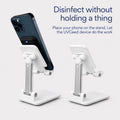
It clips to your iPhone via MagSafe and uses a patented AI-powered app to guide you through the disinfection process in real time - confirming proper distance, angle, and coverage, and verifying when the surface reaches 99.99% disinfection levels.
Where the zero-residue difference matters most:
Kitchen and food prep surfaces. Your cutting board, countertop, and dining table are surfaces that food directly contacts. UVCeed disinfects them without depositing a chemical film between your food and the surface. No rinse step required. No waiting for a wet surface to dry. No wondering what your family is eating off of.
Baby and children's items. High chair trays, pacifiers, teething toys, sippy cups, bottles, and changing surfaces - everything your child puts in their mouth. UV-C disinfection means zero chemical residue on the objects your infant and toddler are ingesting from constantly.
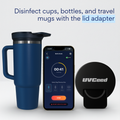
Water bottles and drinkware. The Universal Fit Lid Adapter positions UVCeed over any bottle opening from 0.5 to 4.5 inches - Stanley, Yeti, Hydro Flask, baby bottles, travel mugs, wine glasses, hotel glassware. Interior disinfection with zero chemicals entering your drinking water. Compare that to wiping the rim of a water bottle with a quat-based wipe and then drinking from it.
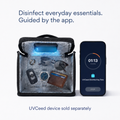
Personal items. Your phone, keys, wallet, earbuds, sunglasses, and makeup brushes. The Disinfecting Tote creates an enclosed UV-C chamber for small personal items - chemical-free disinfection for the things that touch your face and hands all day.
Gym equipment and shared surfaces. Gym wipe stations use quat-based solutions. Every handle, bench, and mat you use has been coated in chemical residue by the previous user. UVCeed lets you disinfect without adding to the residual layer.
Travel surfaces. Hotel remotes, airplane tray tables, rental car steering wheels, restaurant tables. Surfaces where chemical wipes leave a film that your hands, food, and personal items then contact for hours. UV-C leaves nothing behind.
The Numbers
Independent laboratory testing confirms UVCeed's performance on hard non-porous surfaces at 12.7 cm:
- 99.9% reduction of Staphylococcus aureus in 15 seconds
- 99.99% reduction of E. coli in 24 seconds
- 99.9% reduction of SARS-CoV-2 in 32 seconds
No 4-to-10-minute contact time. No chemical film. No accumulating residue. No contribution to antibiotic resistance.
The Complete Protection Kit
The UVCeed Complete Protection Kit includes everything you need for chemical-free surface disinfection across every area of your life:
- UVCeed Device - portable, hospital-grade 265nm UV-C disinfection that clips to your iPhone via MagSafe
- Universal Fit Lid Adapter - disinfects the inside of any water bottle, cup, glass, or travel container
- Disinfecting Tote - enclosed UV-C chamber for phones, keys, wallets, earbuds, pacifiers, and personal items
Developed by Bonutti Technologies - a medical device incubator founded by orthopedic surgeon Dr. Peter M. Bonutti, with over 400 patents and 30+ years of medical innovation. Backed by 8+ U.S. patents. Currently deployed in healthcare facilities including Sarah Bush Lincoln Hospital. Named one of Fast Company's Next Big Things in Tech.
Built-in machine vision safety technology detects humans and pets, automatically disabling UV-C output to prevent accidental exposure. The device only operates through the smartphone app, providing continuous safety monitoring.
Shop UVCeed at uvceed.com - Use code UV15OFF for 15% off + free shipping.
The Bottom Line
You would not eat off a plate coated in an invisible chemical film. You would not let your baby chew on a toy dipped in a surfactant solution. You would not drink water from a bottle lined with quaternary ammonium residue.
But if you are using disinfecting wipes, spray cleaners, or commercial sanitizers on the surfaces where you do those things, that is effectively what is happening - one application at a time, building up a residual layer that entire industries spend millions of dollars testing for and trying to eliminate.
The regulated world already knows this is a problem. Hospitals know it. Food manufacturers know it. Pharmaceutical companies know it. That is why they use UV-C.
Now you can use it too.
Get UVCeed - 15% Off + Free Shipping | Code: UV15OFF
UVCeed is manufactured by UVCeed, LLC. UVCeed is not a replacement for hand hygiene or food safety practices. Results based on independent laboratory testing at 12.7 cm. See uvceed.com for full testing details and disclaimers.
Want More Articles Like This?
Get research on UV-C treatment and product updates delivered to your inbox.