By Justin Beyers & Dr. Peter Bonutti, MD | March 2026 | 10 min read
There's a stat that stopped me cold when I first read it, and I haven't been able to shake it since.
Researchers testing human blood samples for quaternary ammonium compounds - the active chemicals in most disinfecting wipes and sprays - found them in 80% of the samples tested.
Not trace amounts in factory workers. Not detectable levels in hospital cleaning staff. Eighty percent of ordinary people walking around with disinfectant chemicals measurable in their blood.
I'm going to walk you through what we know, what we don't know, and what options you actually have. No panic required - but some awareness is overdue.
What Are Quaternary Ammonium Compounds?
You probably know them by their shelf names: Clorox Disinfecting Wipes, Lysol, and dozens of other products you've been reaching for since at least 2020. The active ingredients doing the germ-killing work in most of these products are a class of chemicals called quaternary ammonium compounds, or "quats" for short.
Quats are effective antimicrobials. That's not in dispute. They've been the backbone of surface disinfection in hospitals, schools, restaurants, and homes for decades.
What is increasingly in dispute is whether the tradeoff is worth it - especially now that we're using them far more frequently than the chemical profiles were originally designed for.
A narrative review published in Cureus in 2025 by Dr. Mitchell Ng, Dr. Michael Mont, and Dr. Peter Bonutti - titled "Clinical and Environmental Harms of Quaternary Ammonium Disinfectants and the Promise of Ultraviolet-C (UV-C) Alternatives" - compiled the growing body of evidence. The picture that emerges is more complicated than most of us realized.
[Full paper available at PubMed Central: PMC12160957]
What the Research Is Showing
Let me be clear about something before we go further: I'm not a toxicologist, and this article isn't medical advice. But Dr. Bonutti, who co-authored the review above, has spent 30+ years in surgical practice where infection control isn't theoretical - it's life and death. When he started asking hard questions about the chemicals we're all using at home, I paid attention.
Here's a summary of what the peer-reviewed literature is surfacing:
They're getting into our bodies. Quats were designed for surfaces, not for systemic human exposure. But a 2022 study published in the Journal of Exposure Science & Environmental Epidemiology found that quats were detectable in human breast milk, with higher levels in mothers who used disinfecting products more frequently. The blood sample data tells a similar story: these compounds aren't staying on the counter.
They may affect immune function. The Ng, Mont, and Bonutti review identified studies showing that QAC exposure is associated with decreased production of immunoglobulins IgM and IgG - antibodies your immune system needs to fight infections. The irony is hard to ignore: a product designed to protect you from germs may be quietly weakening your body's ability to fight them on its own.
There are reproductive concerns. Animal studies have shown decreased sperm concentration and higher rates of birth defects in subjects exposed to quats through ambient environmental contact - not even direct ingestion. The researchers involved have described quats as potential endocrine-disrupting chemicals, meaning they could interfere with hormonal function at very low doses.
Children are more vulnerable. Kids breathe more air per pound of body weight than adults. They put their hands and mouths on every surface they encounter. And their developing systems - neurological, endocrine, immune - are more susceptible to chemical disruption. The EPA classifies quats as pesticides. The labels on most disinfecting wipes literally say "Keep out of reach of children." But in practice, children touch quat-treated surfaces constantly - desks at school, highchair trays at home, toys at daycare.
Resistance is building. Just as overuse of antibiotics has created antibiotic-resistant superbugs, the overuse of quat-based disinfectants is contributing to antimicrobial resistance. The Ng, Mont, and Bonutti review documents well-established resistance patterns among both bacterial and viral species exposed to QAC disinfectants.
The Part That Frustrates Me Most
Here's the thing that really gets under my skin as an engineer who's spent years studying disinfection: most people aren't even getting the germ-killing benefit they think they're getting.
This isn't speculation. Our team published a peer-reviewed in vitro study in Cureus - "In Vitro Evaluation of the UVCeed Mobile Disinfection Device" by Ng, Mont, and Bonutti - that included a direct comparison with Lysol® wipes under controlled lab conditions.
[Full paper available at PubMed Central: PMC11972100]
The results were striking. Lysol wipes required surfaces to remain visibly wet for up to four minutes to achieve effective pathogen kill. That's the EPA-registered requirement printed on the label in small type. A single wipe dries in roughly 60 seconds. So to actually disinfect a surface, you'd need to continuously re-apply with 4 to 6 wipes, keeping it wet the entire time.
How often does that happen in your kitchen? At your kid's school? At the restaurant where you just sat down?
Almost never. Which means most people are getting the chemical exposure without the disinfection benefit. You're absorbing the quats but not killing the germs.
So What's the Alternative?
I co-founded a company that makes a UV-C disinfection device, so I'll be transparent about my perspective here. But I want to lay out the reasoning and let you evaluate it.
Ultraviolet-C light at germicidal wavelengths (around 254–265 nm) has been used in hospitals, water treatment plants, and laboratories for decades. It works by physically damaging the DNA and RNA of microorganisms, preventing them from reproducing. Unlike chemical disinfectants, it's a physical process - no residue, no chemicals left behind, and pathogens can't develop resistance to it because the mechanism is structural, not chemical.
The challenge has always been making UV-C safe and practical for everyday use. Traditional UV-C systems were room-sized machines or unguided wands where you had no idea if the surface actually received an adequate dose.
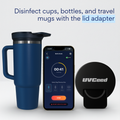
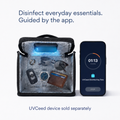
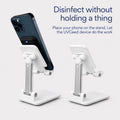
That's the problem UVCeed was built to solve. It's a portable, smartphone-mounted UV-C LED device that uses your phone's camera and an AI-guided app to show you exactly what you're treating in real time. The app tracks coverage, controls dosage based on distance and surface type, and confirms when disinfection is complete. Built-in machine vision detects humans and pets and automatically shuts off the UV-C output to prevent accidental exposure.
In the lab study I mentioned above, UVCeed disinfected a 6"×6" surface in approximately 15 seconds - compared to 4 minutes of wet contact time for chemical wipes to achieve comparable pathogen reduction. That's roughly a 16x speed advantage, with zero chemical residue.
The device achieved log reductions exceeding 6.0 for Staphylococcus aureus, E. coli, and Klebsiella pneumoniae, and over 4 log-unit reductions for SARS-CoV-2 - all under controlled laboratory conditions at specified distances.
What I'd Tell a Friend
If someone I cared about asked me what to do with all this information, here's what I'd say:
You don't need to throw out your wipes tomorrow. But you should understand what's in them, and you should know that the "kills 99.9% of germs" claim on the front only holds true if you follow the dwell time instructions on the back - which almost nobody does.
If you have young children, pay extra attention. The developing body is more sensitive to chemical disruption, and kids interact with treated surfaces differently than adults. Anything that lets you disinfect a pacifier, a highchair tray, or a classroom desk without leaving chemical residue is worth considering.
Read your labels. Look for the words "quaternary ammonium" in the active ingredients. Look at the required contact time. Look at the warnings about food-contact surfaces and rinsing. Most people have never read the back of their Clorox wipes. You should.
Consider adding a chemical-free option to your routine. UV-C isn't a replacement for cleaning - you still need to wipe visible dirt off surfaces. But as the disinfection step that follows cleaning, it offers a way to kill pathogens without introducing new chemicals into your home, your body, or the environment.
The science on QAC exposure is still evolving. We may find that the levels detected in human blood are ultimately harmless. But we may also find the opposite - and the research trend lines are not reassuring.
In the meantime, you have a choice about how much chemical exposure you're willing to accept for a benefit that, in most cases, you're not actually receiving.
This article references peer-reviewed research published in Cureus, available open-access through PubMed Central. For specific medical concerns about chemical exposure, consult your healthcare provider.
Cited studies:
- Ng MK, Mont MA, Bonutti PM. "Clinical and Environmental Harms of Quaternary Ammonium Disinfectants and the Promise of Ultraviolet-C (UV-C) Alternatives: A Narrative Review." Cureus. 2025. PMC12160957.
- Ng MK, Mont MA, Bonutti PM. "In Vitro Evaluation of the UVCeed Mobile Disinfection Device: A Rapid, Portable Approach for Surface Sterilization." Cureus. 2025. PMC11972100.
Justin Beyers is a co-founder and engineer at UVCeed. Dr. Peter Bonutti, MD, is a co-founder of UVCeed, a practicing orthopedic surgeon, and the founder of Bonutti Research, with over 500 patents and 30+ years in surgical innovation and infection control.
Want More Articles Like This?
Get research on UV-C treatment and product updates delivered to your inbox.