A landmark study published in The Lancet reveals that obesity dramatically increases the risk of hospitalization and death from nearly all types of infection. For over 100 million Americans living with a BMI over 30, the findings raise an urgent question: what can you actually control?
A major new study is reshaping how the medical community thinks about infection risk - and the findings have implications for nearly half of all American adults.
Researchers at University College London and the University of Helsinki analyzed medical data from nearly 550,000 adults across Finland and the United Kingdom over a 14-year period. Their conclusion, published in The Lancet in February 2026, was striking: people with obesity are 70% more likely to be hospitalized with or die from an infection compared to those with a healthy BMI.
The risks escalate sharply with weight. Individuals with class 3 obesity (a BMI of 40 or higher) were found to be three times more likely to experience hospitalization, death, or both from infectious disease. And the study didn't just look at one or two illnesses - it examined 925 different bacterial, viral, parasitic, and fungal infections, including influenza, COVID-19, pneumonia, gastroenteritis, urinary tract infections, and lower respiratory tract infections.
Nearly all categories of infection showed worse outcomes for patients with obesity.
Based on their risk models, the researchers estimated that obesity contributes to approximately 11% of all infection-related deaths globally - a figure that has been rising over time as obesity rates climb worldwide.
It's Not About Getting Sick More Often - It's About Getting Sicker
One of the most important distinctions in the study is that obesity doesn't necessarily make people more likely to catch an infection. Rather, it makes recovery significantly harder and outcomes significantly worse.
As lead author Professor Mika Kivimaki of UCL's Faculty of Brain Sciences explained in the study's press release, the research found robust evidence that becoming severely ill from an infection is markedly more common among people living with obesity. He noted that while people may not get infected more easily, recovery from infection is clearly harder.
This matters because it shifts the conversation. If your body is going to fight infections less effectively once you're exposed, then reducing your exposure to pathogens in the first place becomes even more critical.
And here's the reality most people don't think about: pathogen exposure doesn't just happen when someone coughs near you. It happens every time you touch a contaminated surface and then touch your face, your food, or your phone. It happens at restaurant tables, gym equipment, office keyboards, airplane tray tables, hotel rooms, and your children's daycare supplies.
The Numbers That Put This in Perspective
The scale of this issue is enormous. Consider:
- 42% of American adults have a BMI classified as obese (30+), according to the CDC
- 9.2% of American adults fall into the class 3 obesity category (BMI 40+), the highest-risk group in the study
- That's over 140 million Americans in the obese category and over 30 million in the most vulnerable group
- The study found that these populations face 70% to 200% higher risk of severe outcomes from infections that most people recover from without complications
- Obesity's contribution to infection-related deaths has been rising over time - from 9% in 2018 to 15% during the pandemic peak in 2021
Meanwhile, the infections that are most dangerous don't take a season off. Influenza, norovirus, COVID-19, respiratory syncytial virus (RSV), and bacterial infections like Staph and E. coli circulate year-round in homes, workplaces, and public spaces. The 2025–2026 flu season alone has produced over 20 million illnesses and 270,000 hospitalizations in the United States, with norovirus outbreaks surging simultaneously.
For higher-risk populations, every contaminated surface represents a potential encounter with a pathogen that their body may struggle to fight off.
What You Can Control
The Lancet study's authors emphasized the importance of vaccination, weight management, and access to healthy food and physical activity as long-term strategies for reducing risk. Those are all essential recommendations.
But infections don't wait for long-term strategies to take effect. They're on the table in front of you at lunch. They're on the gym equipment you just grabbed. They're on your child's high chair at the restaurant. They're on the hotel remote you touched before bed.
This is where surface disinfection becomes a frontline defense - especially for people whose immune response to infection may already be compromised.
The problem is that most conventional disinfection methods fall short in practice:
- Chemical wipes require 4 minutes of sustained wet contact to kill pathogens like norovirus. Almost nobody waits that long, which means the surface you wiped isn't actually disinfected.
- Hand sanitizer doesn't help with the surfaces you're about to touch - only with what's already on your hands.
- Standard cleaning (soap and water, general spray-and-wipe) removes visible dirt but doesn't reliably eliminate microscopic pathogens.
For years, the only technology that provided reliable, chemical-free, rapid pathogen elimination was UV-C light - the same technology hospitals use to sterilize surgical instruments and operating rooms. But it was confined to large, expensive, industrial equipment.
That's exactly the problem UVCeed was designed to solve.
How UVCeed Puts Hospital-Grade Protection in Your Hands
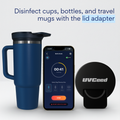
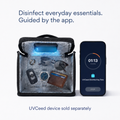
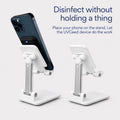
UVCeed is a compact, rechargeable UV-C LED disinfection device that was designed by Dr. Peter Bonutti, a practicing orthopedic surgeon who spent his career focused on infection control. The device connects to your smartphone and uses a medical-grade 265nm UV-C LED - the exact wavelength proven to destroy bacterial and viral DNA - to eliminate 99.99% of pathogens on any surface in 30 seconds.
What makes UVCeed fundamentally different from other UV products:
- AI-powered dosage control calculates the precise UV-C energy needed for each surface, ensuring complete pathogen elimination - not a partial dose that leaves survivors behind
- Augmented reality visualization shows treated vs. untreated areas on your phone screen in real time, turning green when disinfection is confirmed complete
- Machine vision safety automatically detects humans and pets and pauses the UV-C light instantly - a patented feature no other consumer device offers
- Peer-reviewed validation - independent studies published on PubMed Central confirm UVCeed's effectiveness against Staphylococcus aureus, E. coli, Klebsiella pneumoniae, and SARS-CoV-2
The device is EPA-registered, CE-certified, mercury-free, and used in professional healthcare settings including Sarah Bush Lincoln Hospital.
Who Benefits Most
While UVCeed is designed for anyone who wants genuine surface disinfection, the Lancet study's findings make the case especially clear for certain groups:
People managing their weight who want to reduce infection risk while working toward long-term health goals. The study found that even people who lost weight and reduced their BMI saw their severe infection risk decrease by approximately 20% - but until those goals are reached, reducing pathogen exposure provides immediate, actionable protection.
People with metabolic conditions such as diabetes, heart disease, or metabolic syndrome, where the study found infection outcomes were even more compromised.
Caregivers and family members of higher-risk individuals who want to disinfect shared surfaces at home - kitchen counters, bathroom fixtures, remote controls, doorknobs - without relying on chemical wipes that leave residue.
Frequent gym-goers who are actively working on fitness and weight management but are simultaneously touching some of the most germ-laden surfaces in public life. A 2019 study found that free weights in gyms harbor 362 times more bacteria than a toilet seat.
Travelers whose hotel rooms, rental cars, airplane tray tables, and restaurant tables are cleaned by strangers using methods they can't verify.
The Bottom Line
The Lancet study adds powerful new evidence to what infectious disease specialists have been saying for years: not everyone faces the same risk from the same infection. Obesity, age, chronic conditions, and immune status all affect how your body responds when it encounters a pathogen.
You can't always control when you're exposed to a virus or bacteria. But you can control whether the surfaces you touch - the table where you eat, the equipment you work out on, the high chair your child sits in - are genuinely disinfected.
That's what UVCeed provides: 30 seconds of hospital-grade, chemical-free, visually verified disinfection, designed by a surgeon, validated by independent labs, and available wherever your phone goes.
For the 140+ million Americans whose bodies may fight infections less effectively, it's not about fear. It's about taking a practical, science-backed step to reduce unnecessary exposure - and putting the power of protection in your own hands.
Ready to take control of your environment?
Free shipping. 30-day money-back guarantee. Also available on Amazon.
References
- Kivimaki, M. et al. (2026). Obesity and risk of severe infectious diseases. The Lancet. February 2026.
- Centers for Disease Control and Prevention. Obesity prevalence among adults, United States. National Center for Health Statistics.
- CDC FluView Surveillance Report, Week 4, 2025–2026 Season.
- Bonutti, P. et al. In Vitro Evaluation of the UVCeed Mobile Disinfection Device. PubMed Central, 2024.
- Bonutti, P. et al. UVCeed: Leveraging Augmented Reality, Artificial Intelligence, and Gamification for Enhanced Ultraviolet C Disinfection. PubMed Central, 2024.
UVCeed is a disinfection device and is not a medical device. It does not treat, cure, or prevent disease in humans. Effectiveness is based on independent lab testing under controlled conditions; actual results may vary. This article is for informational purposes and does not constitute medical advice. Consult your healthcare provider regarding infection risk and prevention strategies appropriate for your individual health profile.
Want More Articles Like This?
Get research on UV-C treatment and product updates delivered to your inbox.