On Tuesday, February 25, students at Creekview Middle School in the Eagle Mountain-Saginaw school district near Fort Worth started getting sick. By Wednesday, dozens more had fallen ill with vomiting and nausea. The school's custodial team disinfected the building that night, and doors opened again the next morning.
It wasn't enough. New cases kept climbing through Thursday. By Thursday afternoon, school officials - on the advice of the Tarrant County Public Health Department - made the call to close the entire campus on Friday for a full-scale deep cleaning. More than 100 students were affected.
The culprit? Norovirus - the highly contagious stomach bug that causes violent vomiting and diarrhea, and one that most common cleaning products, including alcohol-based hand sanitizers, cannot kill.
Why Norovirus Is a Bigger Threat Than Most Parents Realize
The Creekview outbreak isn't an isolated incident. According to CDC data, there were 644 norovirus outbreaks reported between August 2025 and early February 2026 by states participating in the agency's NoroSTAT surveillance program. The CDC reports roughly 2,500 norovirus outbreaks in the United States every year, with peak season running November through April - right now.
Schools are among the most common outbreak settings. The CDC has noted that norovirus outbreaks on school and university campuses have forced campus closures across the country. Close quarters, shared surfaces, and young children who may not wash their hands thoroughly create the perfect conditions for the virus to spread.
What makes norovirus especially alarming is how little it takes to make someone sick. A person only needs to ingest as few as 100 viral particles to become infected - and a single gram of stool from an infected person can contain billions of them. The virus can survive on countertops, doorknobs, keyboards, and other surfaces for up to two weeks. It's also resistant to freezing and heating, making it incredibly persistent in the environments where our children spend their days.
The Hard Truth: Hand Sanitizer Won't Protect Your Family From Norovirus
Here's the fact that surprises most parents: alcohol-based hand sanitizers are not effective against norovirus. The virus has a firm outer protein shell that alcohol simply cannot break down. Infectious disease experts have been clear on this point - norovirus must be physically washed off hands with soap and water.
And it's not just sanitizer that falls short. Traditional chemical disinfecting wipes require surfaces to remain visibly wet for four to ten minutes of contact time (per EPA guidelines) to actually achieve disinfection. In a busy household, a school cafeteria, or a hotel room, almost nobody waits that long. We wipe and move on - and the virus survives.
The Creekview outbreak is a case study in this exact problem. School crews disinfected the building Wednesday night using standard methods. The next day, cases continued to climb. Standard cleaning simply could not keep pace with how quickly norovirus spreads through a shared environment.
UV-C Light: The Hospital-Grade Technology That Destroys Norovirus at the DNA Level
While chemical cleaners try to dissolve or inactivate pathogens through extended contact, UV-C light takes a fundamentally different approach. Ultraviolet-C light in the germicidal wavelength range (200–280 nm) destroys the DNA and RNA bonds of viruses and bacteria, preventing them from replicating. It's a physical process - not a chemical one - which means pathogens cannot build resistance to it the way they can to chemical disinfectants.
This isn't new or experimental technology. Hospitals have relied on UV-C disinfection since the 1920s to control infections in surgical suites and patient rooms. Peer-reviewed research published in the journal Pathogens confirms that UV-C disinfection of surfaces has several critical norovirus-related applications, from food preparation areas to bathrooms and high-touch surfaces. And a study published in Applied and Environmental Microbiology demonstrated that UV-C light at 254 nm achieved significant log reductions of murine norovirus (a widely accepted surrogate for human norovirus) on surfaces.
The science is clear: UV-C light can do what wipes and sanitizers cannot—neutralize norovirus on contact, in seconds, without leaving any chemical residue behind.
UVCeed: Hospital-Grade Disinfection That Goes Wherever Your Family Goes
Until recently, UV-C disinfection was confined to hospitals and industrial facilities - large, expensive systems designed for professional use. UVCeed changes that. It's the first personal, AI-powered mobile UV-C disinfection device that puts hospital-grade protection directly in your hands.
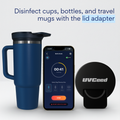
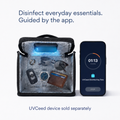
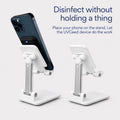
Here's how it works: UVCeed is a compact, rechargeable device that attaches to your smartphone. When you open the free app (available for iPhone and Android), point your phone at any surface, and press start, UVCeed's medical-grade 265nm UV-C LED begins destroying pathogens on contact. The app uses your phone's camera to provide real-time visual guidance - showing you exactly which areas have been treated and confirming when disinfection is complete.
In independent laboratory testing, UVCeed eliminated up to 99.99% of bacteria and viruses, including SARS-CoV-2, on hard non-porous surfaces in as little as 30 seconds. No other consumer UV-C device gives you that kind of verified, visual confirmation.
What Makes UVCeed Different From Other UV Sanitizers
If you've seen UV sanitizer boxes or UV wands on the market, you might wonder what sets UVCeed apart. The differences are substantial:
Most UV sanitizer boxes only work with small items that fit inside the box - a phone, a set of keys. You can't use them on a restaurant table, a school desk, a hotel remote, or a shopping cart handle. UVCeed works on any surface, anywhere, because it's designed to be used in the open. It's pocket-sized (about the thickness of a pencil and the weight of a slice of bread), rechargeable via USB-C, and goes wherever your phone goes.
More importantly, most UV devices leave you guessing. You turn them on, wait, and hope it worked. UVCeed is the only disinfection device on the market that uses patented AI and machine vision to show you the areas you've treated in real time. Its smart dosage control ensures each surface receives the precise amount of UV-C energy needed for effective disinfection - no more guessing, no more hoping.
Safety is built in, too. UVCeed's machine vision automatically detects humans and pets and pauses the UV-C output instantly if anyone enters the treatment area.
Real-World Protection for the Situations That Matter Most
When you hear about an outbreak like the one at Creekview Middle School, the worry doesn't stop at the school doors. Your child touches a desk, a bathroom faucet, a cafeteria tray - and then comes home. Norovirus can travel from school to your kitchen counter, your couch, your baby's toys, all in an afternoon.
UVCeed gives families a practical way to break that chain of transmission. Parents across the country are using it to disinfect:
- Lunchboxes and water bottles before and after school
- Restaurant tables and highchairs when dining out
- Hotel rooms, rental cars, and airplane tray tables while traveling
- Gym equipment and shared office spaces
- Baby gear like pacifiers, bottles, and toys - all without a single chemical, wipe, or spray
Designed by Bonutti Technologies - a medical device incubator with over 30 years of innovation and more than 400 patents - UVCeed was created by Dr. Peter Bonutti, a practicing surgeon who understands the critical importance of infection control. The device has earned multiple industry awards, including a Fast Company 2023 Next Big Things in Tech Award and a Mom's Choice Award.
The Real Cost of Not Disinfecting
Norovirus isn't just miserable. It's expensive. A single illness episode can cost families between $500 and $2,000 in doctor visits, urgent care, and prescriptions. When a child gets sick, a parent typically misses work - sometimes multiple days. And when the virus spreads through a household (which it often does), the disruption multiplies.
Missed school days, missed workdays, missed family events that can't be rescheduled - the ripple effects of a single norovirus infection extend far beyond the 48 to 72 hours of active symptoms. UVCeed pays for itself by helping prevent even one or two illness episodes per year. That's not just peace of mind. It's a practical financial decision.
Take the Next Step After Cleaning
Cleaning removes dirt. But removing dirt is not the same as eliminating the pathogens that make your family sick. UVCeed is the missing step - the 30-second addition to your routine that delivers verified, chemical-free, hospital-grade disinfection on every surface you and your family touch.
Norovirus season is here. Outbreaks are closing schools. And hand sanitizer can't save you from this one.
Protect your family with UVCeed - the smart UV-C disinfection device trusted by physicians, parents, and healthcare facilities.
Shop UVCeed Now at UVCeed.com →
Free Shipping • 30-Day Money-Back Guarantee • Multiple U.S. Patents
Sources & References
- NBC DFW, "Norovirus outbreak closes North Texas middle school," February 27, 2026
- CDC, "Norovirus Outbreaks," updated February 12, 2026
- CDC, "NoroSTAT Data," updated February 18, 2026
- TODAY.com / NBC, "Norovirus Cases Driven by Ultra-Contagious Variant Are Surging," December 2025
- MDPI Pathogens, "Illuminating Human Norovirus: A Perspective on Disinfection of Water and Surfaces Using UVC," 2022
- Applied and Environmental Microbiology (PMC), "Inactivation and UV Disinfection of Murine Norovirus," 2008
- Spectral Platforms / PMC, "In Vitro Evaluation of the UVCeed Mobile Disinfection Device," 2024
Want More Articles Like This?
Get research on UV-C treatment and product updates delivered to your inbox.