Introduction: The Object You Touch 2,600 Times a Day
You wash your hands after using the bathroom. You wouldn't eat off a public toilet seat. You'd be disgusted if someone sneezed directly onto your face.
And yet, several times every hour, you press an object against your cheek that carries more bacteria than all three of those scenarios combined.
Your smartphone.
The average person touches their phone 2,617 times per day, according to research firm Dscout. We carry it into bathrooms, set it on restaurant tables, hand it to children, swipe it while eating, and press it against our faces to make calls. It goes everywhere we go - and accumulates everything we encounter.
The science on phone contamination isn't new, but most people haven't internalized just how significant the numbers are. This article breaks down exactly what's living on your phone, why it resists traditional cleaning, and what actually works.
The Numbers: How Contaminated Is Your Phone?
10 Times Dirtier Than a Toilet Seat
The statistic that launched a thousand headlines - and it's not hyperbole. A study conducted at the University of Arizona found that the average smartphone carries approximately 10 times more bacteria per square inch than a toilet seat. Multiple subsequent studies have confirmed this ratio, with some finding even higher counts.
Why the disparity? Toilet seats are cleaned regularly with harsh disinfectants. They're made of smooth, non-porous porcelain that doesn't trap organic material. And critically, people expect them to be dirty, so they act accordingly.
Phones receive none of that attention. Most people have never intentionally disinfected their phone. Not once.
What's Actually on There
Researchers at the London School of Hygiene & Tropical Medicine swabbed 390 phones and hands in a UK study and found fecal bacteria on 16% of phones sampled. Other studies have identified:
- Staphylococcus aureus - including methicillin-resistant strains (MRSA), found on up to 30% of phones sampled in healthcare settings
- Streptococcus species - common causes of throat infections, skin infections, and pneumonia
- E. coli - indicator of fecal contamination, associated with gastrointestinal illness
- Pseudomonas aeruginosa - an opportunistic pathogen particularly dangerous for immunocompromised individuals
- Influenza and rhinovirus - both remain viable on glass surfaces for hours
- Norovirus - can persist on smooth surfaces for days and requires an extremely low infectious dose (as few as 18 viral particles)
A 2020 study published in Travel Medicine and Infectious Disease found viable bacteria on 99.2% of phones sampled - effectively every single device tested.
The Warm, Oily Ecosystem
Your phone isn't just a passive carrier. It's an environment optimized for microbial survival:
- Body heat. You hold your phone constantly, maintaining surface temperatures between 25-35°C - the ideal range for bacterial growth.
- Skin oils and moisture. Every touch deposits sebum, sweat, and dead skin cells - all of which serve as nutrients for bacteria.
- Protected crevices. Speaker grilles, charging ports, case edges, and camera bumps create sheltered micro-environments where colonies thrive undisturbed.
- Infrequent cleaning. Most phones are never deliberately disinfected, allowing microbial communities to establish and mature.
Your phone is, in microbiological terms, a petri dish you carry in your pocket.
Why This Matters: The Transmission Pathway
Contamination alone isn't a health risk. The risk emerges through transmission - and your phone is uniquely positioned to facilitate it.
The Hand-Phone-Face Triangle
Consider the transmission chain:
- You touch a contaminated surface (door handle, gas pump, shopping cart, subway pole).
- You pick up your phone.
- Pathogens transfer from hand to phone.
- You wash your hands (good practice).
- You pick up your phone again.
- Pathogens transfer from phone back to your freshly washed hands.
- You touch your face, eat food, or press the phone against your cheek.
Handwashing - our primary defense against surface-transmitted illness - is effectively neutralized when the phone recontaminates clean hands immediately after. Every hand wash is undone by the next phone pickup.
This isn't theoretical. A 2015 study in the Journal of Applied Microbiology demonstrated that bacterial transfer between hands and phones is bidirectional and efficient, with transfer rates between 20-30% per contact event.
Phones and Children
Parents frequently hand phones to children for entertainment - in restaurants, waiting rooms, cars, and at home. Young children, whose immune systems are still developing and who instinctively put objects near their mouths, face disproportionate risk from a contaminated phone.
A phone that's been through your workday - touching desks, bathroom doors, elevator buttons, and handrails - is now being held by a toddler who will touch their eyes, nose, and mouth within minutes.
Phones and Food
The habit of scrolling while eating is nearly universal. Your phone sits next to your plate - or worse, you hold it in one hand and your fork in the other. Every touch transfers organisms from screen to fingers to food. Studies on food-handling contamination have identified phones as a significant vector in both home and commercial kitchen environments.
Why Wiping Your Phone Doesn't Work
"I clean my phone with a microfiber cloth." This is the most common response when people learn about phone contamination. It's also inadequate.
Dry Wiping Spreads, Doesn't Remove
A dry microfiber cloth physically displaces some bacteria and removes surface oils, but it doesn't kill anything. It redistributes organisms across the screen surface and embeds them deeper into textured areas (case edges, speaker grilles, button crevices).
Alcohol Wipes: Better, But Limited
Isopropyl alcohol-based wipes do kill many bacteria and viruses on contact. Apple officially endorses 70% isopropyl alcohol wipes for iPhone cleaning. However:
- Alcohol evaporates rapidly. On a smooth glass surface, alcohol reaches effective concentration for only seconds - well below the contact time many pathogens require.
- Crevices and ports are unreachable. Alcohol wipes contact flat surfaces only. Speaker grilles, charging ports, and case edges - where biofilms accumulate - remain untouched.
- Phone cases complicate everything. Textured silicone and leather cases absorb liquids, trap bacteria in their porous surfaces, and resist the brief chemical contact that wipes provide.
- No verification. After wiping, you have no indication of whether the disinfection was sufficient. The phone looks the same either way.
The Frequency Problem
Even if alcohol wipes were fully effective, they'd need to be applied multiple times daily to keep pace with recontamination. You touch your phone 2,600+ times per day. A single wipe at night leaves 16+ hours of accumulation unaddressed.
Most people don't even wipe once a week.
How UV-C Light Solves What Chemistry Can't
Ultraviolet-C light at wavelengths between 200-280 nanometers destroys microorganisms by damaging their DNA and RNA directly. This mechanism is fundamentally different from chemical disinfection - and avoids its key limitations.
Dose-Dependent, Not Contact-Time Dependent
Chemical disinfectants need to remain wet on a surface for a specific duration. UV-C works at the speed of light - once a surface accumulates sufficient radiant energy (measured in mJ/cm²), the disinfection is instantaneous and irreversible. No evaporation. No timing.
Light Reaches Where Liquids Don't
UV-C photons travel in straight lines and reach into grooves, speaker grilles, textured surfaces, and crevices that no wipe can access. Every surface in the light path receives a dose - not just the raised contact points.
No Residue, No Damage
UV-C leaves nothing behind. No moisture that can seep into ports. No chemical films that degrade oleophobic coatings over time. No alcohol odor. The phone is exactly as it was before - minus the microbial contamination.
Broad-Spectrum Efficacy
UV-C is effective against bacteria, viruses (including enveloped and non-enveloped), fungi, and spores. It doesn't discriminate by species or resistance profile - the mechanism targets nucleic acids universal to all microorganisms.
The Problem with Most UV Phone Sanitizers
The consumer market has responded to phone hygiene awareness with a flood of UV sanitizer products - boxes, cases, charging pads, and wands all claiming to disinfect your phone. Most of them share a critical flaw.
No Dose Verification
UV-C disinfection is entirely dose-dependent. Too little energy, and pathogens survive. But almost no consumer UV product tells you the dose being delivered. They run a timer - 3 minutes, 10 minutes - and assume the dose was adequate.
This assumption ignores:
- Bulb degradation. UV-C LEDs and mercury lamps lose output over time. A device that delivered an adequate dose when new may be functionally useless after months of use.
- Distance and angle variation. UV-C intensity drops with the square of distance. A phone sitting slightly off-center in a UV box receives dramatically different doses across its surface.
- Surface geometry. A phone in a thick case, or one with a camera bump elevating it from the UV source, creates shadowed areas receiving insufficient dose.
Without measurement, "sanitized" is a hope, not a fact.
UV Boxes: A Closed System with Open Questions
UV phone sanitizer boxes are popular but problematic. You place your phone inside, close the lid, and wait. But:
- You can't verify coverage during the process
- The box sanitizes only the phone - not the case exterior, not the accessories you also touch
- One fixed geometry means consistent shadow patterns on every use
- There's no feedback if the UV source has degraded below effective output
UVCeed: The Difference Between Clean and Verified Clean
UVCeed was designed by a doctor who understood that UV-C disinfection without dose verification is UV-C theater. The device addresses every limitation of existing consumer products.
Real-Time Dose Feedback
UVCeed's companion app displays the UV-C dose reaching the target surface as you use it. Not a timer. Not an estimate. A measurement of actual radiant energy delivered to the exact area you're treating.
When the dose reaches the threshold for effective disinfection, you know - because the data tells you.
Visual Coverage Mapping
The app shows you precisely which areas have been disinfected and which haven't. Missed spots are visible. Shadow areas are flagged. The guesswork that undermines every other UV product is eliminated entirely.
MagSafe Portability
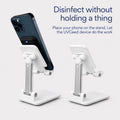
UVCeed mounts directly to your phone via MagSafe - no separate device to carry, charge, or remember. It's always where your phone is, which means it's always available when you need it.
This matters because the biggest barrier to phone hygiene isn't knowledge - it's convenience. A UV box at home only helps at home. UVCeed travels with you.
Beyond Your Phone
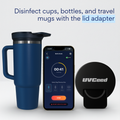
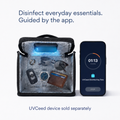
While your phone may be the primary target, UVCeed works on any surface. Keys, wallet, earbuds, glasses, desk surfaces, restaurant tables - anything you touch regularly benefits from verified UV-C disinfection.
Building a Phone Hygiene Routine
Knowing the science is step one. Implementing a practical routine is what actually reduces your risk.
Daily Essentials
- Morning: Disinfect your phone before your day begins. Eight hours of warmth in your bedroom has allowed overnight bacterial growth.
- After commuting: Public transit, ride-shares, gas stations - your phone has been exposed. A quick pass with UVCeed resets the contamination clock.
- Before meals: Make phone disinfection as automatic as handwashing. If you're about to eat, verify your phone is clean.
- Before handing to children: Every time. Non-negotiable.
Weekly Deep Clean
- Remove your phone case and disinfect both the phone and the case interior separately
- Pay extra attention to speaker grilles, charging ports, and button crevices
- Use the UVCeed app's coverage map to ensure complete treatment
Travel Protocol
When traveling, increase your frequency. Airports, hotels, taxis, and restaurants expose your phone to unfamiliar microbial environments. Disinfect after each major touchpoint - check-in, transit, dining.
The Bigger Picture: Why We Ignore What We Can't See
Humans are visual creatures. We assess cleanliness by appearance - a gleaming surface feels clean, a smudged one feels dirty. This heuristic works for macro-level grime but fails completely at the microbial scale.
Your phone looks clean. It isn't.
This isn't about fear. It's about closing the gap between perception and reality. We wash our hands not because they look dirty, but because we know - from a century of public health science - that invisible contamination causes real illness.
Your phone deserves the same rational approach. Not anxiety. Not obsession. Just a science-backed routine that takes the guesswork out of something you touch thousands of times a day.
Conclusion: See What Clean Actually Looks Like
The data is clear: your phone is one of the most contaminated objects in your daily life, and traditional cleaning methods don't adequately address it. UV-C light offers a proven, chemical-free solution - but only when the dose is verified and the coverage is confirmed.
UVCeed is the only device that transforms UV-C disinfection from a timer-based guess into a measured, visual, verified process. Created by a physician. Backed by science. Designed for the way you actually live.
Your phone goes everywhere with you. Now, so does the proof that it's clean.
Want More Articles Like This?
Get research on UV-C treatment and product updates delivered to your inbox.