A groundbreaking study published in Cell is forcing scientists to rethink the fundamental definition of what a virus is. The discovery that certain viruses carry genes for energy metabolism - a trait once reserved exclusively for living organisms - adds to a growing body of evidence that viruses are far more complex, resilient, and adaptable than textbooks have taught for a century. Here's why that matters for anyone who cares about keeping their environment clean.
For most of modern biology, the definition of a virus has been simple: a tiny packet of genetic material that cannot reproduce, generate energy, or do anything at all on its own. Viruses were considered molecular parasites - inert particles drifting through the environment until they stumble into a living cell, hijack its machinery, and force it to make copies of the virus instead.
Under this framework, viruses weren't alive. They were, as Nobel laureate Sir Peter Medawar once described them, nothing more than bad news wrapped in protein.
That framework is collapsing.
A new study published in February 2026 in Cell - one of the world's most prestigious scientific journals - adds striking new evidence that so-called "giant viruses" possess metabolic capabilities previously thought to belong exclusively to living cells. The research, reported on by New Scientist under the headline "Giant viruses may be more alive than we thought," is the latest in a series of discoveries that are redrawing the boundary between the living and the non-living.
And the implications reach far beyond the laboratory. If viruses are more complex and more resilient than we've assumed, then the tools most people rely on to eliminate them from everyday surfaces may be even more inadequate than we already knew.
What Are Giant Viruses - and Why Should You Care?
Giant viruses are a relatively recent scientific discovery. The first one, Mimivirus, was identified in 2003 after having been misclassified as a bacterium for over a decade - because it was simply too large and too complex for scientists to believe it was a virus.
Since then, researchers have uncovered a stunning variety of these oversized pathogens. They've been found in oceans, lakes, soil, permafrost, sewage treatment plants, and even on the Greenland ice sheet. Some have genomes larger than those of certain bacteria. Some encode over 1,000 genes, compared to the handful carried by typical viruses like influenza (which has just 8).
Most critically, scientists have discovered that many giant viruses carry genes for metabolic processes - the chemical reactions that living organisms use to convert food into energy. This includes genes for glycolysis (the breakdown of sugar), the TCA cycle (also known as the Krebs cycle, the central energy-producing pathway in all aerobic life), and even components of the electron transport chain that powers ATP production - the molecular currency of cellular energy.
A landmark 2020 study in Nature Communications analyzed 501 giant virus genomes assembled from environments around the globe and found widespread metabolic genes, including components of glycolysis and the TCA cycle. The researchers concluded that giant viruses can fundamentally reprogram the central carbon metabolism of the cells they infect.
Then, in 2022, researchers at Aix-Marseille University demonstrated that Pandoravirus massiliensis - a giant virus with a genome of 2.5 million base pairs - actually generates an electrochemical gradient across its membrane. An electrical membrane potential is one of the most basic hallmarks of living cells: it's the mechanism that allows cells to function as biological batteries to produce energy. Finding it in a virus particle was, as the research team described it, evidence that positions these viruses as a form of life.
The new 2026 Cell paper builds on these findings, adding further evidence that certain viruses possess energy-related molecular machinery that challenges the century-old assumption that viruses are metabolically inert.
Why This Changes How We Think About Viruses
The textbook definition of a virus - a passive particle with no metabolic activity - has had a direct influence on how the public thinks about pathogen control. If viruses are just fragile packets of genetic code, a quick spray-and-wipe should do the trick, right?
The reality is far more sobering, and the emerging science on viral complexity makes it even more so.
Consider what we already know about the viruses that circulate through everyday life:
Influenza viruses can survive on hard surfaces for up to 48 hours, and on soft surfaces for up to 12 hours. They remain infectious the entire time.
Norovirus - the leading cause of foodborne illness outbreaks - can persist on surfaces for days to weeks. It takes as few as 18 viral particles to cause infection. For context, a single contaminated surface can harbor millions of them.
SARS-CoV-2 was found to remain viable on stainless steel and plastic for up to 72 hours during laboratory testing.
Staphylococcus aureus (including MRSA) can survive on dry surfaces for months.
These are not giant viruses. They're the ordinary, everyday pathogens that circulate in homes, offices, restaurants, gyms, airports, hotels, and hospitals. But the giant virus research underscores a critical point: viruses as a category are far more resilient, adaptable, and biologically sophisticated than most people assume. They are not fragile. They are not easy to destroy. And the methods most people use to try - a quick wipe with a chemical-soaked cloth - are demonstrably insufficient.
The Disinfection Gap Most People Don't Know About
Here's the uncomfortable truth about conventional surface disinfection:
Chemical disinfectant wipes - the kind found in every gym, restaurant, and office - require a sustained 4-minute wet contact time to effectively kill most pathogens, including norovirus. The surface must remain visibly wet with the disinfectant solution for the full duration. Almost nobody does this. A typical wipe-and-move-on takes about 5 seconds, which means the vast majority of "disinfected" surfaces aren't disinfected at all.
Quaternary ammonium compounds (QACs), the active ingredient in most commercial wipes, have come under increasing scrutiny. A 2023 study found that 80% of human blood samples tested contained detectable levels of QAC residue - a consequence of widespread, daily exposure to these chemicals through surface contact and airborne particles.
Standard cleaning (soap and water, general-purpose sprays) removes visible dirt and some bacteria but does not reliably eliminate viruses, particularly non-enveloped viruses like norovirus, which are notoriously resistant to many chemical disinfectants.
Hand sanitizer addresses what's on your hands at the moment of application. It does nothing about the contaminated table, tray table, gym bench, or phone screen you're about to touch next.
The gap between what people believe they've accomplished with a quick wipe and what's actually required for pathogen elimination is enormous. And it's a gap that becomes more concerning as science reveals just how sophisticated and persistent viruses really are.
UV-C: The Technology That Matches the Science
There is one disinfection technology that doesn't depend on contact time, doesn't leave chemical residue, and doesn't care whether a pathogen is a simple virus, a giant virus, a bacterium, or a fungal spore: ultraviolet-C (UV-C) light.
UV-C light at the 265nm wavelength - the peak absorption wavelength for DNA and RNA - destroys pathogens by directly damaging their genetic material, making them unable to replicate or infect. It's the same technology hospitals have used for decades to sterilize operating rooms, surgical instruments, and high-risk patient areas.
Unlike chemical disinfectants, UV-C's mechanism of action is physical, not chemical. It doesn't require the pathogen to absorb a solution. It doesn't need 4 minutes of wet contact. It doesn't leave residue. And it works against the full spectrum of surface pathogens - bacteria, viruses (both enveloped and non-enveloped), fungi, and spores.
The limitation, until recently, was that UV-C technology was confined to large, expensive, institutional equipment - the kind of thing you'd find in a hospital sterilization unit, not in a parent's diaper bag or a traveler's carry-on.
That's the problem UVCeed was built to solve.
UVCeed: Hospital-Grade Disinfection, Redesigned for Real Life
UVCeed was designed by Dr. Peter Bonutti, a practicing orthopedic surgeon with over 400 patents and a career-long focus on infection prevention. His insight was simple: if the same pathogens that threaten hospital patients exist on every restaurant table, hotel remote, gym bench, and airplane tray table, then the same caliber of disinfection technology should be available outside the hospital.
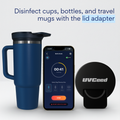
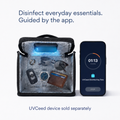
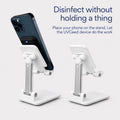
UVCeed is a compact, rechargeable UV-C LED device that attaches to your smartphone (via MagSafe or adhesive mount) and delivers 265nm UV-C light that eliminates 99.99% of bacteria and viruses on any surface in 30 seconds.
But what makes UVCeed fundamentally different from the wave of UV products that have flooded the market is the intelligence built into the system:
AI-powered dosage control - The device doesn't just emit UV-C light and hope for the best. Its onboard AI calculates the precise energy dose required for complete pathogen elimination on each surface, accounting for distance, angle, and coverage. Underdosing - the reason many consumer UV products fail independent testing - is eliminated by design.
Augmented reality visualization - UVCeed's companion app (iOS and Android) uses your phone's camera to show treated versus untreated areas in real time. Surfaces turn green on-screen when disinfection is confirmed complete. You don't have to guess or trust a timer. You can see it.
Machine vision safety - A patented feature no other consumer UV-C device offers. The system uses computer vision to detect the presence of humans and pets in the treatment area and automatically pauses the UV-C output instantly. This solves the primary safety concern that has limited consumer adoption of UV-C technology.
Peer-reviewed validation - UVCeed's effectiveness has been independently verified and published on PubMed Central, with studies confirming elimination of Staphylococcus aureus, E. coli, Klebsiella pneumoniae, and SARS-CoV-2 under controlled laboratory conditions.
The device is EPA-registered, CE-certified, mercury-free (using LED technology rather than mercury vapor lamps), and has been recognized as a Fast Company 2023 Next Big Things in Tech award winner and a Mom's Choice Award recipient. It's currently deployed in professional healthcare settings, including by staff at Sarah Bush Lincoln Hospital.
The Bigger Picture: Viruses Are Evolving. Our Tools Should Too.
The discovery that giant viruses possess metabolic capabilities, generate electrical potential across their membranes, carry genes for energy production, and blur the fundamental distinction between living and non-living entities is more than an academic curiosity. It's a signal.
It tells us that the viral world is far more complex than the simplified models we've relied on. That viruses have been evolving sophisticated biological machinery for billions of years. That they are not the fragile, simple particles the public has been led to imagine.
And it should prompt a simple question: if science is upgrading its understanding of what viruses are capable of, shouldn't we upgrade the tools we use to fight them?
A quick wipe with a chemical cloth was never adequate. The science just keeps making that clearer.
UV-C technology - the same approach trusted by hospitals worldwide - works at the level of physics, not chemistry. It targets the genetic material that all pathogens share, regardless of how complex, resilient, or "alive" they turn out to be. And with UVCeed, that level of protection fits in your pocket.
Curious about what hospital-grade disinfection looks like in real life?
Free shipping. 30-day money-back guarantee. Also available on Amazon.
References
- "Giant viruses may be more alive than we thought." New Scientist, February 2026. Reporting on research published in Cell (2026). DOI: 10.1016/j.cell.2026.01.055
- Moniruzzaman, M. et al. (2020). Dynamic genome evolution and complex virocell metabolism of globally-distributed giant viruses. Nature Communications, 11, 1710.
- Aherfi, S. et al. (2022). Membrane potential and energy metabolism in Pandoravirus massiliensis. Reported in eLife review: Metabolic arsenal of giant viruses: Host hijack or self-use? eLife, 11, e78674.
- Schulz, F. et al. (2020). Giant virus diversity and host interactions through global metagenomics. Nature, 578, 432–436.
- Aylward, F.O. et al. (2023). Virologs, viral mimicry, and virocell metabolism. FEMS Microbiology Reviews, 47(5), fuad053.
- Bonutti, P. et al. (2024). In Vitro Evaluation of the UVCeed Mobile Disinfection Device. PubMed Central.
- Bonutti, P. et al. (2024). UVCeed: Leveraging Augmented Reality, Artificial Intelligence, and Gamification for Enhanced Ultraviolet C Disinfection. PubMed Central.
- Bean, B. et al. (1982). Survival of influenza viruses on environmental surfaces. Journal of Infectious Diseases, 146(1), 47–51.
- van Doremalen, N. et al. (2020). Aerosol and surface stability of SARS-CoV-2. New England Journal of Medicine, 382, 1564–1567.
UVCeed is a portable disinfection device and is not a medical device. It does not treat, cure, or prevent disease in humans. Effectiveness is based on independent laboratory testing under controlled conditions; actual results may vary. This article is for informational and educational purposes and does not constitute medical advice. The discussion of giant virus research reflects published scientific findings and ongoing academic debate; it is not intended to imply that giant viruses pose a direct threat to human health. Consult your healthcare provider regarding infection prevention strategies appropriate for your individual circumstances.
Want More Articles Like This?
Get research on UV-C treatment and product updates delivered to your inbox.