Introduction: Your Hotel Room Isn't as Clean as It Looks
Spring break is just weeks away. Millions of travelers will check into hotels, drop their bags on the bed, and assume the room is clean because it looks clean. Fresh linens, vacuum lines on the carpet, the little paper band across the toilet seat - the signals of cleanliness are everywhere.
But signals aren't the same as proof.
A growing body of research tells a story that most travelers don't want to hear: standard hotel cleaning protocols leave behind significant bacterial and viral contamination on the surfaces you touch most. Not because housekeeping staff aren't trying - they are - but because traditional cleaning methods have fundamental limitations that no amount of spray-and-wipe can overcome.
If you're traveling this spring, understanding what's actually on those surfaces - and what you can do about it - is the difference between a worry-free trip and bringing home more than souvenirs.
What Research Tells Us About Hotel Room Contamination
The University of Houston Study
One of the most cited investigations into hotel hygiene came from researchers at the University of Houston, who swabbed surfaces across multiple hotel rooms shortly after they'd been cleaned and marked ready for guests. The results were sobering.
The germiest surfaces weren't the ones you'd expect. Toilets, which receive the most aggressive cleaning, were among the least contaminated. The worst offenders were the surfaces cleaning staff touched with their own equipment: bathroom counter tops, TV remotes, light switches, and - critically - the handles and buttons of the cleaning carts themselves.
This reveals a systemic issue. When a single cloth or pair of gloves moves from room to room, contamination follows.
Bacterial Transfer and Biofilm Formation
Bacteria don't just sit passively on hotel surfaces. Many species form biofilms - thin, resilient colonies that adhere to hard surfaces and resist standard chemical disinfectants. A 2019 study published in Applied and Environmental Microbiology found that biofilms on common hotel-room materials (laminate, stainless steel, porcelain) could survive repeated exposure to commercial cleaning sprays when application times fell below manufacturer recommendations.
In a real-world housekeeping context - where staff have roughly 20 to 30 minutes per room - surfaces rarely receive the sustained contact time that chemical disinfectants require. The spray goes on, the wipe follows almost immediately, and the biofilm remains.
Viral Persistence on Surfaces
Viruses relevant to travelers - influenza, norovirus, respiratory syncytial virus (RSV), and various cold-causing rhinoviruses - can persist on hard surfaces for hours to days depending on the material and environmental conditions. Norovirus, the leading cause of travel-related gastroenteritis, is particularly tenacious: studies have detected viable particles on stainless steel and laminate surfaces for up to two weeks.
For spring break travelers sharing pools, restaurants, and common areas with hundreds of other guests, the cumulative exposure is significant.
The 10 Germiest Surfaces in Any Hotel Room
Understanding which surfaces carry the highest microbial load helps you focus your attention where it matters most.
1. TV Remote Control
Consistently ranks as the single most contaminated object in hotel rooms across multiple studies. It's handled by every guest, rarely wiped down properly, and its textured buttons trap organic material.
2. Light Switches and Lamp Controls
Touched immediately upon entering the room, often before handwashing. The first point of contact, and the last to be cleaned thoroughly.
3. Bathroom Faucet Handles
You touch these before you wash your hands. Every guest, every time.
4. Phone and Alarm Clock
Pressed against faces, handled frequently, overlooked during cleaning because they're perceived as "not dirty."
5. Door Handles (Interior)
The bathroom door handle, closet handles, and the interior side of the main door all accumulate hand-transferred bacteria throughout a guest's stay.
6. Desk and Table Surfaces
Often wiped quickly but not disinfected. Guests eat, work, and set personal items here - making cross-contamination common.
7. Coffee Maker
The reservoir, buttons, and carafe are frequently missed during standard cleaning. Warm, moist environments are ideal for microbial growth.
8. Ice Bucket and Tray
Handled by bare hands, stacked during storage, and given a cursory rinse at best.
9. Luggage Rack
One of the least-cleaned items in any hotel room. Guests set bags that have traveled through airports, taxis, and public spaces directly onto it.
10. Bathroom Counter
Despite appearing clean, counters frequently retain bacterial contamination from splashing, aerosols, and cross-contamination from cleaning equipment used on multiple rooms.
Why Traditional Cleaning Falls Short
This isn't an indictment of hotel staff. It's a recognition of physics and chemistry.
Chemical Disinfectants Need Contact Time
Most EPA-registered disinfectants require surfaces to remain visibly wet for 1 to 10 minutes to achieve their claimed kill rates. In practice, hotel housekeeping sprays and wipes in rapid succession. The surface looks clean. The pathogens remain.
Cross-Contamination Is Structural
When one cloth services an entire room - or worse, multiple rooms - it becomes a vector rather than a solution. Studies tracking fluorescent tracer particles have shown that standard hotel cleaning practices can spread contamination from high-touch to low-touch surfaces.
Porous and Textured Surfaces Resist Wiping
TV remotes, phone keypads, textured light switches - these surfaces have grooves, seams, and crevices where chemical sprays don't reach. Wiping the surface only contacts the highest points, leaving reservoirs of contamination in every gap.
Visual Inspection Isn't Verification
The fundamental problem is that cleanliness is invisible. A surface can look pristine and harbor millions of colony-forming units of bacteria. Without objective measurement, "clean" is an assumption, not a fact.
How UV-C Light Disinfection Works
Ultraviolet-C (UV-C) light operates at wavelengths between 200 and 280 nanometers - a range that's lethal to microorganisms but invisible to the human eye. At these wavelengths, UV-C photons are absorbed directly by the DNA and RNA of bacteria, viruses, and fungi, causing molecular damage (specifically, the formation of pyrimidine dimers) that prevents replication.
This isn't a new discovery. UV-C germicidal irradiation has been used in hospitals, water treatment facilities, and pharmaceutical manufacturing for over a century. The science is well-established and extensively validated.
What Makes UV-C Different from Chemical Cleaning
- No contact time ambiguity. UV-C works at the speed of light. Once a surface receives a sufficient dose (measured in millijoules per square centimeter), the disinfection is complete.
- No cross-contamination. Light doesn't carry bacteria from one surface to another.
- Reaches textured surfaces. UV-C photons penetrate grooves, seams, and crevices that cloths and sprays miss.
- No chemical residue. Nothing is left behind - no moisture, no film, no fragrance.
- Effective against a broad spectrum of pathogens, including drug-resistant bacteria and viruses that survive chemical disinfection.
The Dose Problem: Why Most Consumer UV Devices Fail
Here's where the market gets complicated. Dozens of consumer UV devices - wands, cases, boxes - claim to "kill 99.9% of germs." But almost none of them measure or verify the UV-C dose actually delivered to a surface.
UV-C efficacy depends entirely on dose: the combination of light intensity and exposure duration at the target surface. Move a wand too fast, hold it too far away, or use a device with insufficient power, and the dose falls below the threshold needed for meaningful disinfection.
Without real-time dose measurement, you're guessing. And with UV-C, guessing means the difference between disinfected and untouched.
UVCeed: Verified Disinfection You Can Actually See
UVCeed was designed by a physician who understood this dose problem firsthand. The result is the only consumer UV-C device that provides real-time feedback and administers a verified, accurate dose.
What Sets UVCeed Apart
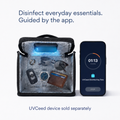
- Real-time dose monitoring. UVCeed's companion app shows you exactly how much UV-C energy is reaching the surface as you use it - not an estimate, not a timer, but a measured dose.
- Visual disinfection mapping. You can see what's been disinfected and what hasn't. No guessing, no gaps.
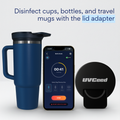
- MagSafe-compatible design. Attaches to your phone for effortless portability - no separate device to pack, charge, or forget.
- Doctor-created. Designed with clinical-grade standards for a consumer audience that expects verified results.
For travelers, this means you can walk into any hotel room and systematically disinfect the surfaces that matter - remotes, switches, handles, counters - and know the job is done. Not hope. Know.
A Practical Hotel Room Routine
- Enter the room. Don't touch anything yet. Set your bag on a hard surface (not the bed or luggage rack).
- Attach UVCeed to your phone. Open the companion app.
- Start with high-touch surfaces. Remote, light switches, faucet handles, phone, door handles.
- Move to flat surfaces. Desk, nightstand, bathroom counter.
- Check your coverage. The app confirms every surface received a complete dose.
Total time: under five minutes. Zero chemicals. Verified results.
Beyond the Hotel: UV-C for the Entire Trip
Hotel rooms are the starting point, but travel exposes you to contaminated surfaces everywhere.
Airplane Tray Tables and Armrests
Multiple studies have found that airline tray tables harbor more bacteria per square inch than the average toilet seat. They're wiped between flights inconsistently, if at all. UVCeed's compact, phone-mounted design makes it practical to disinfect your immediate seating area before takeoff.
Rental Cars
Steering wheels, gear shifts, door handles, and touchscreens in rental cars are used by dozens of drivers between deep cleans. A quick pass with UVCeed covers every surface you'll touch.
Airbnbs and Vacation Rentals
Without the structured (if imperfect) cleaning protocols of hotel chains, vacation rentals introduce even more variability. UVCeed lets you verify cleanliness regardless of the host's standards.
Restaurant Tables and Menus
While you can't control every surface you encounter, high-touch items like menus and table surfaces benefit from a quick, discreet pass - particularly during peak illness seasons.
Traveling with Kids: Why Verification Matters More
Parents traveling with young children face amplified risk. Kids touch everything. They put hands in mouths. Their immune systems are still developing.
For families, the calculus isn't abstract - it's about whether your toddler picks up norovirus from a hotel room carpet or RSV from a poorly cleaned crib. UVCeed's visual confirmation gives parents something no spray bottle can: certainty.
Conclusion: Clean Is a Fact, Not a Feeling
The travel industry sells the appearance of cleanliness - fresh scents, crisp sheets, sealed bathroom glasses. But appearance and reality diverge more than most travelers realize.
UV-C disinfection, when administered at a verified dose, closes that gap. It transforms "it looks clean" into "it is clean" - and gives you the proof to back it up.
This spring break, travel with the confidence of knowing exactly what's on your surfaces and exactly what you've done about it.
Want More Articles Like This?
Get the latest research on UV-C disinfection, health protection, and product updates delivered to your inbox. Join thousands of readers who stay ahead of the curve.