By UVCeed Health & Wellness | May 2026
If your child is in daycare, you already know the cycle. They come home with a runny nose on Tuesday. By Thursday, they have a fever. You keep them home Friday. They go back Monday. By Wednesday, it is something new. Ear infection. Stomach bug. Pink eye. Hand, foot and mouth disease. RSV. Strep. An illness you cannot even identify that lasts four days and then vanishes, only to reappear in your own throat the following week.
This is not bad luck. It is not a sign that your child has a weak immune system. It is a documented, measurable, and entirely predictable consequence of putting young children in shared environments where they touch the same surfaces, mouth the same objects, and are cared for by adults who are simultaneously handling a dozen other children doing the same thing.
The research published just this month tells the story in numbers that every parent should understand - because the scale of the problem is larger than most people realize, and the standard advice for dealing with it is incomplete at best and counterproductive at worst.
The Numbers Are Worse Than You Think
Children in out-of-home daycare get acute diarrheal illness at two to three times the rate of children cared for at home. Approximately 20% of all outpatient visits for diarrhea in children under three are directly attributable to daycare attendance. During a child's first month in daycare, the incidence of diarrheal illness is three times higher than the baseline for home-cared children. And diarrhea occurs 17 times more frequently in diapered children than in toilet-trained children.
Between 2009 and 2019, nearly 5,000 acute gastroenteritis outbreaks were reported in U.S. schools and childcare facilities through the National Outbreak Reporting System, causing over 166,000 documented cases. Nearly 2,000 of those outbreaks occurred specifically in childcare settings.
The pathogens responsible read like a catalog of every illness that has ever sent you scrambling for a backup childcare plan: norovirus, rotavirus, Shigella, E. coli O157:H7, Giardia, Cryptosporidium, RSV, influenza, parainfluenza, and a rotating cast of enteroviruses that cause everything from hand, foot and mouth disease to meningitis-like symptoms.
And here is the part that hits parents hardest: research shows that if your infant contracts a diarrheal illness from daycare, there is at least a 30% chance it will spread to another member of your household. If you have a child in out-of-home care, you are three times more likely to experience acute gastroenteritis yourself over the course of a year than if you do not.
Your child is not just getting sick at daycare. They are bringing it home to you, your partner, and their siblings.
How Daycare Surfaces Become Pathogen Highways
Young children interact with their environment in a fundamentally different way than adults. They do not just touch surfaces - they mouth them. They put their fingers in their mouths an average of 80 times per hour. They share toys by putting them in their mouths and handing them to the next child. They touch their faces, rub their eyes, and handle food with hands that were just on the floor, on a shared play table, or on another child's face.
In a daycare setting, this behavior turns every shared surface into a pathogen transmission highway. The play table. The toy bin. The changing table. The high chair tray. The crib railing. The doorknob at toddler height. The books. The crayons. The water fountain. The bathroom fixtures. Every one of these surfaces is touched by multiple children throughout the day, and every touch is an opportunity for pathogen transfer.
Norovirus and Shigella - two of the most common causes of daycare outbreaks - are known to persist on contaminated surfaces for extended periods. Norovirus can survive on hard surfaces for days to weeks. Shigella can remain viable on surfaces for hours to days. Rotavirus can persist for weeks on hard surfaces at room temperature. These are not fragile organisms that die on contact with air. They sit on surfaces and wait for the next pair of small hands to pick them up.
Daycare staff do their best. But the ratio of children to caregivers, the speed at which surfaces become re-contaminated, and the biological reality of how toddlers interact with objects make it impossible to keep every surface disinfected at every moment. The American Academy of Pediatrics recommends daily cleaning and disinfecting of shared toys and materials, but "daily" means pathogens have hours to accumulate between cleanings.
The Chemical Cleaning Problem That No One Talks About
When you pick your child up from daycare and they are sick again, your instinct is to clean everything at home. You pull out the disinfecting wipes. You spray down the high chair, the changing pad, the crib rails, the kitchen counter, the bathroom sink, and every toy you can find. You feel like you are doing something proactive.
But there are two problems with this approach that most parents never hear about.
Problem one: you are probably not actually disinfecting. Per EPA guidelines, chemical disinfecting wipes must keep the surface visibly wet for the full contact time printed on the label - typically 4 to 10 minutes - to achieve the stated pathogen kill rate. A quick wipe that dries in 30 to 60 seconds has not killed the bacteria or viruses on that surface. It has just moved them around and deposited a layer of chemical residue. Most parents wipe and move on. The surface looks clean. The germs are still there.
Problem two: the chemical residue stays behind. The active ingredients in most consumer disinfecting products are quaternary ammonium compounds - "quats" - which are cationic surfactants specifically designed to bind to surfaces. They do not just sit on the surface and evaporate. They leave a persistent, invisible chemical film that accumulates with repeated applications.
This residual film is a recognized concern in regulated industries. Hospitals, food manufacturers, and pharmaceutical companies spend significant money on specialized testing equipment to detect and measure quat residuals on surfaces - because the residues are a documented health and safety issue.
Now think about where you are applying these chemicals in your home. The high chair tray your baby eats off of. The crib rails they chew on. The toys they put in their mouths. The changing pad their bare skin contacts. The kitchen counter where you prepare their food. The bathroom surfaces they touch and then put their fingers in their mouths.
Every application of a chemical disinfecting wipe deposits a new layer of residue on these surfaces. Your child contacts these residues dozens of times per day through direct skin contact and hand-to-mouth behavior. Research has raised concerns about chronic low-level exposure to quats, including potential links to respiratory irritation, skin sensitization, and endocrine disruption.
You are trying to protect your child from germs. The cleaning products you are using may be creating a different kind of exposure in the process.
There Is a Way to Kill the Germs Without the Chemical Tradeoff
UV-C germicidal irradiation eliminates bacteria and viruses by physically destroying their DNA and RNA with ultraviolet light. It is a purely physical process. No chemicals are applied to the surface. No molecules bind and accumulate. No residue is left behind. When the light turns off, the surface is pathogen-free and chemically unchanged.
This is the disinfection method that hospitals, laboratories, and pharmaceutical facilities have used for decades - specifically because they need to kill pathogens without introducing chemical contamination into sensitive environments. An operating room cannot have chemical residue on surgical surfaces. A pharmaceutical cleanroom cannot have invisible films on production equipment. These industries solved the residue problem a long time ago by moving to UV-C.
No pathogen has developed resistance to UV-C light in over 100 years of use. The mechanism - physical destruction of genetic material - is not something organisms can evolve around. This is fundamentally different from chemical disinfection, where sub-lethal exposure can drive resistance in surviving bacteria.
UV-C works on norovirus, rotavirus, Shigella, E. coli, RSV, influenza, strep, and virtually every other pathogen your child is likely to encounter in a daycare setting. It works in seconds, not minutes. And it works without leaving anything behind on the surfaces your child touches and mouths all day long.
UVCeed: Hospital-Grade Disinfection for the Surfaces Your Child Touches Most
UVCeed is a portable, medical-grade UV-C disinfection device that uses the 265nm wavelength trusted by healthcare facilities to eliminate up to 99.99% of harmful bacteria and viruses in 30 seconds. No chemicals. No residue. No film accumulating on the surfaces your baby eats off of.
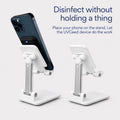
It clips to your iPhone via MagSafe and uses a patented AI-powered app to guide you through the disinfection process in real time - confirming proper distance, angle, and coverage, and verifying when the surface reaches 99.99% disinfection levels.
Where it matters most for parents:
High chair trays and feeding surfaces. Your child eats directly off these surfaces multiple times per day. UVCeed disinfects the tray in 30 seconds with zero chemical residue - nothing between your child's food and a clean surface.
Crib rails and crib surfaces. Teething babies chew on crib rails constantly. UV-C disinfection means no chemical film on the surface your baby mouths for hours every night.
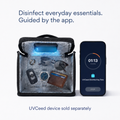
Toys and teething objects. The Disinfecting Tote creates an enclosed UV-C chamber. Drop pacifiers, teething rings, rattles, small toys, and sippy cup parts in the tote, zip it closed, and they are disinfected without chemicals - ready to go back in your child's mouth.
Changing tables and pads. These surfaces contact your child's bare skin and are among the most pathogen-dense surfaces in any home or daycare. UV-C disinfection eliminates surface pathogens without leaving residue on the surface your baby lies on.
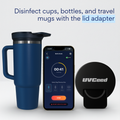
Bottles and sippy cups. The Universal Fit Lid Adapter positions UVCeed over any bottle or cup opening from 0.5 to 4.5 inches. Interior disinfection of baby bottles, sippy cups, straw cups, and toddler water bottles - no chemicals entering the vessel your child drinks from.
Kitchen prep surfaces. The counter where you prepare baby food, cut up fruit, and assemble snack plates. UV-C disinfects the surface without depositing chemical residue that then contacts your child's food.
Stroller trays, car seat buckles, and on-the-go surfaces. Every surface your child touches outside the home - restaurant high chairs, shopping cart handles, playground equipment, waiting room toys - can be treated in 30 seconds before your child contacts it.
The Safety System Built for Homes With Children
UVCeed was designed with families in mind. The device uses built-in machine vision safety technology to detect the presence of humans and pets, automatically disabling UV-C output to prevent any accidental exposure. It only operates through the smartphone app, which provides continuous safety monitoring throughout every session.
You cannot accidentally leave it on. It cannot be activated without the app. If a child or pet enters the treatment area, the device shuts off automatically. The safety system was engineered by the same medical device team that has spent 30+ years building technology for healthcare environments where safety is non-negotiable.
The Complete Protection Kit for Families
The UVCeed Complete Protection Kit includes everything a parent needs:
- UVCeed Device - portable, hospital-grade 265nm UV-C disinfection that clips to your iPhone via MagSafe
- Universal Fit Lid Adapter - disinfects the inside of baby bottles, sippy cups, water bottles, and drinkware with openings from 0.5 to 4.5 inches
- Disinfecting Tote - enclosed UV-C chamber for pacifiers, teething toys, small toys, earbuds, keys, and personal items
Developed by Bonutti Technologies - a medical device incubator founded by orthopedic surgeon Dr. Peter M. Bonutti, with over 400 patents and 30+ years of medical innovation. Backed by 8+ U.S. patents. Named one of Fast Company's Next Big Things in Tech. Currently deployed in healthcare facilities including Sarah Bush Lincoln Hospital.
The Bottom Line
You cannot prevent your child from getting sick at daycare entirely. Immune system development requires exposure to pathogens, and group childcare is where much of that exposure happens. That part is normal and, in the long run, beneficial.
What is not inevitable is the scale of the problem - and the chemical tradeoff that most parents do not know they are making every time they reach for a disinfecting wipe.
The surfaces your child touches most - the ones they eat off of, chew on, lie on, and mouth all day - deserve disinfection that actually works in the time you have, and that does not leave an invisible chemical film behind for your child to ingest.
UV-C light has been the answer to that problem in hospitals for decades. UVCeed puts it in your pocket for the first time.
Kill the germs. Skip the chemicals. Protect what matters.
UVCeed is manufactured by UVCeed, LLC. UV-C disinfection is intended for use on hard non-porous surfaces and objects. It is not a substitute for handwashing, vaccination, or standard pediatric care. Results based on independent laboratory testing: 99.9% reduction of Staphylococcus aureus in 15 seconds, 99.99% reduction of E. coli in 24 seconds, and 99.9% reduction of SARS-CoV-2 in 32 seconds on hard non-porous surfaces at 12.7 cm. See uvceed.com for full testing details and disclaimers.
Want More Articles Like This?
Get research on UV-C treatment and product updates delivered to your inbox.